Thursday, November 24, 2016

Thanksgiving

It's Thanksgiving, so first, a moment to remember all those who've paved the way for us - be they writers, readers, or unknown participants in our collective history. We are on a path together and as writers of historical fiction, we know how important it is to remember.

Our best work takes readers into another time and place to experience something in the past, as though it is happening now. It helps them to understand how it felt to be there. In some ways, we are recreating eye witness accounts. Which brings me to my point.

At this particular moment in history, I believe those of us who are, say over 50, have a duty , to share our stories. Perhaps younger folks don't remember what the Ku Klux Klan is. Perhaps they didn't have friends whose parents survived the holocaust. Perhaps they don't remember the Civil Rights Movement or the Vietnam years. Do they know what it was like to see a friend sneak away to Mexico for an illegal abortion? Or to have a grandparent to die suddenly, because they didn't have access to medical care? Perhaps they can't believe people were denied jobs because they were women, black, brown, or gay? Perhaps they don't know what our soldiers endured in World War II or Korea or Vietnam to ensure that we can speak our minds freely. If you are worried about that echo chamber effect, then share in person, to the younger folks you know who might not remember. We are elders now and it is our responsibility to pass on these stories. They are real and important.

Thursday, November 17, 2016

The Very First European Thanksgiving in the U.S. by Mary Louise Sanchez


As a young child growing up in the 1950s we learned about the First Thanksgiving, complete with the trappings of Pilgrims and Indians. I remember building a ship out of large wooden blocks in kindergarten and sitting in our chairs inside the structure we created. It was called the Mayflower.
Jean Leon Gerome Ferris-THE FIRST THANKSGIVING


Another strong memory is learning to play a piano piece from the John Thompson series.  The beginning words to the song were, "The year 1620 the Pilgrims came over. . . ." Now I know the song is more familiar as the Dutch Christian hymn, "We Gather Together" and the beginning words are the same as its title. 

I also sang "Over the River and Through the Woods" from the music books my classmates and I used in our elementary music classes.


In my own family, we enjoyed the traditional American style Thanksgiving.  The smell of yams baking always brings back a memory of when my sister and I were allowed to camp out in our kitchen overnight, as the smells of Thanksgiving permeated our little fort.

 Earlier smells of roasted chiles in the fall were brought to our Thanksgiving table and the tables of our gente (Hispanic close and extended family) through the fresh green chile side dish, with just the addition of salt and a hint of garlic.


Now I can appreciate the significance of fresh green chile, which we always include in our Thanksgiving meal. I give thanks to the Native Americans who introduced this food to the Spaniards over 400 years ago so that in this present day we can enjoy it almost daily.


Chile (green and red) brings an image to me of the first encounter of Native Americans of the Southwest and my ancestors, the European pilgrims from Spain via Mexico. This encounter was an occasion for Europeans to celebrate the very first Thanksgiving in present day United States.

After years of Spanish exploration, the Spanish government, under King Philip II of Spain, decided to send soldiers and their families from Zacatecas, Mexico (New Spain) to colonize further reaches of New Spain, or as we know it today—New Mexico.


 Juan de Oñate was awarded the contract to lead the expedition to the new land where Franciscans had started missionary work.


The colonizers included about one hundred and thirty Spanish soldiers, many with their families, as well as their servants, for a total of around four hundred people. There were also seven thousand head of livestock, eighty-three carts, and materials to start new lives.
Some of the statues commemorating Onate's expedition- Albuquerque, New Mexico Museum of Art & History


Unlike the English Pilgrims of 1620, who came via the Atlantic Ocean on ships,  the Spanish colonizers made a hard journey along a desert route, known today as the Camino Real.  
Goodreads image
At least twenty two years before the English Pilgrims landed on Plymouth Rock, these colonists arrived at a place near present day El Paso  on April 30, 1598. On that Ascension Day, which is a holy day on the Catholic Church calendar, Juan de Oñate, on the south bank of the Rio Grande, made a formal declaration that this land belonged to Spain and the colonizers gave thanks to God.


Later in May the expedition entered present day New Mexico and established their first capital which they named San Juan de los Caballeros. Just as in the story of the English Pilgrims and the Indians, the Spanish introduced their foods to the native Americans of New Mexico. These natives, in turn, introduced their foods to the Spanish colonizers. One of those foods was—chile. 

Do you have a food on your Thanksgiving or holiday table that gives a nod to your culture and/or traditions?

Subscribe to get posts automatically and never miss a post. You can use the Subscribe buttons to the right, or add http://madaboutmghistory.blogspot.com/ to Feedly or another reader.

Thursday, November 10, 2016

Historical Novelists Before Middle-Grade Became a Genre

Seventy years ago, when I entered the middle-grades for the first time (now you can calculate my age), there was no “Middle-Grade” genre for books. We, of course, read the traditional books by the same famous authors students read today—Robert Louis Stevenson, Mark Twain, and Jack London, to name a few. Before, during, and following World War II, I do not recall that many books were targeted to an audience of young readers. There were exceptions, of course. Esther Forbes’s Newberry Prize-winning Johnny Tremain was and still is a favorite.

This leads me to recommend young readers take a look at two historical novelists who are largely forgotten today. Probably neither of these great authors were recommended by my teachers. Popular movies of the day based upon these authors’ novels perhaps guided me to read their books. I continue to reread them. They are cracking great adventure reads that teach a lot of history in the process.

Samuel Shellabarger (1888–1954) wrote his first historical novel in 1928. During his lifetime he wrote eighteen works of fiction. My favorite of his books is Captain from Castile, written in 1946, about Hernan Cortez' conquest of the Aztecs. A movie based on the novel starring Tyrone Power appeared in 1947. The reader learns about the terrors of the inquisition in Spain and the brutal subjugation of the native inhabitants of what is now Mexico.

Shellabarger's writing usually contains a love interest, but there is no explicit sex.

Another of my favorites is Prince of Foxes, Shellabarger's next book, written in 1947. Again, Tyrone Power starred in the movie of the same name in 1949. Here, the reader is immersed in the intrigues of Cesare Borgia and his infamous family during the time of the Holy Roman Empire before Italy became the country we know today.

In 1950, Shellabarger’s The King’s Cavalier appeared. I am currently rereading this book for the umpteenth time.

My other forgotten historical novelist is Rafael Sabatini (1875-1950). He produced thirty-one novels, plus numerous short stories, a few non-fiction books, and a play. Among my favorite books by Sabatini is Scaramouche, written in 1921, about a lawyer who masquerades as a buffoon during the time of the French revolution. This great novel has been made into movies more than once, but the one I remember starred Stewart Granger in 1952.

Sabatini, like Shellabarger, includes a love interest in his novels, but no sex.

Probably the most famous of Sabatini’s historical novels is Captain Blood, written in 1922. What middle-grade boy, or girl, does not like a roaring pirate tale? Sabatini is known for adhering closely to historical facts in his books; even though, like my approach to writing, his protagonists are fictional. Errol Flynn starred in the 1935 movie, which recently played on Turner Classic Movies. After watching the movie rerun, I reread this book.

Sensing that some folks may consider these books too long or too difficult for today’s middle-grade reader, I performed some “un-scientific” research into the readability of the novels.

The Hemingway Editor software program gives a random selection of the written word from Samuel Shellabarger’s Captain from Castile a “Readability Rating” of Grade 5. By comparison, various websites rate J. K. Rowling’s Harry Potter and the Sorcerer’s Stone as Grade 5.5. My own Bear Claws rates as Grade 5 in the Hemingway Editor.

The books by Shellabarger and Sabatini are typically longer than most on today’s middle-grade bookshelf, but no more so than many of the Harry Potter books. The stories by my two great "forgotten" authors are so compelling I’ll bet they will be read from cover to cover.

My writing has been influenced by Shellabarger and Sabatini, but I do not profess to be in the same league as they. Still, my historical novel Bear Claws, The Iron Horse Chronicles—Book Two, won the Silver Will Rogers Medallion Award for 2016, and the Wyoming State Historical Society awarded Bear Claws First Place in Fiction for 2016. Take a read and let me know what you think.

Golden Spike, The Iron Horse Chronicles—Book Three, the final book in my trilogy about Will Braddock's quest to determine his own destiny during the time of the building of the first transcontinental railroad in the late 1860s, will be released by Five Star Publishing in mid-2017.


Thursday, November 3, 2016

Sara K Joiner: Research, Research, Research

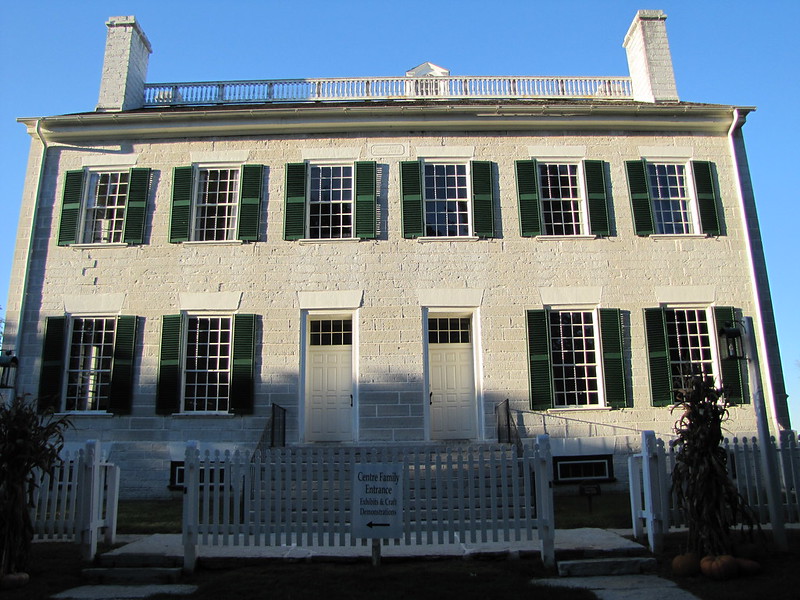
Centre Dwelling at Shaker Village of Pleasant Hill
is now a museum dedicated to Shaker displays
about life in the village.
photo by Sara K Joiner


In 2014 I was offered the opportunity to go with a friend to an even being held at Shaker Village of Pleasant Hill in Kentucky. While I had been to Hancock Shaker Village years earlier, Pleasant Hill operated as both a museum and hotel. I would be staying in one of the buildings that once housed Shakers as they went about their daily lives. My mind raced with the wonder of that thought.

This would be a lot of fun.

As happens, an idea for a book sprang into my head while I was there touring the buildings and learning about life at Pleasant Hill. I didn't do anything with the idea at the time. It was vague and unformed. I would give it time to take root.

Two years later, I returned to Pleasant Hill for another event with the same friend. The vague idea had taken root but it was still struggling to grow. It needed fertilizer. Before my next trip to the village, I had to know more about the history of the place and the people. I wanted to be able to use my time there wisely to gather small details that would help make this story idea blossom.

I searched the catalog at the library where I work and found lots of books on the topic. Books for adults, books for teens and tweens, even books for preschoolers. I started with the basics, as I often do, and read some of the children's books. Reading the children's books allows me to ease into the deeper waters of the scholarly adult material. The children's books teach me the terms and phrases I'll need to know. The adult material adds depth but the children's books add interest.
Looking down over the spiral stairs in the Trustees' Office
at Shaker Village of Pleasant Hill.
photo by Sara K Joiner


As I read the material, I made notes of specific information that I would need to know. With only the main character taking shape in my mind, my research would guide me in a direction for the story. As I read, ideas took shape and questions needed answering.

Unfortunately, I wasn't always finding the answers in the books I had.

I don't rely solely on printed material for research, of course. I'm a librarian, and I love to find new sources of information. I watch documentaries. I buy appropriate music. I search Flickr or Google Images. I follow Twitter accounts or Facebook pages. I perform various and sundry Internet searches.

For the research for this book, I contacted the collections manager at Pleasant Hill and asked to meet with him. I had never done this kind of a interview before, and I had to make sure I didn't waste his time or mine by asking questions that could be answered with a simple Google search.

I kept a list of questions and thoughts about what might or might not happen in the book. Being very up front with him about the vagaries of publishing and the early stages of my work on this project (not a word written, yet!), I tried to ask questions specific to Pleasant Hill. Although there were a few general ones thrown in that I hadn't found answers to. It was a fun and exciting two-hour chat.

When I get to writing this story, which now has much stronger roots and is flourishing in my brain, I will certainly owe a debt to collections manager and the research provided by all those other scholars and authors.

Sara K Joiner is the author of After the Ashes. She is also a public librarian.

Thursday, October 27, 2016

"Soldier Sister Fly Home" by Nancy Bo Flood: A Short Review

Middle-grade novels featuring Native American protagonists are few. Finding one that is authentic, literary, and elegant is a delight. Sister Soldier Fly Home by Nancy Bo Flood and illustrated by Shonto Begay is such a story: a rich tapestry of symbol, metaphor, danger, and reconciliation.

It is 2003 and the war in Iraq has already claimed the life of Lori Piestewa, the first Native American Woman to die in battle on foreign soil.* And Tess's sister, Gaby, has just enlisted, leaving Tess feeling angry, abandoned, and afraid. To make matters worse, Gaby asks Tess to take care of her wild horse, Blue. The last thing Tess wants to do.

Not only is Tess fighting her fear of Blue, she also wrestles with being bi-racial: Navajo and Bilagáana (White). Having her feet in both worlds, she feels she is neither, feels at war with herself. Who is she? Navajo? White?

"We all have many parts Tess. We walk many paths, wear different shoes. Sometimes moccasins, sometimes sneakers. Some paths cross, some come together."

But if I follow one path and leave the other behind, will I lose one? Will I get lost?"

The quote above is a particularly powerful conversation between Tess and her Navajo grandmother, her Shima' Sani. As they draw closer, Tess begins to understand who she already is. Her relationship with her grandfather also unfolds through the story and paradoxically, it is through these Navajo grandparents that she understands more about the part of her that is 
Bilagáana.

Nancy Bo Flood also does a wonderful job of dispelling Navajo stereotypes. Tess is not an Indian who naturally loves horses, herding sheep, or weaving rugs. She is a runner, though, and her grandmother, while traditional in many ways, including the joy of a good joke, loves a good strong latte, Emily Dickinson poetry, and surprising Tess by negotiating the Internet. 

Through a tragic event, Tess learns that there are things she must do even though those are the last things she ever thought she could do. She does not answer all her questions, but she does learn to accept what she can not change. She also learns that her Navajo and White sides do not have to war with each other. The story suggests that perhaps it is not necessary to answer the question, that we can, in the end, be ourselves.

This was a short review, not worthy of the depth of symbol and meaning found in the book. I urge you to include it in your displays for Native American Heritage month, class room library, and personal bookshelves. It is just the sort of book We Need Diverse Books is calling for. And like all good stories, in the end it is about all of us. We discover ourselves and each other there.


You can find out more about Nancy Bo Flood on her website: http://nancyboflood.com/

You can find an interview here.


There is a glossary and discussion questions at the end of the book. You can find more discussion questions here.

*It should also be noted that Lori Piestewa was half Mexican American.


You should also be aware that there are animals killed in the story, which may upset some children (and adults). 


Michele Hathaway is a writer and freelance editor. She has an M. A. in Social Anthropology and has worked in libraries in California, New Mexico, and Pennsylvania. She writes stories set in culturally diverse, historical and contemporary periods.

Thursday, October 20, 2016

Avi: King of the Middle Grade Historical Novel


There are many writers of middle grade historical fiction, but for my money Avi is king because despite adversity, he’s written a lot of highly readable works set in a wide timespan.

Avi is living proof that writing doesn’t always come easily, and that disabilities don’t have to become excuses or barriers. Avi has dysgraphia, which caused him to be labeled as sloppy, erratic and inattentive when he was in school He still reverses letters and misspells words, but that hasn’t stopped him from writing hundreds of thousands of them. Avi says that he persevered because he liked what I wrote, so he learned to refuse to listen to his critics. Now that he is an award-winning author, Avi likes to visit schools and encourage students with learning disabilities. He says those students “come in slowly, waiting for yet another pep talk, more instructions. Eyes cast down, they won't even look at me. Their anger glows. I don't say a thing. I lay out pages of my copy-edited manuscripts, which are covered with red marks. 'Look here,' I say, 'see that spelling mistake. There, another spelling mistake. Looks like I forgot to put a capital letter there. Oops! Letter reversal.' Their eyes lift. They are listening. And I am among friends.”

Avi is the author of over 30 books, many of which are historical novels. His novels range from ones set in the Middle Ages up to the present. Here are a few to try, each from a different historical period:

Crispin: Cross of Lead is a Newbery Award Winner. Set during the Peasant’s Revolt of 1381, this book tells the story of an orphaned peasant boy who flees his village after he is declared a "wolf's head," meaning anyone can kill him on sight. Carrying his mother's lead cross, Crispin goes on a journey to discover who he is.

Sophia’s War tells the story of Sophia Calderwood, who becomes a spy for the American Revolutionaries after witnessing Nathan Hale’s execution in New York City. As a maid for General Clinton, the supreme commander of the British Army, she discovers a traitor in the American army. When no one believes her, Sophia decides to single-handedly stop his treacherous plot.

Iron Thunder tells the story of the nautical battle between the Merrimac and the Monitor through the eyes of Tom Carroll Early, a thirteen-year-old who works in the Brooklyn ironworks after his father is killed fighting for the Union. Hounded by Confederate spies who offer him money for information, Tom must decide whether he trusts the crazy inventor who is building an iron-clad ship.

Catch You Later, Traitor, one of Avi’s most recent books, is set in the 1950s and is about a twelve-year-old kid who loves Sam Spade detective books and radio crime dramas, but finds himself in the middle of a real-life mystery when the FBI accused his father of communism.

Jennifer Bohnhoff is the author of three middle grade historical novels, The Bent Reed, Code: Elephants on the Moon, and On Fledgling Wings. Her next novel, set in New Mexico during the Civil War, is due out next spring. You can read more about her writing at her website, jenniferbohnhoff.com.

Source for this blog post: http://www.scholastic.com/teachers/contributor/avi

Friday, October 7, 2016

Jane’s Book of Ages: Three Not-So-Plain Janes

My blog this month is dedicated to three Janes: the tragic girl queen, a famous author, and a woman whose life was one of drudgery and much sorrow and who yet managed to carry an unquenchable faith in the Lord, joy in reading, and delight in life.

Queen Jane
Lady Jane Grey was born to wealth and power. As the great-granddaughter of King Henry Vll, she was the first cousin once removed to the only surviving son of Henry Vlll, Edward Vl. She was every bit as precocious and brilliant as her bigoted Protestant cousin, and they were close friends. When he was dying, Edward named in her in his will as his successor, knowing that otherwise his half-sister Mary, equally bigoted and  a devout Catholic, would inherit the throne. 

Queen Jane reigned for only nine days. Then Mary – Bloody Mary of our school history books in Scotland – rode into London at the head of an army. Jane’s nine day reign was over.

At first Mary pardoned Jane. However, upon learning Jane’s father had taken part in a rebellion, Jane and her husband, Lord Guilford Dudley, were both beheaded. Queen Jane was a girl of 16. After her accession, Jane became  a popular name for girls  and may have been even more so after her execution.

Author Jane

Jane Austen was born the seventh child to a comfortable middle-class life. Her father was an Oxford-educated English vicar, and he and her mother were much respected in their community. Well-educated themselves, Reverend George and Mrs. Cassandra Austen encouraged their family in creative thinking and to read from his extensive library. Jane and her eldest sister Cassandra were sent to boarding school until financial constraints forced their return home. It was a close, clever family in which the children put on plays, wrote, and played games of charades. 

It was only after Jane’s death her brother named her as author of comical love stories, which were a gently sardonic commentary on the nobility and customs of the day. These novels, of which Pride and Prejudice was ‘her darling’, were  required reading in my English literature class at school and are still widely read and enjoyed today. 

Jane in Sorrow

Finally we come to our third and last Jane.

Jane Franklin was born to Josiah and Abiah Franklin, the youngest daughter in Josiah’s large family. Her father was a tallow chandler, a soap and candle maker. He had neither wealth nor standing in his adopted city of Boston, Massachusetts. His first wife had borne him five living children; his second bore him another twelve, of which the last son was Benjamin Franklin. The youngest, a girl, Josiah named after his mother, and the little English Queen, Jane.

Jane adored her brother Benjamin, and in his turn he loved her. In his own way, he cared for her. Reading a biography through the eyes of the twenty-first century, we think he didn’t do much. But we have to recall how different were times and mores in the eighteenth century. 

Josiah didn’t have the money to educate Benjamin as he would have liked. Jane was fortunate in that her mother could read and taught her to read and Benjamin encouraged this reading. Who knows what the world has lost because Jane was unable to pursue an education.   All of their lives the brother and sister wrote letters to each other. This correspondence is beautifully and delicately described in Jill Lepore’s Book of Ages – Jane Franklin Mecom’s homemade book. 

Benny ran away from home at seventeen to make his fortune and ended one of America’s founding fathers and most famous men. Jane never left home. Her lot was to be marriage and child bearing.

At fifteen, she married a layabout. She lost her first baby and the following two. Jill Lepore speculates Jane, who her brother had heard was ‘a noted beauty’ may have been pregnant when she married. If so, she threw her life away on a ne-er-do-well.

Jane spent her married life either pregnant or nursing, with a husband who was always in debt.
She worked for her father, making soap and candles. She made her own little book through the painstaking boiling and pulping and pressing of rags into parchment. Her Book of Ages. Her days were long and full of drudgery. Throughout, she kept her passion for reading, loving and tending to her family, and writing always to her brother Benny. Although I have not yet finished Lepore’s fascinating book, I’ve read more than enough to heartily recommend it, and to urge teachers and librarians to seek out middle-grade biographies on Jane Franklin Mecom and her little Book of Ages.  A fascinating glimpse of American life. 


As far as I know, the picture I have attached (the recently found Eastman portrait of Lady Jane) is in the public domain. Rather than rely entirely on (distant) schoolday memories, I’ve resorted to Wikipedia to make sure I’m on the right track with my mini-biographies of little Lady Jane Grey and Jane Austen.  I guess she was never crowned, as she was referred to only as ‘Lady Jane’ in our history books.  

- Elizabeth Junner McLaughlin

Subscribe to get posts automatically and never miss a post. You can use the Subscribe buttons to the right, or add http://madaboutmghistory.blogspot.com/ to Feedly or another reader.