Showing posts with label writing process. Show all posts

Thursday, May 11, 2017

Mad About Long Buried History


by Suzanne Morgan Williams

One of the joys and frustrations of writing middle grade historical novels is discovering little known history. I feel like an explorer or an archaeologist unearthing facts and societies I've never known - or that I totally misunderstood. That's fun too. But then there's that thing about "little known"  that means there may not be a lot of information available, or what information there is may have been ignored or buried. Often this deep silence creates the historical narrative that we, in the dominant U.S. culture, have become comfortable with. Taking on an era or event that's been set aside in this way can be jarring, difficult, or frustrating.

The second layer of frustration, that's true of any novel with a tense plot, is that for hours at a time I drop into a different world, I virtually dwell there as I become witness to the combination of historical fact and my imaginings of how it would have been to experience that. I feel what my characters feel, or more accurately,  they feel what I feel while writing. Often, I emerge from the dream/writing state exhausted. And in case you don't know, there is a point in almost all writing where good writers throw up there hands and say, "What am I doing? This is gibberish." (Okay we don't usually say gibberish), Right now, I'm struggling to pass that point with my new Work In Progress (WIP) set in the 17th century. I'm almost there, but not quite.

So it's not surprising to me that I got a reminder this morning of my upcoming posts and, oops, I have a post due today. This accounts for the stream of consciousness you are reading. I'm creating this blog while at the same time I'm wondering what kind of embroidery was popular in 1660 and how many beers led to intoxication if you drank beer atmost meals already. You get it, the important stuff.

But the real joy, and the prize I'm going for, is discovering the details of a time and people who shaped us, though we may not realize it, and bringing that era to life. I won't get it all right. If I could bring back someone from my manuscript's time and place they might respond to the work with a long polite, "Hmmmmm." But I can interpret what I know for modern kids. I can try to make them feel what a sixteen year old who knew nothing of electricity, airplanes, bombs, or proms would feel. I need to do that without giving her our modern day expectations but with giving her all the drama and  human emotions that we suspect haven't changed much over 10,000 years. Now that is fun. I can't wait to hear a reader say, "I feel just like that." Then I've done my job. Wishing you peace, kindness, and discovery.

Thursday, November 3, 2016

Sara K Joiner: Research, Research, Research

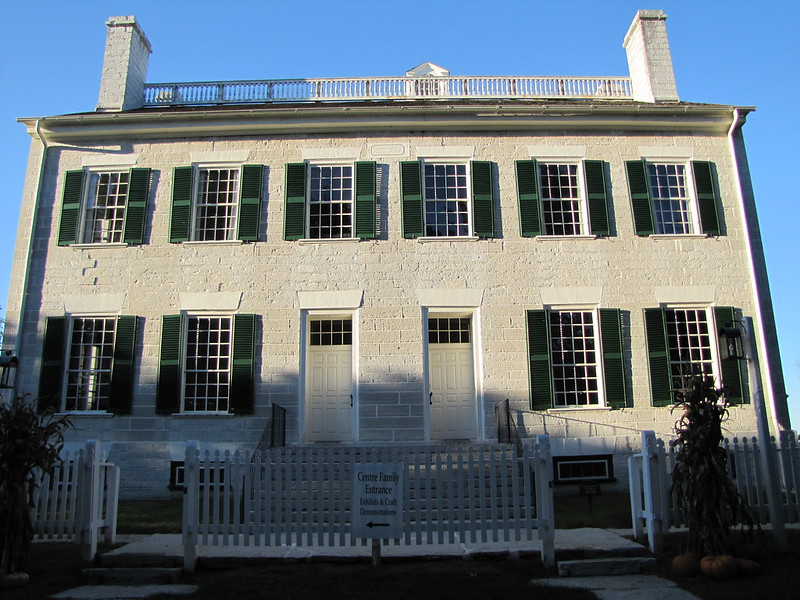
Centre Dwelling at Shaker Village of Pleasant Hill
is now a museum dedicated to Shaker displays
about life in the village.
photo by Sara K Joiner


In 2014 I was offered the opportunity to go with a friend to an even being held at Shaker Village of Pleasant Hill in Kentucky. While I had been to Hancock Shaker Village years earlier, Pleasant Hill operated as both a museum and hotel. I would be staying in one of the buildings that once housed Shakers as they went about their daily lives. My mind raced with the wonder of that thought.

This would be a lot of fun.

As happens, an idea for a book sprang into my head while I was there touring the buildings and learning about life at Pleasant Hill. I didn't do anything with the idea at the time. It was vague and unformed. I would give it time to take root.

Two years later, I returned to Pleasant Hill for another event with the same friend. The vague idea had taken root but it was still struggling to grow. It needed fertilizer. Before my next trip to the village, I had to know more about the history of the place and the people. I wanted to be able to use my time there wisely to gather small details that would help make this story idea blossom.

I searched the catalog at the library where I work and found lots of books on the topic. Books for adults, books for teens and tweens, even books for preschoolers. I started with the basics, as I often do, and read some of the children's books. Reading the children's books allows me to ease into the deeper waters of the scholarly adult material. The children's books teach me the terms and phrases I'll need to know. The adult material adds depth but the children's books add interest.
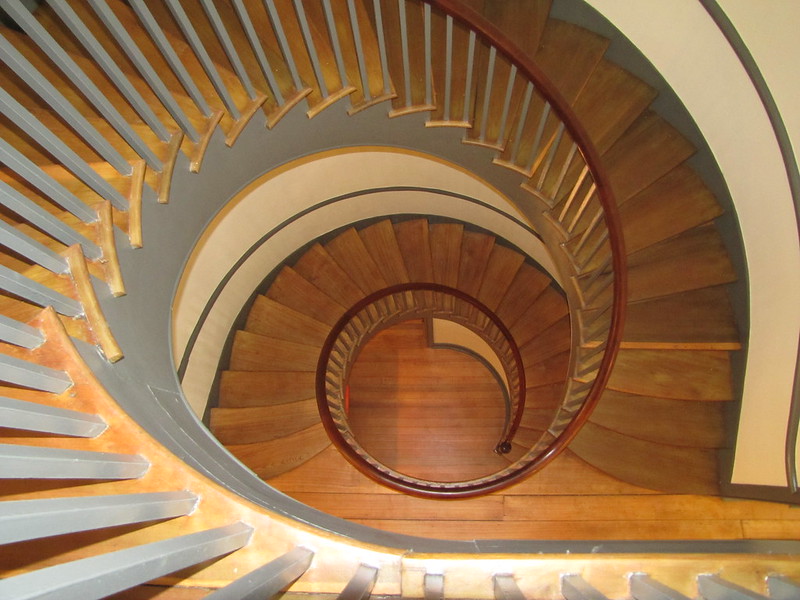
Looking down over the spiral stairs in the Trustees' Office
at Shaker Village of Pleasant Hill.
photo by Sara K Joiner


As I read the material, I made notes of specific information that I would need to know. With only the main character taking shape in my mind, my research would guide me in a direction for the story. As I read, ideas took shape and questions needed answering.

Unfortunately, I wasn't always finding the answers in the books I had.

I don't rely solely on printed material for research, of course. I'm a librarian, and I love to find new sources of information. I watch documentaries. I buy appropriate music. I search Flickr or Google Images. I follow Twitter accounts or Facebook pages. I perform various and sundry Internet searches.

For the research for this book, I contacted the collections manager at Pleasant Hill and asked to meet with him. I had never done this kind of a interview before, and I had to make sure I didn't waste his time or mine by asking questions that could be answered with a simple Google search.

I kept a list of questions and thoughts about what might or might not happen in the book. Being very up front with him about the vagaries of publishing and the early stages of my work on this project (not a word written, yet!), I tried to ask questions specific to Pleasant Hill. Although there were a few general ones thrown in that I hadn't found answers to. It was a fun and exciting two-hour chat.

When I get to writing this story, which now has much stronger roots and is flourishing in my brain, I will certainly owe a debt to collections manager and the research provided by all those other scholars and authors.

Sara K Joiner is the author of After the Ashes. She is also a public librarian.

Tuesday, October 27, 2015

Sara K Joiner: After the Ashes Book Launch

The official book release of After the Ashes was October 15, and I held a book launch at Blue Willow Bookshop in Houston on Saturday. If you've never visited Blue Willow, you should. It is an amazing bookstore, and they host hundreds of events each year.

After the Ashes on display. Note the perfectly-
placed tropical plants.
photo from Sara K Joiner
When I walked in, I saw a gorgeous display of multiple copies of After the Ashes complete with tropical-looking plants.  So perfect!  There was also a customer there who was picking up her pre-ordered copy of the book in preparation for the book launch at 2 p.m. Here's the important part of that: I did not know this person!

The event took place in the rear of the store. My mother made a chocolate cake, which we christened Dutch chocolate in honor of the book. I also had Dutch cookies available, and I decorated the signing table with giant plastic stag beetles similar to those the main character might have collected.

Prizes, including Lava soap, Dutch mints in a tin, and a copy of Krakatoa by Simon Winchester, were given out to people who asked the first questions.

Cathy Berner, a former librarian herself, introduced me, and we were off! I talked about how long it took me to write the book, and how often I revised it. I pointed out early readers who were in the audience and had given me helpful tips.
Me and a member of my critique group. She 
brought me roses!
photo from my critique partner

Me signing books for a friend. She'll 
be doing a giveaway on her blog.
photo from my critique partner
I read a brief passage to whet people's appetites, and then I answered questions. Once the questions were over, I signed books and took pictures like a real author! It was a bit surreal, to be honest. People I've known for years were buying something I wrote and getting me to sign it.

There were about twenty-five or thirty people there, including some I did not know. More than the person I mentioned earlier. That was a thrill! Blue Willow sold out all their copies of After the Ashes. My mother didn't even get to buy one!

My roommate, me and my friend—
all Texas Lutheran alumnae!
photo from my friend
It was also a little mini-reunion of sorts for some Texas Lutheran alumnae. My roommate, one of my friends and a former co-worker all came down from Austin and Seguin to attend. Thanks so much, y'all!

Even these two books were gone before 
the end of the event.
photo from my critique partner
I cannot thank Blue Willow enough for all they did to make the day special, and I cannot thank all my friends who came and supported me. Honestly, it was better than I could have imagined, and I'm still smiling!

Sara K Joiner is a librarian and the author of After the Ashes. This post was originally published on her website.

Tuesday, September 22, 2015

Sara K Joiner: Researching After the Ashes

Research. It is the cornerstone of any good historical fiction. Why are you setting this particular story in this particular time?

Why did I set After the Ashes on Java when Krakatoa erupted?

As I said, the original idea struck me when I read a book about the volcano's eruption. Consequently, the eruption itself becomes a plot point.

This meant I needed to research the eruption. The best source, and the one I relied on the most, was Krakatoa: The Day the World Exploded: August 27, 1883 by Simon Winchester. Whenever I would come across differing accounts, I would rely on Winchester's book to settle those conflicts.

In reading different books about Krakatoa's eruption, I discovered some interesting facts that I couldn't necessarily add to the novel—either the main character never discovered this or it didn't add anything to the story. Here are some of the more amazing facts:

  • Time zones had not been established in 1883. Therefore, recorded times for each of the explosions from the volcano vary quite a bit. Historians today generally identify the first explosion as happening at 1:06 p.m. Sunday, August 26, 1883. The remaining explosions occurred at 5:30 a.m., 6:44 a.m., 8:20 a.m. and 10:02 a.m. Monday, August 27. Time zones were officially established in 1884 at the International Meridian Conference in Washington, DC.
  • The Dutch navy's paddle-steamer Berouw broke her moorings during the tsunamis. She was carried two miles up the Koeripan River in Sumatra and wedged, upright, across the river like a bridge. All twenty-eight crew members were killed. The ship remained there until the 1980s when the last, non-scavenged pieces deteriorated.
  • The final eruption at 10:02 a.m. was heard almost 3,000 miles away on the island of Rodrigues in the Indian Ocean. People there thought they were hearing gunfire from distant ships.

This is what's so fascinating about research. All these little tidbits of information that add up to an awe-inspiring view of the world.

So go forth and research. Learn new and interesting things. Share that knowledge with the world.

Sara K Joiner is the author of After the Ashes and is also a public librarian in Texas.

Tuesday, August 18, 2015

Sara K Joiner: On the Origin of After the Ashes

Once upon a time, a young girl sat reading a book.

Perhaps it was only 2009 and the girl was, in reality, a woman, but the part about reading the book was true. The book was a work of nonfiction for children—The Day the World Exploded: The Earthshaking Catastrophe at Krakatoa by Simon Winchester.

While she read this book, a vague image of a girl exploring a wondrous jungle popped into her head.

"What if…?" the woman, who had written several unpublished novels, thought.

And she began to research.

Books about rainforests. Books about volcanoes. Books about tsunamis. Books about Java. Books about Dutch colonialism.

The woman scoured the Internet for historical photos. She used Google Translate to understand captions written in Dutch or Indonesian.

When the woman took a cruise to Belize, she stood in the jungle and let the feel of it sink into her—the light, the heat, the sounds. Even though the rainforest in Belize and the rainforest in Java were not terribly similar (she knew this from her research), it helped her feel more like that girl the woman saw in her head.

strangler fig in Belize
photo by Sara K Joiner
She saw strangler figs, which the woman had learned were in Java, for the first time. Awestruck, she studied their roots and the way they wrapped themselves around another tree.

The woman took her time writing the story. She wrote and revised and wrote some more.

Three years after that first spark, she decided she could not make the story any better. Then she began looking for an agent. After a short search, she found an agent, and that agent knew how to make the story even better. So the woman wrote and revised and wrote and revised some more.

In 2014, the agent sent the story to an editor. The editor loved the story, but she, too, knew how to make it even better. The editor and the woman worked together. Once again, the woman wrote and revised and wrote and revised some more.

Finally, the story was the best it could possibly be. After six long years of research, writing and revising, the story is coming to readers in October.

That's the story of the origin of the idea for After the Ashes—the story of a girl who explores the jungle and the volcano that destroys everything she holds dear. You can enter a drawing for a free galley copy of After the Ashes from GoodReads.

In addition to writing, Sara K Joiner is a public librarian in Texas.

Thursday, August 13, 2015

A Historical Novel in a Month? by Louise Spiegler


Every November at least a few of my college students will ask me if I want to participate in NaNoWriMo (National Novel Writing Month). 

My response is usually incredulous laughter (the expression of the woman in the mosaic to the right is incredulous enough to express my feelings). November is a month when I am typically teaching three to four college classes with about 120 students and, no, I don’t have a teaching assistant to correct papers for me. Even finding time to write a blog post is a challenge!

However, I usually turn around and encourage those students to take part in the novel-writing challenge themselves.

And, mostly, they respond with incredulous laughter.

As well they might, since they often also work substantial jobs as well as being college students. Some of them work, are college students and parents. 

However, summer is my writing time, so this summer, I decided to take up the challenge and  try writing a first draft novel in month. A historical fiction piece, mind you, set in Ancient Rome.

Writing a first draft is usually is a slow and laborious process for me. In fact, I’d say it’s like clearing a garden of enormous rocks, pulling them out of the ground one by one. Does that sound dire? It’s not supposed to. But there’s a feeling of excavation, of unearthing or uncovering a story. And also a strong feeling of hard lifting. 

And a historical novel is, as many on this blog have pointed out, a massive undertaking of research and fact-checking.

So writing a historical novel in a month seemed crazy.

And yet, I’ve just finished my first extremely messy draft! (Feel free to cheer.)

I feel somewhat shocked, and, as usual when I finish a draft, I have no idea whether the goose has laid a golden egg or whether it has laid… what geese normally lay. No one has even read more than three chapters of it, so I have no sounding board. And that’s unusual for me as well, but I think that’s necessary if you want to write an initial draft so quickly.

The title, at the moment is Anaktoria Across the Waves. If you are an ancient history geek, you’ll recognize that as the title of a poem by the wonderful Greek poet, Sappho, a woman poet, actually, and even more interestingly, a lesbian poet. 

The image to the left is meant to be a portrait of Sappho, but read a little of her poetry and it will be hard to believe she would ever look this stern. (see below for a fragment of her work).

 So here’s how I did it.

I had a strong idea: a girl in ancient Rome, who is the daughter of a surgeon, and who is getting trained to follow in her father’s footsteps, as a doctor. (As I've mentioned elsewhere, this was a possibility for some women in the empire.) But her father disappears and her uncle takes over the surgery. And he is not a fan of having his niece become his apprentice --not least because he has a son of his own to whom he wants to hand down the position. The main thread of the story concerns Anaktoria’s freedoms getting taken away one by one, and how she turns the tables to eventually win back her rights.

For me, this reflects a dual social reality in ancient Rome: women, as in other ancient societies, were restricted in many ways, and to read men's writings about women is to be plunged into a sea of misogyny. And yet, if you dig (and I recommend Bonnie Anderson and Judith Zinsser’s book, A History of their Own, as a good introduction to the complexities of women’s history) there were certain freedoms that women had. For example, they had the right to divorce their husbands, to keep their own dowries and sometimes, to control their own finances. And  that gave them wiggle room.

And professional women, though a small minority, certainly existed, not least in the medical field. There are actually tombstones and memorial plaques commemorating women doctors.

So, what about the research? What about the painstaking hours of research? How can that meld with writing a very fast first draft?

Here’s the thing: You can only write a historical novel in a month if your research is already pretty much solid.


I’ve taught ancient history with an emphasis on Rome for more than ten years. So the era is very familiar to me, even the small details of everyday life. And now that I have a draft, I know which very specific details I still need to look up to make sure I’m accurate and to add depth and flavor. 

Another thing that helped was that I have already completed another novel, entitled The Healer’s Yew which involves Anaktoria as a secondary character. (My heroic agent is currently trying to place it).

Healer stars Anaktoria's best friend, Gaius Petronius Felix, the baker’s son who dreams of being an artist, and Titus, an escaped slave who knows the emperor’s murderous secret, and therefore is being stalked by the emperor’s spies.

So I have a very specific period which I have already extensively researched for another novel.

However, my new novel has a different focus, so I did more research on women’s lives in ancient Rome during the empire. This, again, is fairly familiar territory for me.

What is new and I continue to read up on is Roman medical knowledge and practice. Very surprising stuff! I can now tell you something about antiseptics, something about humoral theory, something about surgery, and perhaps more than I’d like about ancient gynecology. 

So now that I’ve got the story sketched out, I’ll be launching back into deeper research.

Now, if only I could get to visit Rome! If anyone hears of a fairy godmother who grants time and cash-strapped writers tickets around the world, let me know.

I don't know if I will ever try to write a novel in a month again, but I certainly am happy to have a draft to work from, as I get ready to plunge back into another busy school year.

POSTSCRIPT:

Here's a taste of Sappho's poetry:

The moon is down
And the Pleiades
And yet
Alone I lie.


Thursday, July 30, 2015

The Stories in History, by Chris Eboch

Hot trends may come and go, but for some readers, nothing takes the place of great historical fiction. It can explore any period, from ancient – even prehistoric – times, to recent decades (that’s right, your childhood is now historical). The best books let readers explore a fascinating time in the past, through a character who appeals to modern tastes.
Bringing History to Life

Regardless of the time period, historical fiction requires heavy research, in books, online, at museums and through interviews. D. Anne Love has published seven historical novels for young people, including The Puppeteer’s Apprentice and Semiprecious. “Although the former is set in medieval England and the latter in Oklahoma and Texas in 1960, my research process for both books was similar. I read as many primary sources (diaries, letters, journals) as possible, and followed up with other books on the topic. I conducted much of my research online, but I also used libraries for hard to find materials. For Three against the Tide, a Civil War novel set in Charleston, South Carolina, I visited the area five times, taking photos, notes, and visiting local libraries and historical societies.”

With all this research, authors must be organized. Albuquerque author Lois Ruby (The Secret of Laurel Oaks, Shanghai Shadows), says, “I take extensive notes, each fact on a separate index card, all arranged by detailed subject. I do about two years of research before I even begin writing, then re-check for details after the writing is underway.”

By nature, historical fiction writers love research and the minutia of the past. Patricia Curtis Pfitsch, author of Riding the Flume, set in 1894 California, says, “I read my work aloud and I tune my ear to anything that sounds too ‘teacherly.’ I keep reminding myself that it’s not nonfiction. It’s okay if the readers don’t learn everything I learned.”

Mary Ann Rodman, author of Yankee Girl, agrees. “Sometimes it’s hard to keep from showing off all that research you did! For me, a detail only works if it adds to the story in some significant way. If I am unsure, I ask myself ‘Would I include a comparable detail, if this were a contemporary story?’”

The People of the Past

Character is key in bringing stories to life, and in making the past appeal to today’s readers. Love notes that, “I try to show young readers that although we may be separated by hundreds of years from the characters in books, their emotions, goals, struggles, and dreams are very much like our own.”

I agree. In my Arabian-Nights-inspired fantasy The Genie’s Gift, the heroine has led a sheltered life in the 15th-century Ottoman Empire. She wants to find the Genie who can give her “the gift of sweet speech” so people will listen to her, and so she can determine her own future. What modern preteen doesn’t think her parents are overprotective? Who doesn’t want a say in her future?

Historical characters must be appealing, yet believable for their time. “I have to watch myself carefully for ‘thought anachronisms,’” Rodman says. “I like strong, feisty female characters, but if you are going to have one in a book that takes place in the pre-feminist world, you better have a good reason for her behavior.”

Changing social standards produce another challenge. Rodman adds, “It is really hard to write characters who have what are today considered racist or sexist beliefs (but were widely accepted in their time) and make them likable... or at least not villains. I hope that my books show the complexity of events that shaped the way we live in twenty-first-century America.”

I ran into this problem with my historical Mayan drama, The Well of Sacrifice. The Maya practiced human sacrifice and bloodletting. It was an important part of their culture, so not something I should simply ignore. I tried to show the devout religious beliefs that led to that behavior, while also showing the dangers and horror so as not to glamorize it. I wasn’t sure if this would make the book too mature for middle grade readers. However, the publisher tagged the book as “for ages nine and up,” and it’s been used in many schools in the fourth grade. (As an aside, I’ve had teachers say, “Girls love the strong heroine, and boys love the gory stuff.” Kids can often handle things better than adults expect.)

Character authenticity is one of the big challenges of historical fiction, but authors risk confusing readers if the language is too authentic. Doris Gwaltney suggests, “In some instances, as in my Elizabethan novel, Shakespeare’s Sister, the language had to be altered a bit for today’s readers.” She kept the basic language clear, and then “I threw in a few words of the period to create the flavor of the time.”

I avoided this problem in The Well of Sacrifice, The Genie’s Gift, and my Egyptian mystery The Eyes of Pharaoh. Since those characters would not have been speaking English, I didn’t have to worry about when specific English words came into use. I assumed I was “translating” from ancient Egyptian into modern English. I still avoided slang or other words that would jar the story out of its historical time period. However, in the past, people usually spoke in a way that seemed natural to them at the time, not in stiff, formal language. (Read some Egyptian love poems if you don’t believe me.)

On the Shelves

Like the authors who write it, the editors who publish historical fiction tend to love the genre. However, editors also must consider what will sell. If you are one of the many teachers, librarians, parents, or authors who believe that We Need Diverse Books, then vote with your budgets.

So what makes great historical fiction? A spark of inspiration, months of research, carefully chosen details to bring the setting to life, and a dynamic character who appeals to today’s readers, while expressing the differences of her time. With a little luck, the end result is a book that will last long beyond modern trends.

Chris Eboch writes fiction and nonfiction for all ages, with several novels for ages nine and up. The Eyes of Pharaoh is an action-packed mystery set in ancient Egypt. The Genie’s Gift is an Arabian Nights-inspired fantasy adventure. In The Well of Sacrifice, a Mayan girl in ninth-century Guatemala rebels against the High Priest who sacrifices anyone challenging his power. In Bandits Peak, a teenage boy meets strangers hiding on the mountains and gets drawn into their crimes, until he risks his life to expose them.

Visit www.chriseboch.com for samples, advice on writing historical fiction, and a list of favorite historical novels, or visit her Amazon page.

Chris is also the author of You Can Write for Children: A Guide to Writing Great Stories, Articles, and Books for Kids and Teenagers. Remember the magic of bedtime stories? When you write for children, you have the most appreciative audience in the world. But to reach that audience, you need to write fresh, dynamic stories, whether you’re writing rhymed picture books, middle grade mysteries, edgy teen novels, nonfiction, or something else. Whether you’re just starting out or have some experience, this book will make you a better writer – and encourage you to have fun! Order for Kindle, in paperback, or in Large Print paperback.

Sign up for Chris’s Workshop Newsletter for classes and critique offers

The Puppeteer’s Apprentice, by D. Anne Love: A scullery maid in medieval England must face danger and mystery to follow her dream of making the puppets dance.

Riding the Flume, by Patricia Curtis Pfitsch: In 1894 the giant sequoia trees are being felled for lumber in northern California. Should fifteen-year-old Francie risk her life to reveal secret activities?

Yankee Girl, by Mary Ann Rodman: In 1964, Alice Ann Moxley's family moves to Mississippi to protect black people registering to vote, and Alice must make terrible choices in order to have friends.

Shakespeare’s Sister, by Doris Gwaltney: What if Shakespeare had a sister who followed him to London to join the theater and write plays? Doris is also the author of Homefront: The story of Margaret Anne Motley, a teenage girl living on a peanut farm in Isle of Wight County, Virginia, and the ways in which World War II changed her life.

The Secret of Laurel Oaks, by Lois Ruby: A novel based on a real slave girl whose ghost haunts the plantation until a murder mystery is solved with the help of Timberlarken, a most strange tree. Lois is also the author of Shanghai Shadows: When the Nazis invade Austria in 1939, 12-year-old Ilse Shpann and her family flee to Japanese-occupied Shanghai.

Thursday, June 25, 2015

Writing Great Historical Fiction for Children, with Chris Eboch

The author at Coba, Mexico
Our goal at this blog is to target teachers, librarians, and readers of historical fiction rather than other writers. But since teachers, librarians, and readers may also be writers – and summer vacation is a great time to pursue your writing – I thought I’d share some insight into writing historical fiction.

What makes good historical fiction?

·         You need to find a way to communicate your passion. Find something interesting about the time, place, and characters you’ve chosen, and let your enthusiasm shine through.

·         Put away your teacher hat and put on your storyteller’s hat. The story comes first. It’s about interesting people doing challenging things in an exciting time and place. The action shouldn’t stop for facts. Details of setting, daily life, attitudes, etc., should be relevant and fit naturally into the story. No matter how interesting a piece of information is, don’t include it unless it moves the action forward. Historical fiction should not be an excuse to lecture within a fictional framework.

·         Be especially careful with technical information, such as how machines work. This can get tedious. You can always include extra facts as supplemental information on your web site or provide teaching guides for use in the classroom.

·         Except with omniscient viewpoint, all information must be from the point of view character’s POV. You can’t point out what they don’t have. Portray life as it was, and trust your readers to note the differences.

·         Make history live by appealing to all five senses. Try to include smells, tastes, and textures, as well as sights and sounds.

Tikal, Guatemala
Methods of historical research

·         Traveling to a site is especially helpful for inspiration and for noting surrounding details. However, buildings, vegetation, animals and even the climate may change over the years. Don’t assume things looked the same “way back when.” Sometimes this is obvious – visiting Mayan ruins, clearly the buildings have fallen into disrepair and the jungle has closed in. But it’s easy to underestimate how much things have changed. What now looks like a small cluster of large buildings in the midst of jungle might once have been a city center surrounded by miles of smaller homes and farm fields. Even the distant jungle might have been more open, with people clearing away undergrowth and vines to forage for fruit and tap trees for rubber. In more modern cities, the historical buildings may have been there, but the stone might have been light, not darkened by centuries of pollution.

·         Children’s books often have a concise overview of a subject, plus colored pictures of clothing, tools, weapons, etc. Pictorial encyclopedias for kids can be the best place to start to give you a quick overview of a culture.

·         Museums, such as natural history museums and local historical societies, often have old photos, historical artifacts and even recreations of buildings or towns from previous eras. You may need to make an appointment in advance to get into back rooms or archives. Fortunately, today many organizations are putting photos and documents on their websites!

·         History, anthropology, and archeology texts can provide specific details of the culture. Again, the Internet is a boon – when researching a recent nonfiction book about battlefield medicine in World War I, I could access Masters degree theses from Britain on subjects such as the British ambulance corps.

Jaguar, Belize Zoo
·         Travel books/websites may discuss the climate, vegetation, animals, and scenery. They may mention which plants and animals are native versus later introductions, but double-check if you’re not sure.

·         Encyclopedias are a good source of further information about birds, animals, etc. You can get specific details of how they look, sound, and behave. Online dictionaries and encyclopedias may even have recordings of animal sounds.

·         “The Library of Congress Online Catalog contains over 18 million catalog records for books, serials, manuscripts, maps, music, recordings, images, and electronic resources in the Library of Congress collections,” according to the site.

Making tamales with friends in Mexico
·         Experts such as college professors, historians, tourist bureaus, and even avid amateurs can provide information and may be willing to fact-check your work. You can find many of them through the Internet, but check their references before you trust their information. If you are writing about another culture, ask people from that culture to review your manuscript for accuracy and sensitivity.

·         To some extent, you can also rely on human nature through the ages. Although the specifics of religious practice, social structure, and politics often differ, people throughout history have been motivated by the same basic emotions: love, fear, greed, insecurity, pride, piety, etc.


To learn more about writing well, grab a copy of You Can Write for Children: How to Write Great Stories, Articles, and Books for Kids and Teenagers:

In this book, you will learn:

How to explore the wide variety of age ranges, genres, and styles in writing stories, articles and books for young people.
How to find ideas.
How to develop an idea into a story, article, or book.
The basics of character development, plot, setting, and theme.
How to use point of view, dialogue, and thoughts.
How to edit your work and get critiques.
Where to learn more on various subjects.

Whether you’re just starting out or have some experience, this book will make you a better writer – and encourage you to have fun! Order for Kindle, in paperback, or in Large Print paperback.

Chris Eboch is the author of over 30 books for young people, including The Well of Sacrifice, an adventure for ages nine and up set in Mayan Guatemala. Kirkus Reviews called The Well of Sacrifice, “[An] engrossing first novel…. The novel shines not only for a faithful recreation of an unfamiliar, ancient world, but also for the introduction of a brave, likable and determined heroine.” Visit www.chriseboch.com for more advice on writing historical fiction, and a list of great books for young people.

Thursday, June 11, 2015

Historical Fiction Based on Historical Photographs

As the author of The Iron Horse Chronicles, I find that photographs provide me with a solid source on which to base a scene. I follow a historical timeline in my trilogy about the building of the first transcontinental railroad, and I try not to deviate far from it in order to ensure an accurate depiction of the facts. First, I develop a chronological listing of the significant events that occur; then I weave my plot around each event, placing my fictional characters in juxtaposition with the historical personages who were present at that event.

History books, contemporary newspaper articles, and biographies and autobiographies, provided the bulk of the research material I consulted while developing the timelines for the three books comprising The Iron Horse Chronicles. Photographs contained in these sources, plus photos available in museum collections, have given me the basis for placing Will Braddock and his fictional friends and enemies in realistic situations. I personally walked the ground where many of the inspiring photographs were taken to get a better feel for how to describe the locale.


The above photograph served as the basis for an important scene in Bear Claws, the second book in the trilogy. A confrontational meeting took place at the Fort Sanders Officers’ Club near Laramie, Wyoming, between Doc Durant and General Dodge of the Union Pacific Railroad. General Ulysses S. Grant, the Republican candidate for President, refereed their disagreement, rendering a decision that had  a significant impact on the construction of the transcontinental railroad. All of the people in the photograph have been accurately identified. Grant stands left of center wearing a straw hat. Other well known generals are present, including Sheridan and Sherman. I wove a description of this photo into Chapter 37, from which I quote the following selection. Andrew Jackson Russell, a historical personage, was the official photographer for the Union Pacific. Will Braddock is the protagonist in The Iron Horse Chronicles. Luey (Lieutenant Luigi Moretti) and Will’s uncle (Sean Corcoran) are fictional.

Russell flipped the heavy, black drape over his head, and Will watched the camera bellows move back and forth until the photographer had the focus he desired. Then Russell stepped out from under the cloth hood.

 “All right, folks. We’re ready. I’m going to remove the lens cover and count to three, while I expose the plate to sunlight. After three seconds, I’ll replace the lens cap, and the picture will have been taken. Do not move while the lens cap is off! That’s important.”

 A final shuffling of the group took place. General Grant stood in the center leaning both hands on the picket fence. Dodge remained in the Club’s doorway. Doc Durant slouched against the open gate of the fence, sulking like a three-year-old. To the far left, Will saw Luey twist the ends of his mustache to straighten them, then stick one hand into the front of his uniform coat. Will couldn’t suppress his grin. Luey was imitating the famous pose of Napoleon Bonaparte.

“Here we go,” Russell said. He removed the lens cover and counted. “One. Two. Three!” He replaced the lens cap and slid a wooden holder out of the side of the camera, handing it to Will.

Will ran to the back of the wagon and exchanged the container for the one that he found, just as Russell had told him. He raced back to the photographer, who inserted the new plate into the side of the camera.

“One more shot, please,” Russell said. "Ready now. One. Two. Three!”

Russell stood and held up a hand. “Thank you, ladies and gentlemen. All finished.” He shook Will’s hand. “Thank you, young man. You were a big help. Everything went fine except I couldn’t get those two gentlemen on the far left into the picture. The lens is just not that wide.”

Will chuckled. So much for Luey’s imitation of Napoleon making it into the history books. Unfortunately, his Uncle Sean would be left out, too.

In addition to describing a historical event in which the protagonist participated, this scene gave me the opportunity to explain to today’s young readers the cumbersome photography of 1868.


Above is the second shot Russell took in front of the Fort Sanders Officers’ Club that day. I used the above scene to introduce Will to the Union Pacific’s photographer. Will encounters Russell on other occasions, including scenes in Golden Spike, the final book of the trilogy. Students of history will undoubtedly recognize the following, famous photograph taken by Russel on May 10, 1869.


Thursday, March 5, 2015

Manuscripts We Burn, Books We Remember

Thinking About the Scott O'Dell Award
By Suzanne Morgan Williams

A writer friend of mine and genuinely nice person, Kirby Larson, just won the Scott O’Dell Award for her book Dash. I can’t wait to read it. Knowing Kirby won the award, I checked the web to learn to learn more about Scott O’Dell, its namesake. I’d read his Newbery winning Island of the Blue Dolphins when I was a child – I didn’t love it. But what else was there to know about him?

O’Dell wrote dozens of books and won a Newbery Honor (same as Kirby Larson for Hattie Big Sky) for Sing Down the Moon. The title seemed familiar. I flipped to another web page to find a summary. Yes, I’d read it. That was a book I really, really liked. In fact, I’d say it piqued my interest in Native American/U.S. history – a passion that’s shaped much of my own writing. I’m not sure how Sing Down the Moon would stand up to today’s scrutiny of diverse literature, but from my point of view at the time, it was a shocking, emotional introduction to the subject. Of course, O’Dell never knew how the book touched me.


I dug a bit deeper on the O’Dell website. His bio page said he grew up in Southern California in the early 20th century when it was a backwater to San Francisco. He spent his boyhood on California beaches and mountains. He worked in the early movie industry, published his first book at twenty-six. Here’s what caught my eye. His first novel was never published. And later he burned the manuscript. Wow, that’s a bold decision. What makes a writer burn a manuscript? Do I have a few I should burn, or the modern equivalent – permanently delete?

So I started thinking about the body of a writer's or an artist's work. Kirby Larson has written a lot of books and they haven’t all won awards. I’m sure if you spoke with her, or any other writer, you’d find they have favorites as well as some they’d like to revisit and tweak a bit for one reason or another. Becoming an artist is a process. I remembered going to the Georgia O’Keeffe Museum in Santa Fe, New Mexico. I was excited to see so much of her art in one place. What impressed me? There are all kinds of pieces on display – from her earliest rough sketches to masterpieces. It would be a hard stretch to see one of those sketches on its own and think, “This woman is going to be one of the great artists of the twentieth century.” Yet, she was. And I’m glad I had the opportunity to see so many stages of her development.

Not everything an artist creates is great of even memorable. But it all adds up. The artist grows, reworks a project, or produces something new based on the original idea. I take away three lessons: 1) talent takes time and practice to develop into something greater. 2) you don't know which author or which book or which project will be the one that really sings - until it happens. 3) And while you’re waiting it might not be a good idea to burn your manuscripts.