Showing posts with label research. Show all posts

Thursday, November 3, 2016

Sara K Joiner: Research, Research, Research

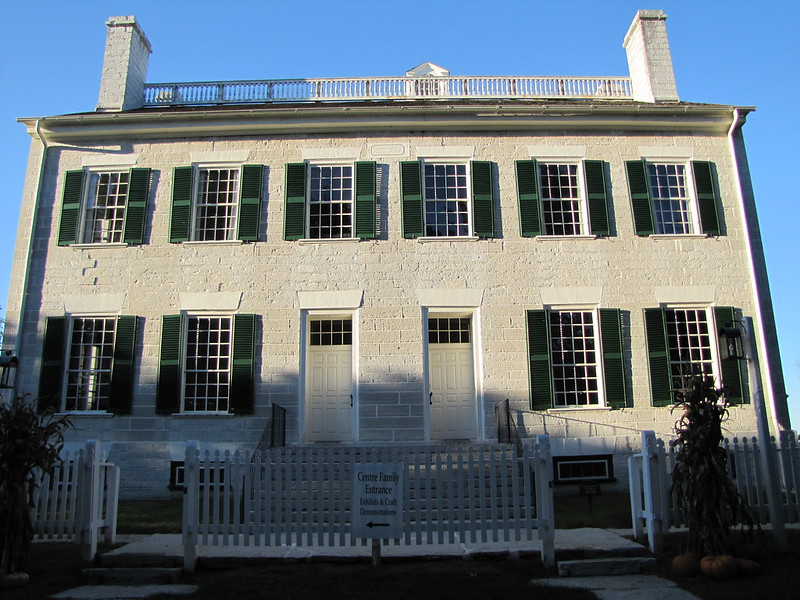
Centre Dwelling at Shaker Village of Pleasant Hill
is now a museum dedicated to Shaker displays
about life in the village.
photo by Sara K Joiner


In 2014 I was offered the opportunity to go with a friend to an even being held at Shaker Village of Pleasant Hill in Kentucky. While I had been to Hancock Shaker Village years earlier, Pleasant Hill operated as both a museum and hotel. I would be staying in one of the buildings that once housed Shakers as they went about their daily lives. My mind raced with the wonder of that thought.

This would be a lot of fun.

As happens, an idea for a book sprang into my head while I was there touring the buildings and learning about life at Pleasant Hill. I didn't do anything with the idea at the time. It was vague and unformed. I would give it time to take root.

Two years later, I returned to Pleasant Hill for another event with the same friend. The vague idea had taken root but it was still struggling to grow. It needed fertilizer. Before my next trip to the village, I had to know more about the history of the place and the people. I wanted to be able to use my time there wisely to gather small details that would help make this story idea blossom.

I searched the catalog at the library where I work and found lots of books on the topic. Books for adults, books for teens and tweens, even books for preschoolers. I started with the basics, as I often do, and read some of the children's books. Reading the children's books allows me to ease into the deeper waters of the scholarly adult material. The children's books teach me the terms and phrases I'll need to know. The adult material adds depth but the children's books add interest.
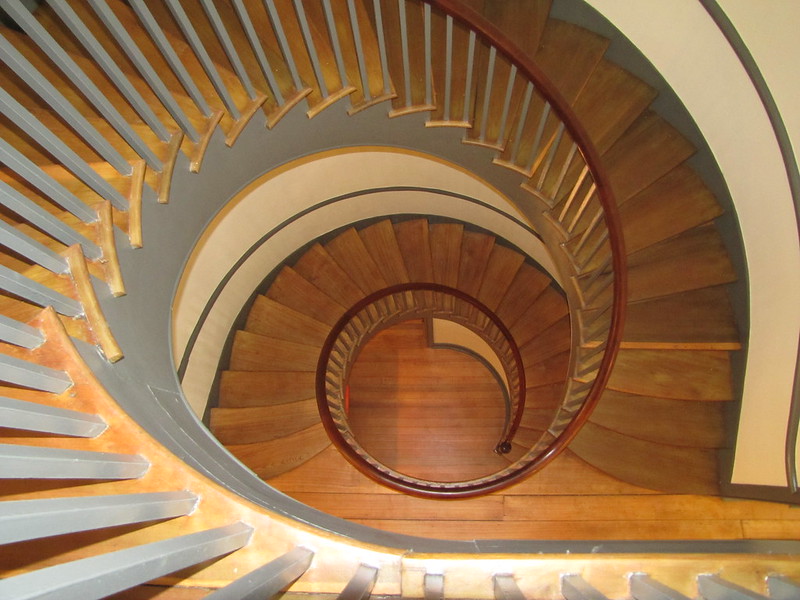
Looking down over the spiral stairs in the Trustees' Office
at Shaker Village of Pleasant Hill.
photo by Sara K Joiner


As I read the material, I made notes of specific information that I would need to know. With only the main character taking shape in my mind, my research would guide me in a direction for the story. As I read, ideas took shape and questions needed answering.

Unfortunately, I wasn't always finding the answers in the books I had.

I don't rely solely on printed material for research, of course. I'm a librarian, and I love to find new sources of information. I watch documentaries. I buy appropriate music. I search Flickr or Google Images. I follow Twitter accounts or Facebook pages. I perform various and sundry Internet searches.

For the research for this book, I contacted the collections manager at Pleasant Hill and asked to meet with him. I had never done this kind of a interview before, and I had to make sure I didn't waste his time or mine by asking questions that could be answered with a simple Google search.

I kept a list of questions and thoughts about what might or might not happen in the book. Being very up front with him about the vagaries of publishing and the early stages of my work on this project (not a word written, yet!), I tried to ask questions specific to Pleasant Hill. Although there were a few general ones thrown in that I hadn't found answers to. It was a fun and exciting two-hour chat.

When I get to writing this story, which now has much stronger roots and is flourishing in my brain, I will certainly owe a debt to collections manager and the research provided by all those other scholars and authors.

Sara K Joiner is the author of After the Ashes. She is also a public librarian.

Thursday, August 4, 2016

Authenticity versus Creativity

By Suzanne Morgan Williams

I have three projects “pending” in various stages of development. One is a fictionalized memoir. (yes, I finally said, “why not?” some of my life is pretty interesting and relevant.) One is contemporary research based fiction, and one – wait for it – is definitely historical fiction. The memoir is half done and resting. The contemporary has been out to a couple of editors and is waiting for revision. The historical is in that “hot writing” stage where, working from a very rough outline, I’m just writing to the end. I’ll see what I get.

But some interesting questions have come up as I work on the historical. It’s not only based on real people, but the plot is true too. That said, there’s precious little information about these people themselves. I’m totally creating their characters. As a writer, that’s good. It gives me flexibility and I’m quite capable of researching to make them believable, and fashioned to their times. This is historical fiction. But, they were real. There are documents about them and letters. So how much will my fiction influence any subsequent thoughts about these folks? Probably not much. But I’m thinking about it.

Maybe I should just change the names. But what I find fascinating is that the story, the plot, is real. Maybe I shouldn’t embellish the plot at all. It’s pretty good as it stands. But with a couple of other characters and some more confrontation the tension is better. With the addition of specific talents and traits that I’m assigning to them, the characters come alive. So I’m probably going to go for full out for historical fiction.

The manuscript will be true to its times. The setting, history, and some extent even the voices will be researched. But the characters – they are themselves. They will be molded from my ideas, my research, and good story. Is that wrong? Do I need to change the names? Can I manage with including an end note that explains what we know is true, what is probably true, and what I cooked up in service to the story?


For now, I’m writing the manuscript, but before I submit it for publication I have to answer these questions. Your thoughts?

Tuesday, September 22, 2015

Sara K Joiner: Researching After the Ashes

Research. It is the cornerstone of any good historical fiction. Why are you setting this particular story in this particular time?

Why did I set After the Ashes on Java when Krakatoa erupted?

As I said, the original idea struck me when I read a book about the volcano's eruption. Consequently, the eruption itself becomes a plot point.

This meant I needed to research the eruption. The best source, and the one I relied on the most, was Krakatoa: The Day the World Exploded: August 27, 1883 by Simon Winchester. Whenever I would come across differing accounts, I would rely on Winchester's book to settle those conflicts.

In reading different books about Krakatoa's eruption, I discovered some interesting facts that I couldn't necessarily add to the novel—either the main character never discovered this or it didn't add anything to the story. Here are some of the more amazing facts:

  • Time zones had not been established in 1883. Therefore, recorded times for each of the explosions from the volcano vary quite a bit. Historians today generally identify the first explosion as happening at 1:06 p.m. Sunday, August 26, 1883. The remaining explosions occurred at 5:30 a.m., 6:44 a.m., 8:20 a.m. and 10:02 a.m. Monday, August 27. Time zones were officially established in 1884 at the International Meridian Conference in Washington, DC.
  • The Dutch navy's paddle-steamer Berouw broke her moorings during the tsunamis. She was carried two miles up the Koeripan River in Sumatra and wedged, upright, across the river like a bridge. All twenty-eight crew members were killed. The ship remained there until the 1980s when the last, non-scavenged pieces deteriorated.
  • The final eruption at 10:02 a.m. was heard almost 3,000 miles away on the island of Rodrigues in the Indian Ocean. People there thought they were hearing gunfire from distant ships.

This is what's so fascinating about research. All these little tidbits of information that add up to an awe-inspiring view of the world.

So go forth and research. Learn new and interesting things. Share that knowledge with the world.

Sara K Joiner is the author of After the Ashes and is also a public librarian in Texas.

Thursday, July 30, 2015

The Stories in History, by Chris Eboch

Hot trends may come and go, but for some readers, nothing takes the place of great historical fiction. It can explore any period, from ancient – even prehistoric – times, to recent decades (that’s right, your childhood is now historical). The best books let readers explore a fascinating time in the past, through a character who appeals to modern tastes.
Bringing History to Life

Regardless of the time period, historical fiction requires heavy research, in books, online, at museums and through interviews. D. Anne Love has published seven historical novels for young people, including The Puppeteer’s Apprentice and Semiprecious. “Although the former is set in medieval England and the latter in Oklahoma and Texas in 1960, my research process for both books was similar. I read as many primary sources (diaries, letters, journals) as possible, and followed up with other books on the topic. I conducted much of my research online, but I also used libraries for hard to find materials. For Three against the Tide, a Civil War novel set in Charleston, South Carolina, I visited the area five times, taking photos, notes, and visiting local libraries and historical societies.”

With all this research, authors must be organized. Albuquerque author Lois Ruby (The Secret of Laurel Oaks, Shanghai Shadows), says, “I take extensive notes, each fact on a separate index card, all arranged by detailed subject. I do about two years of research before I even begin writing, then re-check for details after the writing is underway.”

By nature, historical fiction writers love research and the minutia of the past. Patricia Curtis Pfitsch, author of Riding the Flume, set in 1894 California, says, “I read my work aloud and I tune my ear to anything that sounds too ‘teacherly.’ I keep reminding myself that it’s not nonfiction. It’s okay if the readers don’t learn everything I learned.”

Mary Ann Rodman, author of Yankee Girl, agrees. “Sometimes it’s hard to keep from showing off all that research you did! For me, a detail only works if it adds to the story in some significant way. If I am unsure, I ask myself ‘Would I include a comparable detail, if this were a contemporary story?’”

The People of the Past

Character is key in bringing stories to life, and in making the past appeal to today’s readers. Love notes that, “I try to show young readers that although we may be separated by hundreds of years from the characters in books, their emotions, goals, struggles, and dreams are very much like our own.”

I agree. In my Arabian-Nights-inspired fantasy The Genie’s Gift, the heroine has led a sheltered life in the 15th-century Ottoman Empire. She wants to find the Genie who can give her “the gift of sweet speech” so people will listen to her, and so she can determine her own future. What modern preteen doesn’t think her parents are overprotective? Who doesn’t want a say in her future?

Historical characters must be appealing, yet believable for their time. “I have to watch myself carefully for ‘thought anachronisms,’” Rodman says. “I like strong, feisty female characters, but if you are going to have one in a book that takes place in the pre-feminist world, you better have a good reason for her behavior.”

Changing social standards produce another challenge. Rodman adds, “It is really hard to write characters who have what are today considered racist or sexist beliefs (but were widely accepted in their time) and make them likable... or at least not villains. I hope that my books show the complexity of events that shaped the way we live in twenty-first-century America.”

I ran into this problem with my historical Mayan drama, The Well of Sacrifice. The Maya practiced human sacrifice and bloodletting. It was an important part of their culture, so not something I should simply ignore. I tried to show the devout religious beliefs that led to that behavior, while also showing the dangers and horror so as not to glamorize it. I wasn’t sure if this would make the book too mature for middle grade readers. However, the publisher tagged the book as “for ages nine and up,” and it’s been used in many schools in the fourth grade. (As an aside, I’ve had teachers say, “Girls love the strong heroine, and boys love the gory stuff.” Kids can often handle things better than adults expect.)

Character authenticity is one of the big challenges of historical fiction, but authors risk confusing readers if the language is too authentic. Doris Gwaltney suggests, “In some instances, as in my Elizabethan novel, Shakespeare’s Sister, the language had to be altered a bit for today’s readers.” She kept the basic language clear, and then “I threw in a few words of the period to create the flavor of the time.”

I avoided this problem in The Well of Sacrifice, The Genie’s Gift, and my Egyptian mystery The Eyes of Pharaoh. Since those characters would not have been speaking English, I didn’t have to worry about when specific English words came into use. I assumed I was “translating” from ancient Egyptian into modern English. I still avoided slang or other words that would jar the story out of its historical time period. However, in the past, people usually spoke in a way that seemed natural to them at the time, not in stiff, formal language. (Read some Egyptian love poems if you don’t believe me.)

On the Shelves

Like the authors who write it, the editors who publish historical fiction tend to love the genre. However, editors also must consider what will sell. If you are one of the many teachers, librarians, parents, or authors who believe that We Need Diverse Books, then vote with your budgets.

So what makes great historical fiction? A spark of inspiration, months of research, carefully chosen details to bring the setting to life, and a dynamic character who appeals to today’s readers, while expressing the differences of her time. With a little luck, the end result is a book that will last long beyond modern trends.

Chris Eboch writes fiction and nonfiction for all ages, with several novels for ages nine and up. The Eyes of Pharaoh is an action-packed mystery set in ancient Egypt. The Genie’s Gift is an Arabian Nights-inspired fantasy adventure. In The Well of Sacrifice, a Mayan girl in ninth-century Guatemala rebels against the High Priest who sacrifices anyone challenging his power. In Bandits Peak, a teenage boy meets strangers hiding on the mountains and gets drawn into their crimes, until he risks his life to expose them.

Visit www.chriseboch.com for samples, advice on writing historical fiction, and a list of favorite historical novels, or visit her Amazon page.

Chris is also the author of You Can Write for Children: A Guide to Writing Great Stories, Articles, and Books for Kids and Teenagers. Remember the magic of bedtime stories? When you write for children, you have the most appreciative audience in the world. But to reach that audience, you need to write fresh, dynamic stories, whether you’re writing rhymed picture books, middle grade mysteries, edgy teen novels, nonfiction, or something else. Whether you’re just starting out or have some experience, this book will make you a better writer – and encourage you to have fun! Order for Kindle, in paperback, or in Large Print paperback.

Sign up for Chris’s Workshop Newsletter for classes and critique offers

The Puppeteer’s Apprentice, by D. Anne Love: A scullery maid in medieval England must face danger and mystery to follow her dream of making the puppets dance.

Riding the Flume, by Patricia Curtis Pfitsch: In 1894 the giant sequoia trees are being felled for lumber in northern California. Should fifteen-year-old Francie risk her life to reveal secret activities?

Yankee Girl, by Mary Ann Rodman: In 1964, Alice Ann Moxley's family moves to Mississippi to protect black people registering to vote, and Alice must make terrible choices in order to have friends.

Shakespeare’s Sister, by Doris Gwaltney: What if Shakespeare had a sister who followed him to London to join the theater and write plays? Doris is also the author of Homefront: The story of Margaret Anne Motley, a teenage girl living on a peanut farm in Isle of Wight County, Virginia, and the ways in which World War II changed her life.

The Secret of Laurel Oaks, by Lois Ruby: A novel based on a real slave girl whose ghost haunts the plantation until a murder mystery is solved with the help of Timberlarken, a most strange tree. Lois is also the author of Shanghai Shadows: When the Nazis invade Austria in 1939, 12-year-old Ilse Shpann and her family flee to Japanese-occupied Shanghai.

Thursday, July 16, 2015

Robert Lee Murphy--Museums Provide Hands-On Research Material

In writing The Iron Horse Chronicles I frequently visit museums where I can walk among the exhibits and sometimes even touch them. This provides a stronger sense of what life was like decades ago rather than simply reading about the items or looking at pictures in books. I want to share with you how I do this by looking at three museums in Lubbock, Texas, that I had the privilege of visiting recently while attending the 2015 annual convention of the Western Writers of America.


The American Wind Power Center exhibits a collection of windmills used in the western settlement of our country. In my book Eagle Talons I describe the huge windmills that the railroads erected along their right-of-ways every ten to twelve miles. Water was essential to the production of steam in wood-burning and coal-fired locomotives. In many places, the only way to obtain that precious commodity was to drill a well and pump the water to the surface with a windmill. The Center has a huge windmill actually used by the steam railroads. There are no more working windmills along the tracks today.


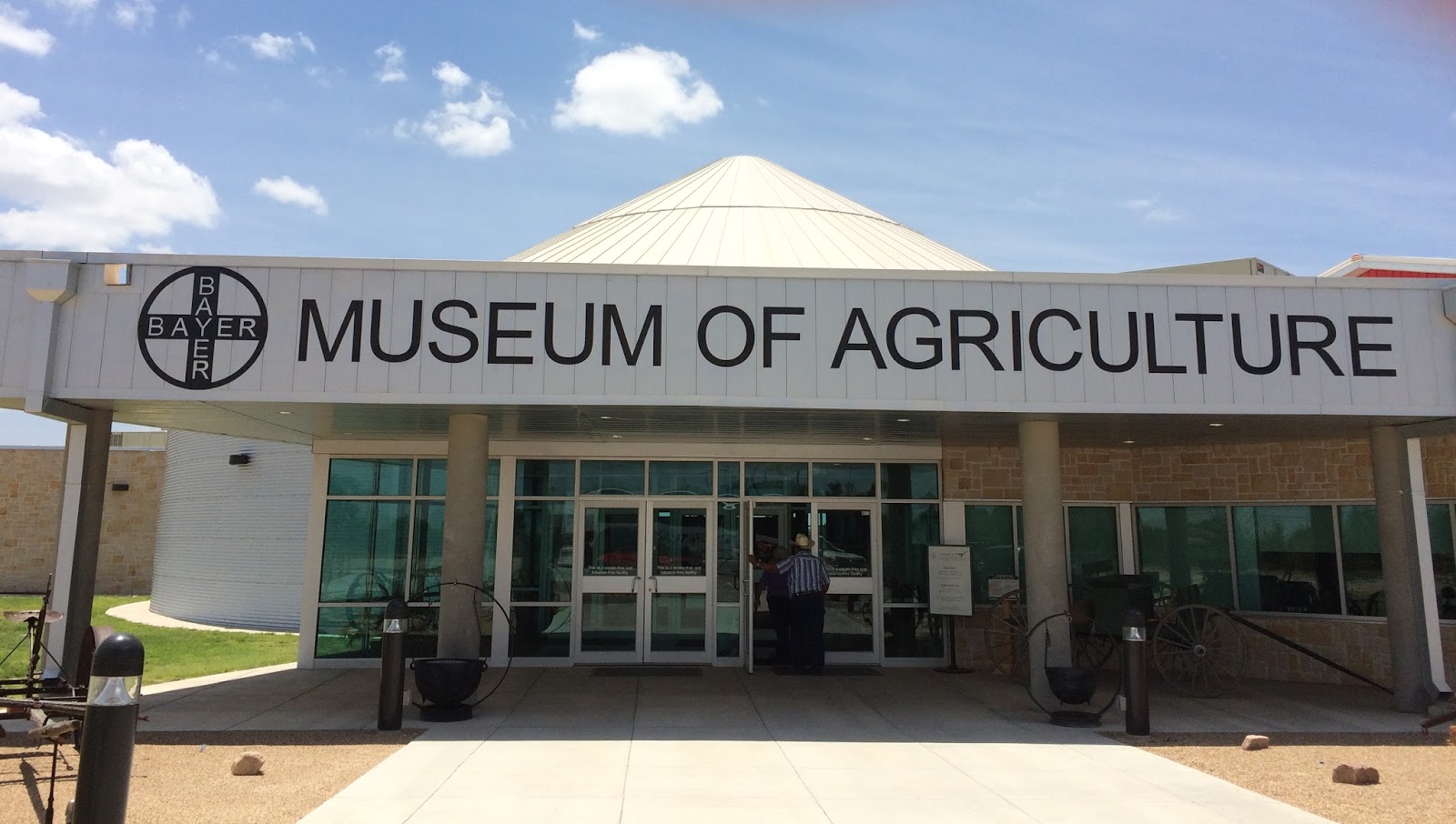
The Bayer Museum of Agriculture presents hundreds of farming and industrial implements used by farmers over the past couple hundred years. Of particular interest was a reconstruction of a blacksmith shop. It is the threat of having to spend years as an apprentice working in such a place that drives Will Braddock, the young protagonist of Eagle Talons, to run away on his quest to determine his own destiny and wind up helping build the first transcontinental railroad. Blacksmiths were indispensable to the settlement of America. Blacksmithing was, and still is, hard work.


The National Ranching Heritage Center contains dozens of structures relocated from sites in Texas and New Mexico. They range from dugouts to two-story frame houses and numerous barns and outbuildings. A railroad depot provides a close-up look at a typical waiting room with its pot-bellied stove. Will Braddock visits many of these depots throughout The Iron Horse Chronicles. The Center has a nice collection of firearms, some of which Will uses in his struggles with Paddy O'Hannigan and his other enemies. There are also examples of horse-drawn vehicles. The Conestoga wagon is the type in which Jenny McNabb, Will's young lady friend, is traveling west when her family is ambushed by Cheyenne Indians in Eagle Talons.


Folks who live in the Texas Panhandle have easy access to these museums. Others who may be traveling across the country should make time to stop and visit them. If you are not going to be in Texas anytime soon, visit similar museums in your area. Young people, and old, will be impressed with these wonderful institutions. Everybody will come away better educated.

Tuesday, June 9, 2015

Sara K Joiner: Take Advantage of Your Libraries

I was fortunate enough to attend two sessions about writing historical fiction at the Texas Library Association's Annual Conference. The second session, from Ann Weissgarber, focused on utilizing libraries for research.

As a librarian, I know the wealth of information libraries contain. As a writer of historical fiction, I know the importance of research.

But I didn't always know the the full power available to me at libraries.

I still remember the first time I ever heard of inter-library loan. I was in tenth grade and had recently watched Coal Miner's Daughter with Sissy Spacek as Loretta Lynn. Naturally, I wanted to read the book, but my high school library didn't have it.

Undeterred, my mother and I went to the public library the next weekend. This was a bigger deal than it sounds as that library -- the Friench-Simpson Memorial Library in Hallettsville, Texas -- was 20 miles from my house.

Unfortunately, the library didn't have the book either. Mom suggested I try to get it through inter-library loan.

"What is that?" I asked.

"When one library doesn't have the book you want, they can get it from another library," she explained.

That sounded too good to be true. The library would simply get it from somewhere else? You couldn't do that at the video store or a department store or Walmart.

Certain this was something only available at big libraries like Houston, where my mother grew up, I walked up to the circulation desk at my little one-building library prepared to be laughed right out onto the street.

"Can you do inter-library loan?" I asked timidly.

"Yes, we can," the librarian said. "You just need to fill out this form."

Imagine my shock!

Coal Miner's Daughter arrived about a month or later, and I read it with delight. A paper inter-library loan band obscured the cover, but that was a small price to pay for the incredible service provided by inter-library loan.

Now that I'm a librarian, I know how much work inter-library loans are for library staff. But it's still worth it. The service is generally free and there is still some minor paperwork, but much of the heavy lifting is done online now. One of the more fascinating aspects of inter-library loan is seeing where the material came from. I once got a book from the United States Department of State Library, which is how I learned there was a State Department Library.

A library's card catalog --
the original search engine
At college, I discovered another library secret. Librarians love to do research! When I had exhausted my own meager research skills as a freshman, I shyly approached the circulation desk once again. Admittedly, the desk at Texas Lutheran University's Blumberg Library was quite a bit larger than the desk at the Friench-Simpson Memorial Library.

I explained my needs. I can no longer remember the specifics -- whatever paper I was writing at the time was not nearly as exciting as reading Coal Miner's Daughter.

Off I was led on a journey through the largest reference collection I had ever seen up to that point -- Statistical Updates for every country, subject dictionaries, resource guides, plus the usual encyclopedias (more than World Book), atlases and almanacs -- all up-to-date. She also showed me how to use the online databases to find even more information.

Most importantly, she empowered me to find information on my own.

Once I started library school at the University of Texas at Austin -- and found an even larger reference collection -- I didn't feel so overwhelmed by the sheer amount of information found there.

As a librarian and historical fiction author, I get to combine the best of both worlds. Researching time periods, events and lives for information that will be useful or interesting in novels for children. What could be better?

Tell your students to ask librarians for help. We won't give you the answers, but we'll give you a ton of resources to find what you need. The tougher the question, the more we enjoy the challenge.

Take advantage of our skills. We paid a lot of money to graduate schools to get them. Remember Google doesn't have all the answers. Your librarian may not have the answer either, but she will go out of her way to find it. Google will never do that.

Sara K Joiner is the author of After the Ashes, coming in October from Holiday House. She is also the children's coordinator for the Brazoria County Library System.