Showing posts with label movies/TV. Show all posts

Thursday, December 29, 2016

Sara K Joiner: Early Days of the Movies

2016 has been a rough year, especially when thinking about well-known individuals who have died. From David Bowie and Alan Rickman to Prince and Anton Yelchin to George Michael and Carrie Fisher, lots of people around the world have lost someone they didn't know personally but who meant a great deal nonetheless.

I've spent a lot of time this year mourning strangers who were friends. And now I have to add Debbie Reynolds to that list.

I was about nine years old when I saw Singin' In the Rain for the first time. I loved it! Not only is it my favorite movie musical, it's also my favorite movie about the movies and one of my favorite movies in general. Set during the transition from silent films to "talkies," it introduced me to a world I knew nothing about. It showed history happening to people who lived it.

Recently, I read I Don't Know How the Story Ends by J.B. Cheaney. Although set earlier, it reminded me of Singin' In the Rain. It's about a young girl who spends a summer in Los Angeles with her extended family in 1918. Her step-cousin is infatuated with the movies and ropes her into "starring" in the picture he's making. Cameos from Charles Chaplin, Mary Pickford, Douglas Fairbanks, Mack Sennett and D.W. Griffith pop up throughout. There's a great discussion of Griffith's classic Intolerance. It gives readers a lot of details for further entertainment, including the actors and directors mentioned plus movies to watch.

I Don't Know How the Story Ends is a great book for middle grade readers, especially if they love the movies. Watch it with Singin' In the Rain for a good look at the full span of the early days of filmmaking. And don't forget to watch a silent film or two, as well. They're treasures.

Sara K Joiner is the author of After the Ashes. She is also a librarian.

Thursday, February 18, 2016

Making Sense of the Political Noise - for Kids and Adults

By Suzanne Morgan Williams

We're preparing for our presidential caucuses here in Nevada - phones are ringing, television and internet sites are full of political ads, and campaign volunteers are knocking on doors. It's no wonder I'm thinking about books for kids with political themes. But I came up short on titles that actually talk about the political process, historical fiction or not. So that's my first question. Do any of you know of YA or children's books that address politics? Elections? I can think of lots of books that have to do with war, homelessness, drugs, and other social issues but very few about the process. Yes, there are biographies of politicians, but what else?

Instead of featuring books about politics this week, I want to recommend a book for eighth grade and up about how to assess the rhetoric and political claims that we're all bombarded with. It's no surprise to me that politics uses the vocabulary of war - contest, campaign, captains, ground game, target precincts.This is serious business that creates fortunes, gathers or shares power, and changes lifes. Our children, the future voters and citizens who will guide the country long after we're gone, need to be educated so they aren't just swept along by the media. They need to think carefully.

So, everyone please read Paul Fleischman's Eyes Wide Open, Going Behind the Environmental Headlines.  It's not directly about politics, and some of you may disagree with his point of view on the environment, but the lessons are clear and can be applied to most messaging, statistics, or claims we hear. Fleischman says on his website: "THE GOAL: Giving readers 14 and up the briefing they need to comprehend their moment in history. And a riveting moment it is."

This easy to understand book is a primer in media, democracy, and how the point of view of those behind the advertisements and articles determines the information they provide. I'd say in this election year, Eyes Wide Open is a must read for all ages. Comments are welcome!

Thursday, February 11, 2016

Historical Fiction Book Buzz at the Movies by Mary Louise Sanchez


Google image
 Movies have been on my mind lately, perhaps because we watched a few during the holidays. Also, we recently visited Palm Springs, California and side-stepped around the stars on the sidewalks honoring movie stars and various people in the entertainment business.


Recently  I was browsing the collection of movies at our local library and noticed it had E.T. the Extra-terrestrial.
Google image
Even though I've seen the movie, I didn't think our seven and nine-year-old grandchildren had seen it. So, I checked the movie out. Our grand kids gave it glowing reviews. It got me thinking that I should now browse the library more intently for children's movies based on history.


Google image
The 2016 Oscars will be broadcast on February 28.
This brings to mind the fact that many fine movies were first children's books—specifically historical fiction. There are other fine movies which are animated or were television shows that also help teach history. You can rent these movies or even purchase them. Many fine documentaries and some movies are even on YouTube. I encourage you to look at reviews and the ratings to see if these are appropriate for your children.

Be aware that movie producers and directors take artistic license when these movies are produced, and the movies may not be accurate portrayals of the historical events or people. They may also veer from the original book. While watching the movie, children could note where they think history may have been fictionalized; and then they could search for the facts. Even so, movies make the time periods come alive with the costuming, settings, and often the language and music. 

In the past I have hosted Oscar parties for our family, which included young children. Everyone was requested to attend the party dressed in their "red carpet attire." Our granddaughters and nieces came dressed in their Disney princess Halloween costumes.
Google image
(That's one way to get more use from the costumes.) We also had a red cloth at the entry way, complete with paparazzi (husband with a camera). We have played many games at various
Google image
Oscar parties, but one game that was particularly fun was where everyone, including children, had to find something in our house that called to mind a prop in a movie. The rest of us had to figure out which movie the prop was in. What Oscar parties have you had or attended that were memorable? What are your ideas for an historical movie family/classroom premiere?


 My favorite historical fiction movie was made for adults and is based on the book  Gone With the Wind by Margaret Mitchell

Google image


Here are some movies based on children's historical fiction books, and my nominees for an historical fiction film fest with your classroom or family. What are some of your favorite movies based on an historical event, time period, or person that would appeal to children?

Sarah Plain and Tall by Patricia MacLachlan

Google image


Roll of Thunder Hear My Cry by Mildred D. Taylor


Google image


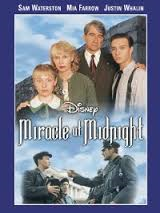
 Miracle at Midnight (TV movie) based on Number the Stars by Lois Lowry
Google image

Miracle at Moreaux based on, Twenty and Ten by Clair Hutchet Bishop

Google image

If you're interested in middle grade historical fiction books, we hope you'll click the button to the right side of the post and/or add your email so you can subscribe to: 

http://madaboutmghistory.blogspot.com


Thursday, September 24, 2015

Verisimilitude or Phony History

Verisimilitude is a big word that means giving the appearance of being real or truthful. A historical novelist has an obligation to his or her readers to write a story that is credible, authentic, and plausible. In writing The Iron Horse Chronicles, I spend countless hours scouring sources to ensure the historical timeline in which I place my characters adheres closely to the truth. Readers implicitly place a trust in me to provide an account of events that is believable and honest, while at the same time being entertaining and educational.

Printed books must compete with a plethora of electronic media. E-books are becoming more prevalent, making access to the written word potentially easier; but to many it is still easier to watch a television show or a movie. Middle grade students undoubtedly learn much about history from these latter media, and I am frustrated by what has been presented recently about the building of the first transcontinental railroad.

Screenwriters apparently do not feel the necessity to adhere to the principle of verisimilitude. Today’s scripts remind me of the Western movies of the 1940s and 50s (which I devoured as a boy) that didn’t care what stood in the way of a “good story.” Two recent offerings from the producers of the visual media have been disappointing because of their unnecessary distortion of history.

Hell on Wheels, an original AMC television series (TV-14), commenced in the fall of 2011. I have watched every episode and have marveled at how the writers ignore the facts. Recently, the conclusion of the show’s fourth season invented a meeting between President Ulysses S. Grant and Mormon leader Brigham Young in Salt Lake City. No such meeting occurred. The screenwriters included Doc Durant, who appears throughout the series as the Union Pacific’s principal on-scene manager. They never mention General Grenville Dodge, who was the real force behind the physical construction of the UP. When Durant, a financier, occasionally came west from the company’s New York headquarters, he usually made a mess of things. The Salt Lake City scene also included Collis Huntington, whom the screenwriters present as the manager of the Central Pacific’s field construction. Huntington was the CP’s lobbyist in Washington, DC. Charles Crocker was the driving force in the field. Students, young and old, who are not familiar with the history of westward expansion will come away with a misunderstanding of the facts.

The Lone Ranger, a 2013 Walt Disney movie (PG-13), also presented a distorted version of the building of the first transcontinental railroad. The scriptwriters abandoned verisimilitude in favor of sensationalism. For the Comanche Indians to have attacked the Union Pacific Railroad, as depicted in the movie, they would have had to make a thousand-mile trek from Texas. The Sioux and the Cheyennes did attack the railroad in Nebraska and Wyoming, but the railroad traversed their hunting grounds. The Utes and the Shoshones, who inhabited Utah and were the tribes physically in a position to have attacked, were peaceable in 1869. There were no Indian attacks at the time of the driving of the Golden Spike. As a boy, I was an avid watcher of the Lone Ranger and Tonto. I looked forward to enjoying the resurrection of those memorable characters in the new movie, but the distortion of history ruined it. Sadly, some young readers of my book Eagle Talons told me the movie was a favorite.

Now that I have vented my frustration, I must return to finishing the third book in my trilogy and try to remain reasonably close to the truth. I admit to placing my fictional characters in juxtaposition with historical personalities in order to write about the real events of history. I'll try hard to use verisimilitude.