Showing posts with label 1800s. Show all posts

Thursday, August 10, 2017

Sara K Joiner: Following the Corps of Discovery

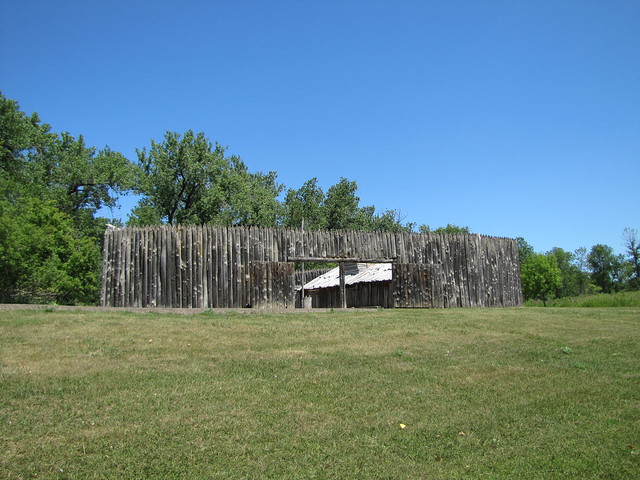
Recreation of Fort Mandan, where Lewis and Clark
wintered in 1804-05 and where Sacajawea joined
the expedition.
photo by Sara K Joiner
I recently returned from vacation where we traveled along some of the route that Meriwether Lewis and William Clark traversed during their 1804-06 expedition. Considering how difficult it is to get to places like Fort Mandan or Pompey's Pillar even with motorized vehicles and paved roads, Lewis and Clark's journey is almost impossible to believe.

Walking in the Corps' footsteps truly impressed upon me the remarkable nature of all those who made that trek. What an amazing feat they accomplished!
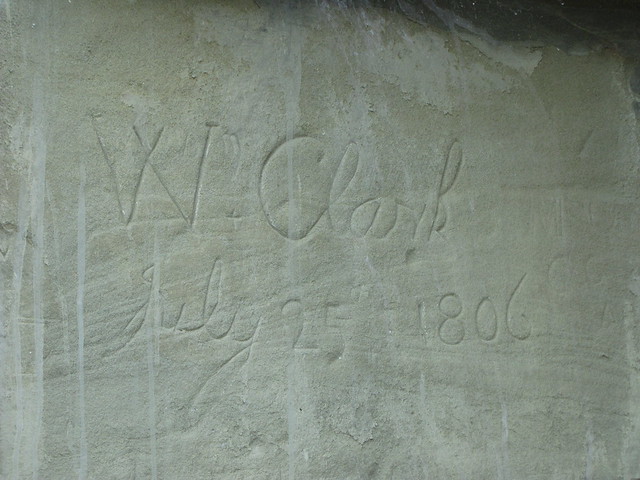
William Clark's carved signature
at Pompey's Pillar - the only
physical evidence remaining
of the Corps of Discovery.
photo by Sara K Joiner

To journey along with the Corps of Discovery without leaving the comforts of home, try some of these books.

Sacajawea: The Story of Bird Woman and the Lewis and Clark Expedition by Joseph Bruchac tells the story from Sacajawea's and Clark's point of view as they relate the tale to Sacajawea's son years later.

Virginia Driving Hawk Sneve's Bad River Boys: A Meeting of the Lakota Sioux with Lewis and Clark imagines a meeting between the Corps and the Native nation.

My Name Is York by Elizabeth Van Steenwyk focuses on York, a slave owned by Clark, and tells the story of the expedition through his eyes.

Laurie Myers' Lewis and Clark and Me: A Dog's Tale imagines what Lewis' dog Seaman saw on the journey and all the new experiences he had.

Sara K Joiner is the author of After the Ashes and a public librarian.

Thursday, June 15, 2017

Sara K Joiner: Environment and History

While I was researching After the Ashes, I learned about the impact environmental disasters can have on people and geography. Sometimes these disasters happen without warning, such as the volcanic eruption and tsunamis that resulted from Krakatoa's eruption. Other times, these disasters take time for their effects to have an impact.

There are a number of great books that use environmental disasters as a key element of the plot.

Andrea White's novel Radiant Girl is set in Pripyat near the Chernobyl in the former Soviet Union when nuclear facility melts down in 1986. Katya, the main character, is looking forward to the opening of a new amusement park when disaster strikes in the middle of the night. People she knows and cares for are killed in the initial explosion, and her entire world is turned upside down when the government moves her family from their comfortable home in Pripyat to an apartment in Odessa.

The Last Girls of Pompeii by Kathryn Lasky is set in the ancient Roman city in the year 79. Main character Julia has a disability and relies on her slave Mitka for help, comfort and friendship. When Mount Vesuvius erupts and shatters their world, the two girls have only themselves to rely on if they want to survive.

In The Killing Sea by Richard Lewis, white American Sarah and Indonesian Ruslan are forced to work together after the 2004 Indian Ocean tsunami. Both have been impacted by the disaster, and both need to reach help. Along the way they learn they have more in common than they realized.

Jame Richards' Three Rivers Rising, a novel in verse, is set during the 1889 Johnstown Flood in Pennsylvania. Main character Celestia loves a boy from the wrong side of the tracks which leads to her being disowned by her family. Taking shelter with the boy's family, she is living in Johnstown when the dam breaks and millions of cubic feet of water coming rushing into town.

When it comes to talking about environmental disasters that have shaken the world, you also need to look at nonfiction to learn about the causes and effects of these catastrophes. Dangerous Planet: Natural Disasters That Changed History by Bryn Barnard does just that. Readers learn about the Great Fire of London, the blizzard that led to the creation of the New York Subway, and deforestation that changed the course of Ethiopia's history.

The effects of the environment on history are far-reaching and impact us in ways we can never imagine. Thankfully, through historical fiction, we can place ourselves right at the center of those historic events.

Sara K Joiner is the author of After the Ashes. She is also a public librarian.

Thursday, March 2, 2017

Historical Sleuthing with 'The Detective's Assistant' by Kate Hannigan


I attended Kate Hannigan's session at the summer 2016 SCBWI (Society of Children's Book Writers and Illustrators) conference in Los Angeles. After listening to her interesting presentation, I asked if she would be interested in being our guest blogger. She was gracious and agreed to share the story behind her award winning middle grade history novel, The Detective's Assistant. We both agreed this post was apropos for Women's History Month.

She writes fiction and non-fiction from her home in Chicago. Her historical novel The Detective’s Assistant was the winner of the 2016 Golden Kite Award for best middle-grade novel, received starred reviews from Booklist and The Bulletin of the Center for Children's Books, was a Booklist Editors' Choice selection, a Nerdy Book Club Award winner, a Bank Street College Best Children's Book selection, named to state reading lists, as well as an Amelia Bloomer Project List for Feminist Books selection and a Mighty Girl Top Books for Tweens and Teens pick. It also has been optioned for film. Kate’s non-fiction picture book A Lady Has the Floor (Calkins Creek), spotlighting the life and accomplishments of Belva Lockwood, publishes in 2018. Visit her online at KateHannigan.com.


Historical Sleuthing with ‘The Detective’s Assistant’


I was researching a story about camels in the American West of 1856, just after the Gold Rush, when I stumbled upon my own golden nugget. It was just a few sentences about Allan Pinkerton’s detective agency and the day a woman named Kate Warne walked in to his office. But it would grow to become my obsession and later the middle-grade history-mystery novel The Detective’s Assistant (Little, Brown Books for Young Readers).


Pinkerton recounts in his writings that he’d assumed Kate Warne was there to apply for a secretary position, but she talked her way into having him hire her as a detective. She said she could “worm out” the secrets of the wives and girlfriends of Chicago’s crooks and criminals, and Pinkerton thought it was a marvelous idea. “We live in progressive times,” he told her, and he fancied himself a progressive man.


America’s first woman detective? I was so delighted by the possibilities of telling Kate Warne’s story that I immediately dropped my camel research and dove deep into the Pinkertons—doing my own detective work. And I’ve found it all so fascinating, I’m still reading everything I can about this period of American history.


Because Chicago’s fire in 1871 wiped out so much of the city’s history and records, there is not a lot of material about Kate Warne’s life before becoming a Pinkerton agent. What we know comes from Pinkerton’s accounts in his detective stories, written long after the cases. But there are a few records that survived of Kate Warne’s own words regarding the Pinkerton Detective Agency’s most important case—the thwarting of the Baltimore Plot to assassinate President-Elect Abraham Lincoln on his way from Illinois to Washington and his inauguration. So I relied on them to help shape Kate’s character in my story.


Because these examples of historical record thrill the history nerd in me, I made sure to weave them into the story. For example, the actual messages Pinkerton telegraphed back to the home office in Chicago during the perilous journey through deadly Baltimore in the days leading up to the 1861 inauguration—where Pinkerton referred to President Lincoln as “Nuts,” himself as “Plums,” and Kate Warne as “Barley”—make an appearance in the novel. As do a few newspaper reports that I found both funny and informative.


By wrapping such a crucial moment in the history of our nation in a rollicking story, I thought I could reach more young readers. I hoped that by creating an underdog like Kate Warne’s niece, the irrepressible Nell Warne, we could journey with Kate Warne and the Pinkerton detectives and witness history—and see that it was exciting and heart-stopping and very much worth knowing about.


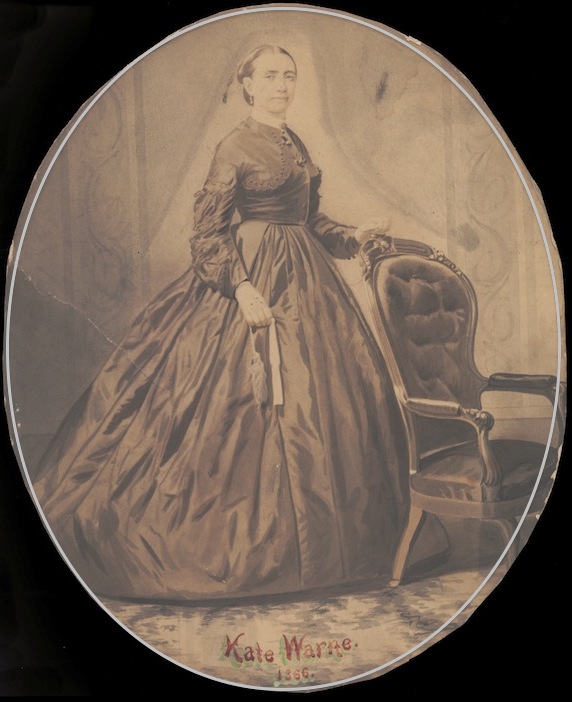
There are no known photographs of Kate Warne. Here is a painting dated 1866, courtesy of the Chicago History Museum.
And by throwing the spotlight on a lesser-known, essentially forgotten player from our past, Kate Warne, I’ve tried to show that history is filled with people who contributed to the building of our country but didn’t necessarily represent the mainstream. Because she was a woman, Kate Warne was dismissed as Pinkerton’s lover and her contribution forgotten. Historians pointed to the fact that she was buried near Pinkerton in Chicago’s Graceland Cemetery.


So I went there and checked it out, and she is. But so are many other Pinkerton detectives, so are we to assume they were all Allan Pinkerton’s lovers too? I believe what he wrote about Kate Warne—that she was one of his finest, most capable operatives.


While I hope The Detective’s Assistant makes young readers intrigued by our past and inspired to learn more about American history, I find that it’s also inspired me. I’ve been bitten by the history bug, and now all I want to do is dig up more fascinating people—women and people of color especially, who have long been overlooked by traditional historians.


There is a saying that history is written by the winners. For me, I think history can be a whole lot more interesting when we discover the stories of those just outside that winner’s circle.

"In celebration of Women's History Month, Kate will be giving away THREE COPIES of The Detective's Assistant! Comment below for a chance to win!"


Thursday, February 16, 2017

JASPER AND THE RIDDLE OF RILEY'S MINE : An Interview with Caroline Starr Rose


Today I'm pleased to welcome Caroline Starr Rose to the blog for an interview on her newest historical fiction, Jasper and the Riddle of Riley's Mine. Among Caroline's works are her award-winning middle grade historical fictions May B. and Blue Birds.

"Jasper and the Riddle of Riley's Mine is a rollicking adventure, warm and funny, chockablock with bad guys and good guys, mysteries and deceptions, dangers and disasters. it's a rip-roaring tale and a romping good read." --Newbery Award-Winning Author, Karen Cushman

Desperate to get away from their drunkard of a father, eleven-year-old Jasper and his older brother Melvin often talk of running away, of heading north to Alaska to chase riches beyond their wildest dreams. The Klondike Gold Rush is calling, and Melvin has finally decided the time to go is now—even if that means leaving Jasper behind. But Jasper has other plans, and follows his brother aboard a steamer as a stowaway.

Onboard the ship, Jasper overhears a rumor about One-Eyed Riley, an old coot who's long since gone, but is said to have left clues to the location of his stake, which still has plenty of gold left. The first person to unravel the clues and find the mine can stake the claim and become filthy rich. Jasper is quick to catch gold fever and knows he and Melvin can find the mine—all they have to do is survive the rough Alaskan terrain, along with the steep competition from the unscrupulous and dangerous people they encounter along the way. [Amazon Book Summary]

Caroline, thank you for joining us on Mad About Middle Grade History today. Can you tell us how you came up with the idea for Jasper?

Jasper and the Riddle of Riley’s Mine is a blend of a couple different ideas that had been floating around in my head for a while. When I was first researching the American frontier for the novel that became May B., I happened to read a book called Women of the Klondike. It was a fascinating glimpse into a moment in history I hardly knew anything about. A few years later, my sons asked if I’d ever write a book about a boy. Around the same time, as I was thinking about their question, I read an article in the Albuquerque Journal about an eccentric millionaire named Forrest Fenn who had hidden treasure somewhere in New Mexico and written a cryptic poem about its location. The first person to figure it out could keep the treasure. Lots of treasure hunters have searched, but so far no one has found Fenn’s fortune. I took that Klondike setting, added my first boy protagonist, Jasper Johnson, and threw in a mysterious mine worth millions available to the first person who could solve five riddles leading to its location.

Just writing about it now makes me think, “I’d like to read that book!”


In the words of Jasper, "It was better than fine!" What sort of research did you do for this book?

Map of the Klondike
A few weeks ago I looked over my notes and realized I’d read four novels (middle grade mysteries, gold rush fiction, and a third round with Huckleberry Finn) and around 14 non-fiction books in preparation for writing Jasper. I also watched a couple documentaries, visited countless websites, and for the first time ever, traveled to a place in one of my stories. (My husband and I took an Alaskan cruise in 2015).


I know Jasper was modeled after Huckleberry Finn. Can you tell us more about this?

When my sons asked me to write a story with a boy protagonist, I immediately thought of Huck Finn. I mean, has there ever been a more memorable boy in the history of American literature? I couldn’t go wrong in using Huck as a starting place, I figured. The more I thought of it, the more I realized he would make a great model for a Klondike gold rush character. Huck’s colloquial speech, sharp observations, sweet gullibility, resourcefulness, and tendency to speak his mind all fit perfectly with the gold rush setting, where misinformation abounded and quick wits were necessary to survive.


What is the main thing you want readers to take away from your book?

I hope readers close the book feeling like they’ve been to the Klondike gold rush, that they experienced everything right alongside my characters and really have a sense of what the world was like over a hundred years ago. I’d love it if it took some time for them to readjust to regular life! I also hope readers might reflect on wealth and riches and what really matters in this world.

Miners climbing the Chilkoot Pass


Who are some middle-grade historical fiction authors that inspire you?

Karen Cushman is the master. I also enjoy Christopher Paul Curtis, Augusta Scattergood, Kirby Larsen, Jennifer Holm, and Laurie Halse Anderson.


A great list of authors! This is your third work of historical fiction. Why is historical fiction important?

It is so easy to be inwardly focused, to think that our lives and our current moment in history are the ultimate. Historical fiction invites us to look beyond our experiences, our perceptions, and the way the world functions in this time period. Ideally, it leaves us with a better sense of others—even if we don’t always agree with them—a better sense of ourselves, and the ability to appreciate both the differences and similarities between the past and present.

What has been one of your most rewarding experiences as an author?

Knowing characters I’ve created live apart from me in the hearts and minds of readers is pretty much everything.

Is there anything else you’d like to say?

Thank you for the opportunity to visit Mad About Middle-Grade History today! 

Caroline Starr Rose is an award-winning middle grade and picture book author whose books have been ALA-ALSC Notable,* Junior Library Guild, ABA New Voices,** Kids’ Indie Next, Amazon’s Best Books of the Month for Kids, and Bank Street College of Education Best Books selections. In addition, her books have been nominated for almost two dozen state awards lists. In 2012 Caroline was named a Publishers Weekly Flying Start Author for her debut novel, May B. She spent her childhood in the deserts of Saudi Arabia and New Mexico and taught social studies and English in four different states. Caroline now lives with her husband and two sons in New Mexico. You can find Caroline here .


Michele Hathaway is a writer and freelance editor. She has an M. A. in Social Anthropology and has worked in libraries in California, New Mexico, and Pennsylvania. She writes stories set in culturally diverse, historical and contemporary periods.

Subscribe to get posts automatically and never miss a post. You can use the Subscribe or Follow by E-Mail buttons to the right, or add http://madaboutmghistory.blogspot.com/to Feedly or another reader. 

Thursday, January 5, 2017

Inauguration Day and the Presidency

On January 20, 2016, the United States of America will inaugurate its forty-fifth President when Donald J. Trump takes the oath of office. This date, along with the fact that one month later on February 20 we celebrate President’s Day, makes it an appropriate time to look into the history of all of our country’s presidents.

The oath of office is a simple statement contained in the Constitution: “I do solemnly swear (or affirm) that I will faithfully execute the Office of President of the United States, and will to the best of my ability, preserve, protect and defend the Constitution of the United States." The words “So help me, God,” are not written in the constitution, but have been added by many presidents.


Lives of the Presidents, Fame, Shame (and What the Neighbors Thought), written by Kathleen Krull and illustrated by Kathryn Hewitt, provides an excellent introductory overview of each of the presidents through Barack Obama. This is one of the extensive series of the Lives of series of books that include titles about scientists, artists, explorers, and many more.


Presidents, written by James Barber, in association with the Smithsonian Institution, is one of the Eyewitness Books’ series. The book is an easy read, excellently illustrated to keep the younger reader’s attention. An interesting companion book is First Ladies, written by Amy Pastan. It also is profusely illustrated and an easy read. Both books have been updated to include the Obamas. Having these two books side by side makes for an enjoyable educational experience.


A more comprehensive look at each president is contained in Our Country’s Presidents, written by Ann Bausum for the National Geographic Society. The dust jacket points out that this volume provides “comprehensive information for school reports.” In addition to the biographical information about each president, there is a special chapter that explains “The Electoral College” in an easily understood manner. A separate supplement contains stories about “Our Country’s First Ladies.”
Again, both volumes include Barack and Michelle Obama.


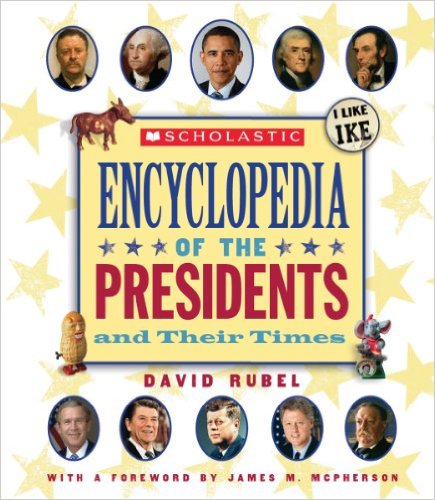
Scholastic provides the Encyclopedia of the Presidents and their Times, by David Rubel. The format offers a page for every year since 1789. This chronological history explains how the president in each year influenced or was impacted by the events that took place. A special section, “A History of the White House,” provides an extensive, well illustrated, story of the evolution of the executive mansion. Another interesting addition is the section on the “Presidential Election Results,” providing the distribution of the electoral vote (and where available the popular vote) for each of the candidates, from all of the political parties, who ran for the office. The Obamas are included.


The Big Book of Presidents by Nancy J. Hajeski provides “fascinating presidential trivia, including . . . little-known facts.” Did you know Millard Fillmore installed the first kitchen stove in the White House?  In addition to timelines and biographical facts about each president, the book contains many interesting special articles, such as: “The Houses of Congress” and “Assassinations.” Like all of the books described above, this volume is current through President Obama.


A fascinating, small book entitled Presidential Losers, by David J. Goldman, delves into controversial personages such as Aaron Burr, who assassinated Alexander Hamilton. In addition to several interesting one-time candidates, the book educates the reader on the persistent candidates who consistently lost. Henry Clay tried three times unsuccessfully, and William Jennings Bryan was another three-time failure.


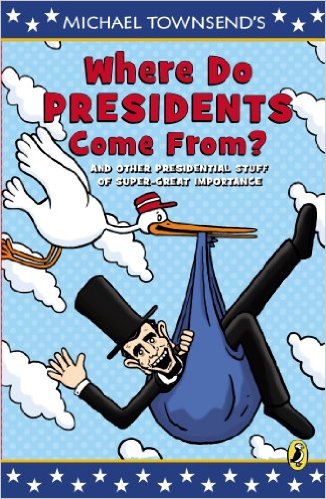
As the old cliché goes, last but not least, is Where Do Presidents Come From? And Other Presidential Stuff of Super-Great Importance, by Michael Townsend. Whereas I skimmed through many of the previously listed books, I read this one from cover to cover. Middle-grade readers will get a kick out of this comic book presentation. Heck, even I couldn’t put it down, and I haven’t been a middle-grader for almost seventy years. Townsend does not cover each president in detail, but provides an overall history of why the United States has a president and what his (that is still the correct pronoun at this writing) duties entail. One of the more fascinating chapters is “How Does a President Get Elected?” Included is a simple explanation of why we have an Electoral College. Naysayers from the losing political party consistently demand that the next election be decided by popular vote. These folks will learn why our founding fathers created this compromise protection for all of the states after reading this funny presentation. After all, we do not elect a president just for the overcrowded population centers.

Our country has just gone through what pundits today claim is an unprecedented election. Studying the history of our presidents and how they achieved this lofty position reveals many shenanigans and much gnashing of teeth by conflicting political parties over the years. When I was a middle-grade student we were required to memorize the names of the presidents. Perhaps not the most necessary of requirements, but at least we knew who they were and what they accomplished. Students today certainly should be taught the history of why we are a republic, why there are three branches of government, and why we select the important position of President the way we do.

In Bear Claws, The Iron Horse Chronicles--Book Two, I included scenes about the presidential campaign of Ulysses S. Grant in 1868 as he toured Wyoming on the first transcontinental railroad. The lives of the presidents have impacted all citizens since the nation's founding. It is right and proper that we know about them and honor them.
Thursday, December 22, 2016

A Boy Called Dickens


Thanks to the Muppets, multitudes of children and adults have been introduced to A Christmas Carol. I suspect far fewer have been properly introduced to the author, Charles Dickens—who is not, after all, Gonzo.

A Boy Called Dickens, by Deborah Hopkinson and illustrated by John Hendrix, is an excellent avenue into the life of this famous author and his work.


"Come along, now. We are here to search for a boy called Dickens. He won't be easy to find. The fog has crept in, silent as a ghost, to fold the city in cold, gray arms." --Hopkinson


Dickens at the blacking warehouse. By Fred Bernard
The book opens, dear reader, with a chase through the icy streets of London as we attempt to follow the lonely, ragged, and elusive 12-year old Dickens. He leads us to Warren's Blacking factory, where he works 10 hours a day packaging bottles of shoe polish. 

Dickens' only relief to the drudgery is the stories he makes up. Today, Charles tells his friend Bob Fagin about a boy named David who runs away from the cruelty of factory work. His tale is cut short when the boss enters, demanding silence and work.


The ghosts of Dickens' stories come alive through Hendrix's illustrations as they follow Charles through the soot-choked fog of 19th century London. 

"Then Dickens walks on, surrounded by pickpockets; ladies with shattered hopes; a miserly old man; a young gentleman with great expectations; a proud, heartless girl. There are lawyers, clerks, convicts, and keepers of old curiosity shops. There are even ghosts and spirits. And children like Dickens, trying to hold on to a dream.

"All these characters and their stories swirl about the boy like the fog."


It is not until the mid-point that we discover why Dickens is in this cold, miserable, and isolated state. His father is in debtor's prison. Dickens is working to survive. 

When his father is released, things begin to look up for the Dickens family, but Charles is still sent to work, though his family does not need his income. Here, in poetic brilliance, Hendrix illustrates Dickens turned away from us, on a blank white page. 

Dickens' father finally ends this wretched period of Charles' life and sends him back to school. Spring has turned to summer. Sunlight streams through clean windows onto a warm classroom cluttered with books, boys, and even a few mice. 

We leave Dickens as a grown up, still walking the streets of London but no longer followed by his ghosts, which we must assume, found a home in his books. 

The impact of this episode on the life of Charles Dickens must have been profound. We see it in his advocacy for social reform, and we read it in his books. Was it the birthplace of Ebeneezer Scrooge? We can only guess. 

"Oh! but he was a tight-fisted hand at the grindstone Scrooge! a squeezing, wrenching, grasping, scraping , clutching, covetous old sinner! Hard and sharp as flint from which no steel had ever struck out generous fire; secret, and self-contained, and solitary as an oyster." A Christmas Carol by Charles Dickens


My copy, purchased at Blackwells in Oxford, UK.


 Parents, Teachers, and Librarians:

I found A Boy Called Dickens in the children's fiction of my local library (3rd to 8th grades). I find picture books in this section are sadly neglected. Rescue this one and give it some exercise.

  • Create a Dickens' display including: A Boy Called Dickens, biographies, and children's versions of Dickens' stories. Parents may enjoy these versions as, let's face it, the original works are a hard slog for even the most devoted English major.  (Thank you Kat, for pointing that out.)
  • The Christmas season is a great time for a Dickens-themed display. Host a storytime featuring "Stave One" of A Christmas Carol (an awesome read-aloud. Try it!). You might follow with a showing of one of the many versions of A Christmas Carol, or to guarantee a crowd, The Muppet Christmas Carol. Steer everyone to the display and include books on London. Usborne has a great book. If possible, include food such as Christmas pudding, mince pies, and hot spiced cider.
  • For older students, discuss the impact they think Dickens' early life might have had on his later work. Discuss the wretched things that happen to people in our time. Imagine a different world and how that might be brought about. 

"and it was always said of him that he knew how to keep Christmas well, if any man alive possessed the knowledge. May that be truly said of us, and all of us! And so, as Tiny Tim observed, God bless Us, Every One!"
--A Christmas Carol by Charles Dickens


Michele Hathaway is a writer and freelance editor. She has an M. A. in Social Anthropology and has worked in libraries in California, New Mexico, and Pennsylvania. She writes stories set in culturally diverse, historical and contemporary periods.

Subscribe to get posts automatically and never miss a post. You can use the Subscribe or Follow by E-Mail buttons to the right, or add http://madaboutmghistory.blogspot.com/to Feedly or another reader.

Thursday, September 8, 2016

Sara K Joiner: A Hard Day's Work

Throughout our country's history, Americans have been known for their work ethic. Even today, Americans don't use all of their vacation time (if they earn it). Studies have shown that taking a break from work actually benefits both the employer and the employee.

While the United States falls behind other developed nations in providing paid days off, Americans work an average of 1788 hours a year. The average work-week today is 40 hours, but that wasn't always the case. In the 1800s, people worked between 60 to 70 hours a week.

In honor of Labor Day on Monday and the hard working Americans it celebrates, here are some books about historical laborers.

So Far From Home: The Diary of Mary Driscoll, an Irish Mill Girl by Barry Denenberg tells the story of an immigrant from Ireland who finds work in the textile mills in Lowell, Massachusetts. When other mill workers talk of unions and strikes, Mary is forced to decide if the money she earns is worth the hazards she faces at work.

Melanie Crowder's Audacity tells a fictionalized version of the life of Clara Lemlich. Clara, a Jewish immigrant, found work at the Triangle Shirtwaist Factory in New York City. Before and after the fire at the factory, she fought for increased safety measures for workers throughout the garment industry.

Breaker Boys: How a Photograph Helped End Child Labor by Michael Burgan is nonfiction. It demonstrates the power of photography to change society by focusing on boys who worked in the coal mines and the life-threatening work they did.

Sara K Joiner is the author of After the Ashes. She is also a public librarian.

Thursday, September 1, 2016

History and the National Park Service

The National Park Service celebrated its 100th birthday on August 25, 2016. There are two ways to look at history and the NPS. First, there is the history of the founding of the NPS and the stories associated with the establishment of each of the parks, monuments, and sites. Second, there is the history of our country that the NPS preserves at its numerous historical sites.

The first officially designated National Park was Yellowstone, established in 1872. In the years immediately following its creation, civilian superintendents oversaw the protection of Yellowstone; but they lacked the resources to fend off poachers, souvenir hunters, and developers. In 1886, the US Army sent troops to provide muscle to the protective efforts. Today, the Army’s installation there is designated Fort Yellowstone National Historic Landmark and serves as headquarters for Yellowstone National Park. The army relinquished its responsibilities when President Woodrow Wilson signed the Organic Act on August 25, 1916, creating the National Park Service, a federal bureau in the Department of the Interior.

Theodore Roosevelt with John Muir
John Muir, a famous naturalist, was a staunch advocate of creating national parks at Yosemite, Sequoia, Grand Canyon, and Mt. Rainier. President Theodore Roosevelt toured Yosemite with Muir on a camping trip in 1903. Yosemite had been protected by the state of California since 1864 based upon a law signed by President Abraham Lincoln. It was Muir and Roosevelt, however, who worked with California Governor George Pardee to turn Yosemite into a national park in 1906. Theodore Roosevelt also signed the Antiquities Act of 1906, allowing the president to set aside "historic landmarks, historic and prehistoric structures, and other objects of historic or scientific interest" in order to stop their destruction. This act has led to the creation of more than fifty national monuments, and the act is being used even now by President Barack Obama. 

This website contains a complete listing of the facilities maintained by the National Park Service:https://en.wikipedia.org/wiki/List_of_areas_in_the_United_States_National_Park_System#National_Historical_Parks


Cavalry Barracks, Fort Laramie, Wyoming
This bring us to the second way of relating history to the NPS. As a writer of historical fiction, primarily oriented toward the middle grade reader, I have relied on personal visits to many NPS historic sites in my research travels. In The Iron Horse Chronicles, many of Will Braddock’s scenes occur at the military forts built to protect the railroad and its workers from attacks by the Indians. Fort Laramie National Historic Site in Wyoming provides the visitor with the ability to see how soldiers lived on the frontier during the time when the first transcontinental railroad was under construction. My frequent visits to Gettysburg National Military Park in Pennsylvania, though a long way from the frontier, gave me a better understanding of what it would have been like to be a soldier following the Civil War.

Union Pacific Engine #119
An important research site for The Iron Horse Chronicles is the Golden Spike National Historical Site in Utah. Here, the visitor witnesses replicas of two locomotives touch cowcatchers after the reenactment of the driving of the golden spike. To stand near one of these engines when they steam past puts the viewer right into the action—the imagination becomes real life. Walking the ground where history occurred at any such site is worthwhile for students, teachers, and writers.


Although calling it a "kid's" guide might be a turn-off for some middle grade students, the book National Parks: A Kid's Guide to America's Parks, Monuments, and Landmarks, by Erin McHugh, provides an excellent introduction for planning a family visit or school outing. The writing is listed on Amazon and Barnes & Noble as appropriate for ages 8 to 12, but the middle grade student can benefit from reading it. The book concentrates on the environmental parks, but it does include information for some historical sites. For the middle grade teacher, the National Park Service provides lesson plans and other aids at this site: https://www.nps.gov/teachers/index.htm

Pulitzer Prize winning novelist, environmentalist, historian, Wallace Stegner said: "National parks are the best idea we ever had."

Happy Birthday National Park Service!

Thursday, July 21, 2016

Buffalo Bill

Buffalo Bill served as an inspiration for the protagonist, Will Braddock, in The Iron Horse Chronicles. Both boys embarked on a life of their own at age fourteen. It has been said that the youth of the mid-nineteenth century grew up faster than those of today. Knowing the history of Buffalo Bill, I felt comfortable that the adventurous life into which I thrust Will Braddock at that age could actually happen. I also knew from personal experience that accepting responsibility at that age was possible, since I took my first job at age fourteen.

Born William Frederick Cody in 1846 in Iowa Territory, several months before it became a state, the future showman grew up on a frontier farm. When Bill was seven, his father, Isaac, was stabbed by a pro-slavery advocate during a rally when he spoke in support of abolition. Bill helped carry his father away, displaying early on his ability to act for himself. Bill’s father died in 1857 of pneumonia attributed to his earlier stabbing. From age ten, Bill worked to help support his mother and sisters. At fourteen, Bill became a Pony Express rider earning a reputation as one of the best. I wrote about the Pony Express on this website in a post entitled "Orphans Wanted" on May 26, 2016.

In The Iron Horse Chronicles, Will Braddock becomes a hunter for his uncle’s Union Pacific Railroad survey inspection team. At the same time Will is hunting antelope for a survey team of five working on the first transcontinental railroad in Wyoming, William Cody is hunting buffalo to feed hundreds of tracklayers for what would become the Kansas Pacific Railway. The Kansas Pacific, known until 1869 as the Union Pacific Eastern Division, had lost the race to the Union Pacific Railroad in 1866 to be the first railroad to lay track to the Hundredth Meridian and earn the right to build west to meet the Central Pacific Railroad, coming east out of California.

Cody earned the admiration of several Army officers for his marksmanship while hunting for the railroad, and it is believed they bestowed upon him the nickname of “Buffalo Bill.” Bill later served as a scout for the Army in its wars with the Native Americans. His efforts earned him a Medal of Honor in 1872. In a strange political maneuver, Congress revoked the medal in 1917 (along with 910 other recipients) when they retroactively tightened the rules. Since Bill had served as a civilian scout, and not a soldier, he was deemed ineligible. Seventy-two years after Cody died on January 10, 1917, Congress restored his medal.

Bill Cody would have known about the great hundredth meridian expedition organized by Thomas “Doc” Durant, the Union Pacific’s vice president and general manager, in October 1866. I wrote about what I consider to be “the first wild west show” on my own website’s blog on June 6, 2016. You can read that post by following this link:

Perhaps it was from the Union Pacific’s Grand Excursion to the Hundredth Meridian that Cody gained the inspiration for founding Buffalo Bill’s Wild West Show. This show became a huge success in the United States during his lifetime. Bill and his show also toured Europe repeatedly, and they played to Queen Victoria of Great Britain on three different occasions. 

Did Will Braddock and Bill Cody know one another in the late 1860s? It’s doubtful they met, but each was probably aware that the other was considered a top hunter by his respective railroad. In Bear Claws, The Iron Horse Chronicles—Book Two, Will Braddock guides a hunting expedition for a fictional German nobleman, much as Bill Cody did for a real-life Russian prince.


Eagle Talons, The Iron Horse Chronicles--Book One, received the Bronze Will Rogers Medallion Award in 2015 in the category of books for Younger Readers. Bear Claws has been selected as a finalist for the 2016 Will Rogers Medallion Award for Younger Readers.The winners will be announced at an awards ceremony in Fort Worth, Texas, on October 29, 2016. I plan to be there.

Thursday, May 12, 2016

When Camels Roamed the Old West by Sherry Alexander

Did you know the U.S. government once experimented with using camels in the old west? It's a case where truth is stranger than fiction--and provides fertile soil for historical fiction. Today I invited writer, author, blogger, and child advocate Sherry Alexander to tell us about her research, books, and articles about camels in the old west. 

When Camels Roamed the Old West 

Three years ago while doing research on the California Gold Rush of 1849, I came across a newspaper article from 1857 that announced the arrival of camels in Texas. I’ve always loved American history, but until that moment I had no idea that camels were part of the Old West. That article was only six sentences long, but it started me on a journey that led to the writing of two books for middle grade and up—one non-fiction and one fiction.

In 1836, the Seminole War was under way in Florida. U.S. Army Captain George Grossman asked Congress to import camels to use as transportation over the rough Florida terrain. Congress denied that request. However, the idea did not die. Twelve years later, the request made its way to Congress once again. This time it was to use camels in the newly acquired southwest which included Texas, Nevada, and Utah, most of Arizona and New Mexico, and parts of both Colorado and Wyoming. Once Mexican territory, this 525,000 square miles became part of the United States with the signing of the Treaty of Guadalupe at the end of the Mexican-American War in 1848. Congress said no to the request, but, then Senator, Jefferson Davis was listening. When he became U.S. Secretary of War in 1853, he asked for the camels again. Congress was reluctant, but they finally agreed to a test. In 1856, thirty-two camels from the Middle East arrived in Indianola, Texas, and another forty-one landed nine months later.

The experiment lasted until the Civil War, and while the camels proved their worth time and time again, they lost favor. After the war, the Army auctioned some to circuses and entrepreneurs and turned loose others to fend for themselves in the deserts. My non-fiction book, The Great Camel Experiment of the Old West, chronicles their journey, but the incident that drove me to write my first middle grade novel occurred long after the Civil War.

For more than forty years, stories about wild camels, or ghost camels, were the stuff of legends throughout the southwest. The animals harassed miners, cowboys, and ranchers, and spooked horses and mules. Apaches even corralled them to sell to local butchers who passed the meat off as beef to the silver miners in Arizona, New Mexico, and Colorado. However, one particular camel sparked my imagination and its very own legend.

It was a large, male Bactrian, or two-hump, camel. Those who actually saw it described it to local newspapers as reddish in color, shaggy, and mean. One of the last sightings of this red ghost before its death in 1886 was on a creek in southeastern Arizona three years earlier. It was a time when bands of Apache who left the reservation with Geronimo were attacking small Arizona ranches. A ranch woman encountered the camel at the creek near her home, and was killed. The witnesses said it stomped her to death.

I couldn’t get that incident out of my mind. I kept wondering, “What if?”
What if she had a son who didn’t see the animal that killed his mother, but found unusual tracks and long red hair? What if that son wanted revenge for his mother? What if the boy’s father was an army scout ordered back to the fort to hunt down the renegade Apache? There were so many what ifs that I couldn’t stop thinking about the story, so I wrote it.
Search for the Red Ghost is a middle-grade action/adventure and coming of age story that pits thirteen-year-old Jake Thrasher against the inherent dangers of the desert in 1883 Arizona. His Army Scout father refuses to hunt the animal responsible, so Jake takes matters into his own hands. He leaves the safety of his small ranch and follows a sparse trail through an inhospitable desert filled with snakes, wolves, grizzlies, renegade Apache, and the ever-present threat of death. Will he find his red ghost? You'll have to read the book to find out.

Sherry Alexander's stories and articles have appeared in Red Squirrel Magazine and Guardian Angel Kids. She lives in Southwest Washington with her husband of 47 years, two dogs, two horses, a gaggle of grand kids, and the occasional pack of coyotes. Search for the Red Ghost is her first MG novel, and is available both as an ebook and in print from Amazon, Barnes and Noble, MuseitUp Publishing, and all ebook retailers.

Her blog for kids http://rightsherry.blogspot.com/

Her web site http://www.sherryalexanderwrites.com

Her author's page on Amazon http://www.amazon.com/Sherry-Alexander/e/B001KMESIC/ref=sr_ntt_srch_lnk_1?qid=1461546929&sr=8-1

Her Goodreads page https://www.goodreads.com/author/show/5679922.Sherry_Alexander

Here is a link to an online non-fiction article "Camels in the Old West" in the February 2015 issue of Guardian Angel.

Thursday, March 31, 2016

Nineteenth Century Internet

The “nineteenth century internet” might not impress middle-grade students today, but it provided the first means of transmitting messages around the world in virtually real-time. This marvelous invention, which eventually evolved into the present-day internet, was the telegraph. Between these two mass-communication methods came the telephone, radio, television, computers, and satellites. When I was a middle-grade student and an active member of the Boy Scouts of America, one of the skills we strove to learn was Morse Code. Even after I went into the US Army in 1960, telegraphic systems were used to send messages around the world. The story of the evolution of communications is told nicely by Janice Parker in Messengers, Morse Code, and Modems.

In the early 1800s, several inventors, most notably in England, were experimenting with harnessing the power of electricity in order to send a signal over a wire. But the generally accepted “inventor” of a successful telegraph system is American painter Samuel F. B. Morse. He had been fascinated with the study of electricity as a youth, but it was not until he reached middle age that he embarked seriously on the idea of creating the telegraph. At the age of 41, after studying art in France, Morse sailed back home in 1832. Conversations with fellow passengers about the possible ways of using electricity to aid communications stimulated his interest. He immediately went to work on the endeavor that resulted in successfully demonstrating his invention at the United States Supreme Court in 1844. The message he tapped out to prove the telegraph could work is well known to American school children: “What hath God wrought?” A good biography of Morse’s life and work is contained in The Invention of the Telegraph and Telephone in American History by Anita Louise McCormick.

The Morse Code system of dots and dashes fascinated politicians, newspaper reporters, and railroad operators, who quickly took advantage of this speedy way of communicating. During the Civil War both the Union and the Confederate armies used the telegraph to control movements of troops and supplies. President Abraham Lincoln was a strong advocate of the new electric system of communication. He spent hours in the telegraph office of the War Department, across the street from the White House, receiving reports from the battlefields and sending orders to his commanders. President Lincoln, Willie Kettles, and the Telegraph Machine by Marty Rhodes Figley tells the story of the youngest telegraph operator in the War Department.

When the threat of a Civil War increased in 1860, the only means of communication between the contiguous states on the east coast and the new states of Oregon and California on the west coast was via mail delivered cross-county by stagecoach or sent onboard ships around Cape Horn, South America. From April 1860 to October 1861 the Pony Express shortened the delivery time of mail from weeks to less than ten days. But all the time the Pony Express was operating between St. Joseph, Missouri, and Sacramento, California, workers hurried to stretch a telegraph line across the intervening prairies and mountains. With the transmission of the first telegram from California’s Chief Justice to President Lincoln in October 1861, the Pony Express died. Now, a message could travel in a matter of minutes almost anywhere in the country.

The original cross-country telegraph line followed the route of the overland stagecoach. When President Lincoln signed the Pacific Railroad Act of 1862 on July 1 of that year, the construction program included a telegraph line to parallel the railroad. When the Union Pacific joined with the Central Pacific at Promontory Summit, Utah, on May 10, 1869, cross-country stagecoach travel ended, and telegraph traffic switched to the new lines adjacent to the iron rails. One of the most famous transmissions via the telegraph to reach all points around the country, and even points in Europe via the recently completed undersea cable, was “Done.” That simple message signaled the driving of the golden spike and the completion of the first transcontinental railroad. Andrew J. Russell's famous photograph shows a spectator standing on the crossbeam of the telegraph pole above the ceremony.

I write about this historic telegraphic event in Golden Spike, The Iron Horse Chronicles—Book Three. This book is yet to be published, but the first two books in my trilogy (Eagle Talons and Bear Claws) contain numerous scenes depicting the important use of the first “internet” as work progressed to extend the railroad from Omaha, Nebraska, to Sacramento, California, in the late 1860s.