Showing posts with label family stories. Show all posts

Thursday, July 26, 2018

FAMILIES IN STORIES: by Mary Louise Sanchez


My soon to debut book, The Wind Called My Name,
is based on my mother's life growing up in a small southern Wyoming town during the Great Depression. Her Hispanic family plays a big part in the story.  Below is a picture of the real Margarita Sandoval with her brother, Ernesto.
When I was writing the Author's Note, I often thought I should include a genealogy chart because my two maternal great-grandmothers are in the story, as well as my maternal grandparents, and some of my mother's siblings.

The family in my story is intact, but that was the case for many families during the Great Depression era, even though the fathers were sometimes away working.  In my story, the father and eldest son are working for the Union Pacific Railroad in Wyoming, while the remainder of the family is in New Mexico.
After a year, they are reunited in Wyoming, but do not have their large extended family nearby, and now they must rely only on each other to be strong in the face of adversity.

So many children's books today show a picture where children deal with divorce and even abandonment, but I want readers to see a strong family unit and how it deals with injustices of the time. Hopefully readers will come away with a sense of what family meant to the Sandovals.

Here are some middle grade historical fiction books that exemplify the kind of family unit you will read about in my novel, The Wind Called My Name. The release date is September 18, 2018 which happens to be the birthday of my maternal grandmother, Josefita (Maes) Sandoval. 

Thursday, June 21, 2018

Don’t Let the Stories Die - Jodi Lea Stewart on keeping #History Alive

Cross the Bridge into History
Unique Challenges

Historic novel writing presents many unique challenges. Foremost, the writer didn't personally live during that time era, or perhaps he/she lives in New York but loves writing about the Old West.  Slick documentaries and photos often don’t go far enough to immerse the writer or the reader in the “feel” of that particular slot of time.

Stories from people who are long gone still live on to a degree via the written word through journals, newspaper articles, Bible notes, diaries, even plays. If you are fortunate enough to find someone whose ancestors lived during a particular historic time, say during the Ellis Island emigrant burst, all the better because you’re going to get stories no one else has heard, and most likely, tidbits from a different perspective.

I call those stories, especially the ones obtained first person, the REAL STORIES because they come from the mouths of those who lived them.

Blackberry Road, my latest novel, is a snapshot of a hot summer in 1934 Oklahoma. A girl called Biddy narrates a whopping tale of murder and spookiness that begins in May when school is out and ends when the blackberries are turning brown on the vine – about mid- to late-summer. Biddy’s family jumps right out at you like a real family, and why is that?

Because they are, and I didn’t let their stories die.

Turning 'Real' into Fiction

Collecting family stories, recipes, lore, and copying old handwritten Bible notes over the years created the realistic backdrop for Blackberry Road. Fictional Biddy has twelve brothers and sisters. My mother had eleven. Both Biddys, the fictional and the real, were from sharecropping families living in Oklahoma in the 1930s. 

Dirt poor, but rock solid, those families had to eat, live, and survive everything from snake bites to drought (or flood) to miserable housing conditions.

In my particular case, I was fortunate to mingle and mix with a real sharecropping family because they were my own relatives. You can be sure the stories at our reunions or get-togethers flew around like greased spitballs; and there I was, in the thick of it, laughing and asking questions, my pen flying over the notebook I kept with me at all times.

Most members of the real Blackberry Road family have now passed on, but their lives and experiences will live on forever simply because I didn’t let the stories die. My job as a writer was to make fiction seem like reality and reality seem like fiction. 

You can do the same thing.

No Family Stories to Collect? No Problem!

Don’t despair if you don’t have actual family stories to gather. Story opportunities full of "nuggets" pop up everywhere. All you have to do is cross the bridge, so to speak, and be ready to take notes. 

A chance to record stories “from the horse’s mouth” is as close as that elderly lady you see every day on the bus. Befriend her and see life as it was through her eyes. Maybe it’s a friend’s uncle who served in the military and lived through stories that seem too fictional to be true but are true just the same. 

A person volunteering for a church street choir used to be homeless many years ago – what was that like, and how did he or she escape homelessness? The Vietnamese family down the street who barely made it to the USA in 1971 – how did they do it, and what happened when they got here? 

Your friend tells you she has a grandfather who was a butler in the deep South in the early 1950s. Wow! Can you go see him and make sure his stories don’t die?

You don’t know until you try, right?

At an Early Age . . .

This history-collecting mindset can be encouraged at an early age. Teachers can inspire their students to sit down and talk to their own grandparents and parents to collect stories from long ago, or even a few decades ago. Telling the stories to the class or submitting them as a written assignment wins on all levels. A field trip to a retirement home to sit down one-on-one with the residents and collect stories from times past could turn up historical and entertaining information that might lead to a lifetime of story collection for those students. At the very least, it gives the young and the old a chance to relate and talk to one another.

Librarians are famous for encouraging the young to “dig and dig some more” academically. A contest for the most interesting, newly discovered historic story “as told by” could turn up a goldmine of data! A librarian’s influence on the young to respect and preserve history is something that cannot be measured but is truly a stake in our future.

Living stories are waiting for you, your students, your children, and your friends to discover, record, and save. It’s up to all of us to not let those stories pass away into oblivion.

Two Old Stories That Didn’t Die

“I remember Mom making my dresses from flour sacks and my bloomers from flannel undershirts. She used innertube rubber for the waist and legs. She made me at least three dresses for the year. When I grew out of them and had to wear them anyway, it was sure pitiful.” ~ the real Biddy, age 92.

“It was my job to lead my blind grandma to the outhouse, and I would read the Sears and Roebuck catalog to her while I waited. That’s how, when I was ten years old, I got the second doll of my childhood. We read about her in the catalog, and she cost 95-cents. Grandma bought it for me for taking such good care of her. I thought my doll was the most beautiful thing in the world. She had rubber bloomers, and I kept her hung up on a wall. In those days, we didn’t have screens on most of the windows and some grasshoppers got hold of those rubber bloomers and ate them up. I had to kill those varmints for doing that!” ~ the real Biddy, age 92

Jodi Lea Stewart was born in Texas to an “Okie” mom and a Texan dad. Her younger years were spent in Texas and Oklahoma; hence, she knows all about biscuits and gravy, blackberry picking, chiggers, and snipe hunting. At the age of eight she moved to a large cattle ranch in the White Mountains of Arizona. Later, she left her studies at the University of Arizona in Tucson to move to San Francisco, where she learned about peace, love, and exactly what she DIDN’T want to do with her life. Since then, Jodi graduated summa cum laude with a BS in Business Management, raised three children, worked as an electro-mechanical drafter, penned humor columns for a college periodical, wrote regional western articles, and served as managing editor of a Fortune 500 corporate newsletter. She currently resides in Arizona with her husband, two Standard poodles, two rescue cats, and numerous gigantic, bossy houseplants.
She is also the author of a “Nancy Drew meets Tony Hillerman” trilogy; SILKI: THE GIRL OF MANY SCARVES: Summer of the Ancient, Book One; Canyon of Doom, Book Two; Valley of Shadows, Book Three, set in the modern-day Navajo Nation and featuring a sassy protagonist with an addiction to scarves and a penchant for trouble.

Blackberry Road is a panorama of dirt-poor but honest Oklahoma life as told through a sharecropper’s teenaged daughter. The murder of a beloved teacher stretches into mysterious sounds coming from the woods to beyond the hidden caves of Coody’s Bluff. Before it’s over, the truth brushes shoulders with some of 1934’s most notorious criminals. Blackberry Road is Jodi Lea Stewart’s first historic novel.

Thursday, December 14, 2017

FROM FAMILY TREE TO HISTORICAL FICTION by Mary Louise Sanchez


As the holiday season  is once again upon us, our thoughts turn to family. We remember Thanksgiving, Christmas, or other holiday gatherings. What a wealth of story nuggets we have available to us if we open our eyes and ears at family gatherings. These nuggets can make for authentic stories of historical fiction.
Authors of historical fiction often draw inspiration from their own lives and lives of their family members. Children can do the same thing. Teachers should encourage children to write and share their own stories. As Isabel Campo says, "Our universe is made up of 'vacant silences'. There is room for seven billion stories, one written by each person in this tiny planet."

Holidays are golden opportunities to get names of ancestors and details of the lives of family members, particularly the elderly. When I was a young girl, after the Thanksgiving foods were divided and the dishes were washed and dried, my maternal grandmother used to encourage me to play songs on the piano. I played the songs she enjoyed singing as a girl, when she attended school taught by  the Sisters of Loretto in New Mexico. Grandma particularly enjoyed singing The Old Oaken Bucket.


We also learned Santa Claus never visited our ancestors—not even my parents, who were born in the 1920s. In fact, my dad's northern New Mexican Christmas traditions resembled Halloween Trick or Treat today. He and his siblings went house to house gathering goodies as they asked for "Mis Christmas".  
On many Christmas Day evenings our dad played a Spanish version of the dreidel game with us. We bet using pinon nuts and never  realized this was a Jewish game because the only Jews we knew were in the Bible. How did my ancestors learn this game in their rural, northern New Mexico homes?


In my work-in-progress, The Wind Called My Name, the story is loosely based on my mother's life growing up in a small Wyoming town during the 1930s. I used the fact that Santa Claus was not a predominate figure in my dad or mom's lives in the story. My mother's maternal grandmother lived with the family in Wyoming. So, I put my great-grandmother in the story because I knew her from my mother's stories. My other great-grandmother plays a part in the story too. I actually knew her and used a little idiosyncrasy about her in the story. Some other ancestors have a part in the story because I've met them through my genealogy research. (I'm toying with putting a family tree in the Acknowledgement page).

 I gave my mom my first draft of my story as a gift about twelve years ago. Since then, I have made quite a few revisions. My father used to say my story was "all lies" because of all the changes I made to the story. He thought if you used real people in the story, then the story should be all factual. Thus, adults, as well as children, need to be taught and should understand that historical fiction stories are a combination of true facts and made-up details.

In the study of a historical fiction novel, it would be helpful to make a grid so that students can write down what they believe is factual and what they believe is imaginary. Then they can do research in various ways to check the facts about characters, settings, and plot.  These are things I do to learn more about the author and what he/she writes. This activity could certainly be used with my middle grade historical fiction novel, The Wind Calls My Name. Its anticipated debut is summer of 2018.

1.  Read the author's dedication for mention of people that might be in the story.

2.  Read the author's notes about settings.

3.  Read the author's Acknowledgement page.

4. Research character's names; historical events; places


Encourage your students to turn off their digital devices and connect to real people in their lives and family tree and see what roots they discover.

What story nuggets do you have from your own family or that you have learned about in stories?

Thursday, April 13, 2017

Immigration: Always in the News

To say that Immigration is in the news these days is an understatement. The truth is, people have been moving around the planet since the first humans ventured out of Africa. What causes people to leave the comforts of home? Adventure lures some, economic gain attracts others. but the inciting incidents that move masses of people are usually due to famine, persecution, and war. It's no surprise then that much historical fiction centers on immigration stories. Here are a few I've discovered recently.


Last year, I reviewed several Irish historical fiction stories including the Nory Ryan series by award winning Patricia Reilly Giff. Maggie's Door, the second in the series, follows Nory as she journeys to America in the wake of The Hunger--the terrible potato famine of 1845-1847.Wrenching, yet inspiring, Nory overcomes tremendous odds to bring herself and her little brother across an ocean to find her remaining family.


Streets of Gold, by the beloved children's book author Rosemary Wells and beautifully illustrated by Dan Andreason, is a retelling for children of Mary Antin's memoir The Promised Land. Due to increasing persecution, a Jewish family emigrates from Russia at the turn of the century.

As with Maggie's Door, the father leaves first to establish a job and home before sending for the family. This struck me as a key dynamic I had not understood before. Immigration stories are very much about the courage of those left behind and the complication of making the journey without a father.

When the family arrives in America, they discover the streets are not paved with gold, of course. But they are safe. They are together, again.


Journey to America by Sonia Levitin is another Jewish immigration story, which takes place on the
eve of WWII. Again, the father precedes the family to America leaving his wife and three daughters to escape Germany when the time is right.

This story opened portrays the flight of many people into Switzerland before WWII, the difficulties children faced there, and the overwhelming situation for the Swiss in dealing with the flood of refugees. Some children were exploited while other Swiss generously took children into their own homes, although this further separated children from their families. It was often months before refugees could obtain an exit visa, if they could obtain one at all. Levitin also shows how each child may cope differently with upheaval in their lives.


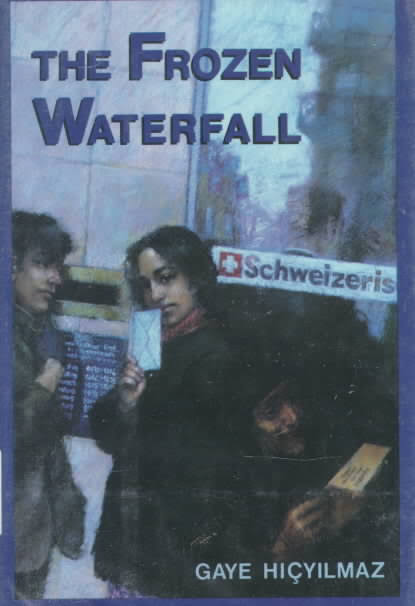
The Frozen Waterfall by Gaye Hiçyılmaz is a more contemporary immigration story, but I add it here because it is a rare find--a Turkish family that immigrates to Switzerland for economic reasons.

Twelve-year old Selda has trouble adjusting to life in Switzerland, but her friendship with a Turkish boy who is an illegal immigrant leads to the realization that life can not only be difficult, it can be dangerous. This book is for upper middle-grade and high school. It is also quite long, and the writing is fair, but for me, it was worth the effort to gain a valuable perspective, and to understand more intimately the hardships of immigration on not only children but also parents.


I hope these books will inspire you to find more immigration literature and share it with the children in your lives. Please share any of your favorites with me!


Michele Hathaway is a writer and freelance editor. She has an M. A. in Social Anthropology and has worked in libraries in California, New Mexico, and Pennsylvania. She writes stories set in culturally diverse, historical and contemporary periods.

Subscribe to get posts automatically and never miss a post. You can use the Subscribe or Follow by E-Mail buttons to the right, or add http://madaboutmghistory.blogspot.com/to Feedly or another reader. 


Thursday, June 9, 2016

When You Realize Time is Finite

Well, at least your time is. When I was a little girl, I used to sit by my grandfather in the warm summer afternoons listening to the radio. If I was lucky, he'd pull out his pocket watch, take his knife, and flip open the back. There were all the fabulous gears, clicking back and forth. Better yet were the tiny jewels sparkling in the sunlight that streamed across the room. "It keeps perfect time," he'd say. Time was important to him - he was a railroad man and those trains had schedules to meet. If I were luckier still, when I begged for a story, he'd tell me one. There was nothing I liked better than hearing his stories, unless it was listening to my grandmother's.

Lately, I've become aware of a different schedule, one for stories, I've been digging around to fill in the blanks in family histories and I've discovered a great resource in the google books project. Much as this open book project worries writers that their work will be e-published without compensation, the books I've found are from the late 1800s and they contain information on my far removed ancestors that I've not discovered in any other place. The reason? Someone took the time to interview living people and write down their stories. Those living people are now long dead, but these collections and transcriptions contain many interesting stories - embellished or not - and connections to ancestors I couldn't make on my own.

My take away from this is that I need to be writing down my own memories, the stories I was told by my parents and grandparents, and collecting stories from my still living cousins, aunts, and siblings. We have the information in our heads that our grand-children and great grand-children may want someday. So I've started a new project - writing a family story per day. These are either ones that I've discovered (these date to the time of the earliest European settlements in North America) or ones that I remember - which are from a bit later time period :) I'm not sure these snippets will become anything publishable yet, but they may.

I wish, when I was studying history, that I'd known how many of my own ancestors were represented in the dry paragraphs in the very thick, and dry, history book. I liked history, but it didn't seem personal then. It does now. And my own memories have an expiration date - sometime. Maybe you have to reach a certain age to feel the reality of history as life. I'm there. Or maybe, if you read great historical fiction, you can achieve the same realization as a child or young adult. What historical fiction books gave you the feeling that history was, in fact, about living, feeling people that you cared about? Comments please. . .

Thursday, October 1, 2015

Gifts from the Past

By Suzanne Morgan Williams


We are living in a time children born today and in the future will consider historical. What we, our parents, and grandparent remember clearly will seem fuzzy and perhaps unbelievable. A world without personal computers? A time when Japan was one of the United States’ great enemies? What? No plastic? Future authors will bring out current time to life with details and characters that they’ll construct from blogs, journals and museums. We won’t be here in person to inform them. And whether we’re talking about authors or descendants yet to be born, we could leave them a gift.

A few years ago my uncle died and my aunt, knowing I was interested in genealogy and family stories, sent me a large box. When I opened it, I found a treasure of my grandfather’s papers and small items that my uncle had inherited from him. I read through the paid off mortgage note for $800, the 1905 Kansas University yearbook, and the railroad passes and retirement documents. I held his draft cards. Then I unzipped a pouch that was nestled in the bottom of the box. The smell of his tobacco escaped after being encased for near fifty years. I was transported to his side, listening to the staccato words of the announcer calling the plays of a ball game through the big console radio. I waited patiently for him to tamp down the tobacco in his pipe, strike a match, draw in the flame to light the pipe, and then hold the match for me to blow out. How I loved him. All that was in the smell of his tobacco.

My grandmother had saved the pouch and the pipes. My mother had delivered it to my uncle. His wife had passed it to me. Now it’s stored in my bedroom. Who else will love that tobacco like I do. Probably no one, unless I tell the stories that go with the smell. 

So my suggestion: We are the keepers of our own history. What objects do you have that hold memories for your children, grandchildren, or community? Do some things need to be donated to your city or state historical society? Can you create a box to pass down with small things that will spark emotions? Be prudent. No one wants a collection of junk to sort through. But a photo, a souvenir, your great grandmother’s poetry may be magical. They will convey our own history in all its rich detail. And for those yet to be born, be sure to write down the stories.

Teacher Tip – consider having your students create memory boxes for themselves, with their families, or virtual ones for the characters in novels you’re reading. Then they can author the stories to go with the contents.