Showing posts with label American Civil War. Show all posts

Sunday, October 12, 2025

Chris Eboch on #Haunted History - Learning #History through Ghost Stories

Some children find it difficult to connect to history. Historical fiction can help, by telling history through the lens of exciting stories, full of action and adventure. If that is not enough to attract a young reader, consider ghost stories.

Some ghost stories are also set in historical times, such as Ghosts I Have Been, by Richard Peck, which is set in 1913. Still, the humor, chills, and spunky heroine will appeal to contemporary readers. Blossom Culp has visions, and here they connect her to the sinking of the Titanic.

Other books in the Blossom Culp series also feature ghosts with history connections. 

For even longer ago history, try Lady Margaret’s Ghost: A Felicity Mystery (American Girl Mysteries), by Elizabeth McDavid Jones. Set in the 1770s, 11-year-old Felicity must run the household while her mother and siblings are way. Felicity has a sick horse, so this mystery will especially appeal to young horse lovers.

Set Today, Ghost of the Past

Many other ghost stories are set present-day, with a modern child connecting to a ghost. In some of these, the ghost is not especially historical – it simply a way to add mystery and chills. Peni R. Griffin wrote The Ghost Sitter about a girl killed in a firework accident who haunts her suburban home. Finally a family with a girl her age moves in, and the girl helps free her.

Laura Ruby wrote Lily’s Ghosts based on stories a friend told her about her family’s “haunted” house. “As a kid, I adored anything scary – ghosts, monsters, mummies, you name it,” Ruby says. “So, when I sat down to write my own books, I wrote the ones I would have liked to read when I was a kid.”

Ghosts at War

Other titles have ghosts strongly rooted in history. These spectral figures provide a glimpse of the past, without requiring the reader to be totally immersed in the historical setting. The Battlefield Ghost, by Margery Culyer, tells the story of a ghost who was a soldier with Washington during the Battle of Princeton. 

The Nina Tanleven Mysteries, by Bruce Coville, all feature ghost adventures. The one with the strongest history hook is book 2, The Ghost Wore Gray: Nina and her friend Chris meet the ghost of a Confederate soldier. What is he doing hunting a hotel in New York State? A mystery as well as a ghost story, this fun novel touches on both the Civil War and the Underground Railroad.

The Civil War is a popular error for ghosts, apparently. Two books by Elaine Marie Alphin Ghost Cadet and Ghost Soldier – also involve Civil War ghosts.

Lois Szymanski and Shelley Sykes wrote the Gettysburg Ghost Gang series of six books. “We love the research that goes into writing civil war era ghosts,” Szymanski says. The Gettysburg Ghost Gang uses a contemporary setting with civil war era ghosts. “Our ideas come from our history research and our experiences on actual ghost investigations,” Szymanski says. “For instance, in our history research we found that hundreds of women fought in the Civil War dressed as men.” This inspired A Whisper of War.

Ghost Who Can't Forget the Past

In my Haunted series, thirteen-year-old Jon and his eleven-year-old sister, Tania, are typical modern kids – except for the fact that Tania can communicate with ghosts. In The Ghost on the Stairs, the kids help investigate a hundred-year-old tragedy in Colorado silver mining country. The Riverboat Phantom puts them on the Mississippi River on an antique riverboat. For The Ghost Miner’s Treasure, Jon and Tania travel to the Superstition Mountains of Arizona, where the ghost of an old miner is still looking for his lost mine. In this series, the ghosts are being held in this world by something that happened in the past. In order to help free the ghosts, Jon and Tania must understand that past.

Get a teaching guide to use with The Ghost Miner's Treasure. It includes discussion questions on topics from science to ethics, plus critical thinking, writing, and mapmaking projects.

If you are considering using ghost stories to connect kids to history, be sure to review the book first. In some cases the history connection is strong and accurate. However, this is not always the case. Still, if you have a very reluctant history reader, getting them started on ghost stories in general could be a way to ease them toward historical ghost stories and then other historical fiction.

While ghost stories are not usually the most historically detailed of historical fiction, they can be a bridge for young readers who prefer the paranormal to the historical.

What other middle grade ghost stories can you think of that use realistic historical elements?

Subscribe to get posts automatically and never miss a post. You can use the Subscribe buttons to the right, or add http://madaboutmghistory.blogspot.com/ to Feedly or another reader.

Chris Eboch writes fiction and nonfiction for all ages, with 40+ published books for children. Her novels for ages nine and up include The Genie’s Gift, a middle eastern fantasy; The Eyes of Pharaoh, a mystery in ancient Egypt; The Well of Sacrifice, a Mayan adventure, and the Haunted series, which starts with The Ghost on the Stairs. Learn more at www.chriseboch.com or her Amazon page.


Chris is also the author of You Can Write for Children: How to Write Great Stories, Articles, and Books for Kids and Teenagers, available for the Kindle, in paperback, or in Large Print paperback.

Thursday, February 23, 2017

Sara K Joiner: A Review of "Mary Bowser and the Civil War Spy Ring"

If you or your students are interested in codes, ciphers and clues, then Mary Bowser and the Civil War Spy Ring by Enigma Alberti is just the book for you.

Telling the fictionalized story of Mary Bowser, a freed slave who worked as part of Elizabeth Van Lew's Union spy ring during the Civil War, readers will find a woman determined to do what she can to end the horrors of slavery. Mary served as a servant in the Confederate White House and was well-placed to learn a great deal of information that passed across Jefferson Davis' desk.

While the book isn't long or difficult to read, it has a great deal of drama and danger which makes it ideal for reluctant readers. Mary has an antagonistic relationship with O'Melia, the Irish lady's maid to Varina Davis. Will O'Melia discover that Mary isn't the simple-minded servant she claims to be?

Mary had been a slave for the Van Lew family before being freed by Elizabeth who recognized Mary's intelligence. After being sent to school in Philadelphia, Mary eventually taught in Liberia before returning to the United States to marry. Her wedding occurred on the same day Virginia seceded from the Union in 1861. Not long after that, Elizabeth Van Lew began recruiting spies for the Union and convinced Mary to work in the Davis household. Clever and educated, Mary Bowser risked her life spying for the Union. If anyone had learned she could read and write, she could have been killed as it was illegal in Virginia for slaves to be literate.

In addition to the story, the main focus of the book is on spycraft and deciphering messages. Throughout the tale, Mary keeps a diary (which may or may not be historically true) that she hides in different places throughout the Confederate White House. Readers' goals are to use the clues hidden in pictures and across the margins to find the final hiding place of the diary. An envelope with a Caesar cipher wheel, vellum with cutout holes, red acetate and a page from Uncle Tom's Cabin help readers solve the puzzles to lead them to the answer. If they grow frustrated or cannot solve them, the answers are provided in a sealed section at the end.

There are lots of clues. I have to admit that I didn't even spot all of them until I read the answers. Morse code, Vignere ciphers, the language of flowers, hidden writing -- it's all here to be pored over and puzzled out by readers.

While I will admit to not being the type of reader who particularly likes codes, I did enjoy deciphering the clues and challenging myself to solve the problems before I gave up and broke the seal. That's when I learned that although I had determined the location of Mary's diary, there were quite a few other clues I missed.

The acetate, vellum, cipher wheel
and page that come with the book.
Unfortunately, because of the pieces that come with it, this book wouldn't necessarily stand up to heavy library or classroom use and is really only able to be used by one, or perhaps two, readers at a time. It is fun to solve the riddles, though, and I gained a tremendous appreciation for the poor men and women who had to translate simple messages into codes that appeared to be gibberish. That takes some time!

And, of course, it is always worthwhile to learn about people and their lives. Mary Bowser was quite remarkable and even began teaching freed slaves to read almost as soon as the war ended.

Mary Bowser and the Civil War Spy Ring is written by Enigma Alberti and illustrated by Tony Cliff. It is the first of Workman Publishing's Spy On History series. The next book in the series, Victor Dowd and the WWII Ghost Army, will be available in January 2018.

Workman Publishing supplied a free copy of the book for review purposes.

Sara K Joiner is the author of After the Ashes. She is also a public librarian.

Thursday, June 30, 2016

Tillie Pierce: Eyewitness to Gettysburg

 It's fun to read two works based on the same primary source. When you do and find scenes or turns of phrase common to both, it's a safe bet that the words or the scene came from the original material.


The Battle of Gettysburg occurred from July 1-3, 1863. One of the witnesses to the battle was fifteen year old Tillie Pierce. More than 20 years after the battle, she wrote her memoir, Tillie Pierce: Teen Eyewitness to the Battle of Gettysburg.


Thunder at Gettysburg, written by Patricia Lee Gauch (Calkins Creek, 2003) is a simple little chapter book written for elementary and middleschool-age students who have mastered easy readers. Ms. Gauch's main character is Tillie, and her book is a work of fiction that retells the biography on a very simple level. It is an historically accurate account of a young girl's involvement in the Battle of Gettysburg, especially her experiences helping wounded soldiers.


My book, The Bent Reed, is a work of fiction, but like many works of historical fiction, it includes historical characters. Sarah McCoombs, the teen-aged protagonist, and her family don't exist. Most of their neighbors did. I set the fictitious McCoombs family's farm right in the thick of the action, between two real farms that took a beating with actual artillery. Almost everything that happened in The Bent Reed actually did happen, but to other, real people. One of those people was Tillie Pierce. After her home is commandeered and turned into a hospital, Sarah McCoombs tends to wounded soldier from both the Confederate and Union Armies. Much of her empathy is derived from Tillie Pierce's writing.


Tillie actually shows up in a crowd scene in my book. She is named in a group of girls who went to the ladies seminary, a Gettysburg finishing school for young ladies. They are depicted waving flags during a Union parade through town. I got the description of the parade, including the songs they sang and the names of some of the handsome young men parading in their spiffy new uniforms, from her memoir.


To commemorate the Battle of Gettysburg and celebrate Independence Day, The Bent Reed will be offered on Amazon at special low prices from June 30-July 7th.


Jennifer Bohnhoff teaches New Mexico History to 7th graders at a Middle School in Albuquerque, New Mexico. She is the author of The Bent Reed, Code: Elephants on the Moon, and On Fledgling Wings, all works of historical fiction for middle grades and Tweet Sarts, a funny contemporary novel for middle grade readers. Swan Song, a dual narrative contemporary/historical fiction for young adults, is due out later this summer and can be preordered for Kindle on Amazon, or in paperback at her website.

Thursday, March 31, 2016

Nineteenth Century Internet

The “nineteenth century internet” might not impress middle-grade students today, but it provided the first means of transmitting messages around the world in virtually real-time. This marvelous invention, which eventually evolved into the present-day internet, was the telegraph. Between these two mass-communication methods came the telephone, radio, television, computers, and satellites. When I was a middle-grade student and an active member of the Boy Scouts of America, one of the skills we strove to learn was Morse Code. Even after I went into the US Army in 1960, telegraphic systems were used to send messages around the world. The story of the evolution of communications is told nicely by Janice Parker in Messengers, Morse Code, and Modems.

In the early 1800s, several inventors, most notably in England, were experimenting with harnessing the power of electricity in order to send a signal over a wire. But the generally accepted “inventor” of a successful telegraph system is American painter Samuel F. B. Morse. He had been fascinated with the study of electricity as a youth, but it was not until he reached middle age that he embarked seriously on the idea of creating the telegraph. At the age of 41, after studying art in France, Morse sailed back home in 1832. Conversations with fellow passengers about the possible ways of using electricity to aid communications stimulated his interest. He immediately went to work on the endeavor that resulted in successfully demonstrating his invention at the United States Supreme Court in 1844. The message he tapped out to prove the telegraph could work is well known to American school children: “What hath God wrought?” A good biography of Morse’s life and work is contained in The Invention of the Telegraph and Telephone in American History by Anita Louise McCormick.

The Morse Code system of dots and dashes fascinated politicians, newspaper reporters, and railroad operators, who quickly took advantage of this speedy way of communicating. During the Civil War both the Union and the Confederate armies used the telegraph to control movements of troops and supplies. President Abraham Lincoln was a strong advocate of the new electric system of communication. He spent hours in the telegraph office of the War Department, across the street from the White House, receiving reports from the battlefields and sending orders to his commanders. President Lincoln, Willie Kettles, and the Telegraph Machine by Marty Rhodes Figley tells the story of the youngest telegraph operator in the War Department.

When the threat of a Civil War increased in 1860, the only means of communication between the contiguous states on the east coast and the new states of Oregon and California on the west coast was via mail delivered cross-county by stagecoach or sent onboard ships around Cape Horn, South America. From April 1860 to October 1861 the Pony Express shortened the delivery time of mail from weeks to less than ten days. But all the time the Pony Express was operating between St. Joseph, Missouri, and Sacramento, California, workers hurried to stretch a telegraph line across the intervening prairies and mountains. With the transmission of the first telegram from California’s Chief Justice to President Lincoln in October 1861, the Pony Express died. Now, a message could travel in a matter of minutes almost anywhere in the country.

The original cross-country telegraph line followed the route of the overland stagecoach. When President Lincoln signed the Pacific Railroad Act of 1862 on July 1 of that year, the construction program included a telegraph line to parallel the railroad. When the Union Pacific joined with the Central Pacific at Promontory Summit, Utah, on May 10, 1869, cross-country stagecoach travel ended, and telegraph traffic switched to the new lines adjacent to the iron rails. One of the most famous transmissions via the telegraph to reach all points around the country, and even points in Europe via the recently completed undersea cable, was “Done.” That simple message signaled the driving of the golden spike and the completion of the first transcontinental railroad. Andrew J. Russell's famous photograph shows a spectator standing on the crossbeam of the telegraph pole above the ceremony.

I write about this historic telegraphic event in Golden Spike, The Iron Horse Chronicles—Book Three. This book is yet to be published, but the first two books in my trilogy (Eagle Talons and Bear Claws) contain numerous scenes depicting the important use of the first “internet” as work progressed to extend the railroad from Omaha, Nebraska, to Sacramento, California, in the late 1860s.

Thursday, March 24, 2016

Sara K Joiner: Picture Books for Middle Schoolers

It's easy to think that picture books are simple stories for young children. Once readers reach certain reading milestones they're expected to abandon picture books for the more complex stories found in chapter books and novels.

But ignoring an entire sector of publishing could be detrimental to your students' understandings of history. Think about what they could learn if you took fifteen to twenty minutes to read an historical fiction picture book to them. Besides, who doesn't love to be read to?

Here are just a few that I enjoy.

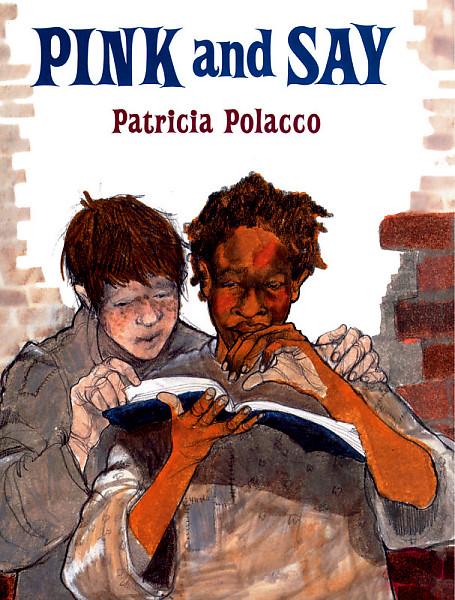
You can teach lessons about the Civil War, but one of the best stories is Pink and Say by Patricia Polacco. Although it's a picture book, the characters are teenagers. Both boys are soldiers in the Union Army, but Pink is African American while Say is white. The two form a powerful friendship and the story has a devastatingly heartbreaking ending. Fair warning: I can never read this book without crying, so have tissues on hand for your students.

Tim Tingle's Crossing Bok Chitto is another glorious story that would work perfectly in a middle school classroom. It's about a young Choctaw girl who befriends a slave family on a nearby plantation. When the family learns the mother will soon be sold away, they plan an escape and receive help from the Choctaws.
The illustrations are beautiful, and Tim Tingle is a gifted storyteller. He is also Choctaw which gives the story the authenticity that is lacking in a large percentage of fiction about Native Americans.

Finally, The Bicycle Man by Allen Say is set in occupied Japan after World War II. Two American soldiers and the tricks they can do on a borrowed bicycle impress the main character, an elementary student who has never seen Americans before. Reading this to your students can help impart a sense of wonder about the meeting of two different cultures.

There are a world of beautiful, inspiring and well-written historical fiction picture books out there. When you're trying to introduce history to your students, don't rule them out as a method to teach.

Sara K Joiner is the author of After the Ashes. She is also a librarian.

Tuesday, September 8, 2015

Jennifer Bohnhoff on History's 'What ifs'

New York: E. Anthony (ca. 1846)
In February 1861 the lieutenant colonel in command of the 2nd U.S. Calvary Regiment stationed at Fort Mason, Texas received orders to report to General-in-Chief Winfield Scott in Washington D.C. for reassignment.

When the officer's stagecoach stopped over in San Antonio, he was accosted by three secessionist army commissioners. Texas sided with the south, but as there had been no formal declaration of war, the policy was to allow federal soldiers to march out of the state unimpeded.

The commissioners announced that the U.S. garrison at San Antonio had already left, and that the city was under Confederate control. The lieutenant colonel must declare himself in favor of the Confederacy, or the commissioners would detain him as a prisoner of war.

The officer drew himself to attention and proudly stated that he was not a Texan, but a Virginian, and that he would decide for himself which side to take. His brave comportment must have cowed the commissioners, because they chose not to press the issue. He continued his journey eastward.

When he arrived in Washington D.C., General Scott offered the man the top field-command position in the Union Army. The lieutenant colonel declined, choosing allegiance to his state over his country.

That lieutenant colonel was Robert E. Lee, and his decision to align himself with the south profoundly affected the course of American history. Had those commissioners in San Antonio imprisoned that lieutenant colonel, the Civil War would have been a very different.

What if Robert E. Lee had moldered in a Confederate POW Camp for the entire period of the Civil War?

Such 'what ifs' are the fodder of alternative histories, those works of fiction in which events play out differently than actually happened. In these novels, the South wins the war, or slaves revolt on their own and now fight both North and South, or Europe intercedes for one side or the other. The stream of history jumps its course and nothing is as we know it.

But not all 'what ifs' are in the realm of alternative history.

What if you woke one day to find an enemy army camped on your property?

What if your house became a field hospital for one side, then the other?

What if your crops were trampled, your animals slaughtered and your fields littered with bloated corpses?

These were some of the questions I asked myself when I was writing The Bent Reed, my historical novel set in Gettysburg


I found the answers in journals, memoirs and newspaper articles from the period, and in secondary sources that quoted the personal remembrances of people who had lived through the battle. I then created a fictitious family plunked their farm down right where armies would collide. I made them suffer through many circumstances that had happened to real people. The stream of history stayed in its channel and ran its course, even if it flowed over rocks that I had imagined into place.

Historical novels help readers put themselves into the swirling events of history. By reading them, we begin to ask our own 'what ifs.'

What if I were present at the Battle of Gettysburg? How would I have reacted to the violence or its aftermath? What lessons can I learn from those who have gone before me?

The answers not only help us understand the past, but help us to proceed into the future.

Jennifer Bohnhoff is a 7th grade social studies teacher and the author of two historical novels for middle school readers.  You can learn more about her and her books here.   For more details on Robert E. Lee's brush with the Confederacy, see Civil War in Texas and New Mexico Territory by Steve Cottrell (Pelican Publishing Co, 1998).

Tuesday, July 14, 2015

Sara K Joiner: On the Confederacy, Textbooks and the Power of Historical Fiction

Since those horrible murders in Charleston in June, the country has engaged in a debate on the significance and meaning of the Confederate battle flag. Some argue it is a racist symbol of a racist past, while others believe it is a symbol of Southern pride.

Texas monument at Antietam
National Battlefield in Maryland.
photo by Sara K Joiner
Into the middle of that debate walked the new American history textbooks that the Texas Board of Education approved.

They whitewash history and sweep all the ugliness of our nation's past under a rug.

History textbooks are no strangers to controversy. There are people who want to include all the sordid details and those who want only the most pleasant facts mentioned.

Textbook writers and publishers have to find a happy medium. Then they have to cater to the education boards of the two largest textbook buyers in the country—California and Texas.

This is where historical fiction can bring history into focus.
New York monument at Antietam
National Battlefield in Maryland.
photo by Sara K Joiner

Now, more than ever, as our nation grows ever more diverse and the millennial generation is the largest group in the country, historical fiction writers have an obligation to be as honest as possible in their writing. We owe our readers emotional honesty and as much historical accuracy as we can provide.

We should refer to the wholesale slaughter of indigenous peoples as the genocide it was. We should speak truthfully about the horrors of slavery. We should remember the terrors perpetrated under Jim Crow.

Crystal Allen's The Laura Line wrestles with slavery as it continues to affect present generations. Noni Carter's Good Fortune shows one girl's experience from capture to enslavement to escape.

The Winter People by Joseph Bruchac gives readers an introduction to Native life and resistance in colonial times. How I Became a Ghost by Tim Tingle shows the cruelty meted out to the Choctaw during their forced removal from ancestral lands.

Sharon Draper's Stella By Starlight and Augusta Scattergood's Glory Be are both set in the segregated South and show the racism prevalent at the time, albeit from very different points of view.

Give these books to students. Let them read about fictional characters living and suffering through true historical moments. It's the best way to separate symbols from history and see the truth that lies somewhere between the textbook and the novel.

Sara K Joiner is the author of After the Ashes, coming in October from Holiday House. She is also the children's coordinator for the Brazoria County Library System.

Thursday, April 2, 2015

Robert Lee Murphy - Historic Platte River Route

My frontier, historical trilogy The Iron Horse Chronicles takes the young protagonist, Will Braddock, on a quest to determine his own destiny at the time of the building of the first transcontinental railroad. Eagle Talons, book one, is currently available, while Bear Claws, book two, will be released in November 2015. The third book, Golden Spike, will follow thereafter. In Eagle Talons, Will’s adventures take him along the Platte River, which was the route the Union Pacific Railroad followed when they constructed the eastern half of the “Pacific Railroad.”


While doing research on the route of the first transcontinental railroad, one of the first places I visited was the Western Historical Trails Center in Council Bluffs, Iowa, located off I-80 where it crosses the Missouri River. The center provides an informative introduction to four important trails that passed through that region before the transcontinental railroad made travel easier and faster. The center is administered by the State Historical Society of Iowa, a division of the Iowa Department of Cultural Affairs. Their website: http://www.iowahistory.org/historic-sites/western-historic-trails/

The Lewis and Clark Trail passed north and south through the area, following the Missouri River. Three of the trails, however, crossed the river and proceeded west along the Platte River. Animals originally created paths beside the Platte River, which joins the Missouri south of Council Bluffs, Iowa, and Omaha, Nebraska. Native Americans, pursuing the animals over the centuries, pounded these paths into trails. The Oregon Trail, the Mormon Pioneer Trail, and the California Trail continued to follow the Platte River in the early part of the nineteenth century, providing the pioneers with the "road" to their future. These three, heavily-traveled trails paralleled the Platte across Nebraska and into the Rocky Mountains. The Pony Express followed a portion of the Platte during its short existence.

Council Bluffs Library
In 1859, Grenville Dodge met Abraham Lincoln in Council Bluffs to discuss the best route for a transcontinental railroad. At that time, there were competing proposals for building a railroad across the country, with routes ranging from south of the Canadian border to north of the Mexican one. Dodge had performed extensive surveys across the west, and based on these exploratory trips, he recommended the Platte River route as the best "path" for the first transcontinental railroad. After Lincoln became president, he wanted to connect Union-sympathetic California and Oregon more securely to the eastern states. Because of the secession of the southern states, which led to the Civil War, routes leading through the Confederacy were ruled out. Lincoln, remembering Dodge’s recommendation, signed the Pacific Railroad Act of 1862, designating that the railroad be built along the historic trails of the Platte River. During the Civil War, Grenville Dodge served as a general in the Union Army. Following the war he became the chief engineer for the Union Pacific and supervised the building of the eastern portion of the transcontinental railroad from Omaha to Promontory Summit, Utah.

The National Park Service, in conjunction with the Forest Service and in one instance the Bureau of Land Management, has produced full-color brochures for each of the three westbound trails and the Pony Express route. Each brochure measures approximately 8” by 45” in six folds. One side of the brochure is a profusely illustrated, comprehensive narrative about the trail. The opposite side is a detailed, annotated map of the entire route of the trail. History teachers and librarians who are looking for a fascinating way to provide historical information about the westward expansion across the western states can use these brochures as bulletin board posters. In a couple of instances the maps are downloadable in PDF, but without the narrative information. Having two copies of each brochure would enable the side-by-side posting of the entire brochure.

Here is a small portion of the Oregon Trail map to provide an example of the detail.


The National Park Service will provide the brochure if requested by email. (Hint: if there is a limit of one brochure per inquiry, have an associate order one.) Here are the websites for each of the four recommended brochures.

Oregon Trail:

Mormon Pioneer Trail:

California Trail:

Pony Express: