Showing posts with label historical fiction. Show all posts

Thursday, July 19, 2018

Independence Month


Independence Month? There is no such month; however, July might very well qualify if one were to be designated. Two of the world’s greatest democracies celebrate their independence in July. Citizens of the United States of America celebrate their freedom from the then tyrannical British Crown on July 4—Independence Day. The people of the French Republic celebrate their freedom from their own abusive monarchy on July 14—Bastille Day.

An understanding of the many events leading up to and occurring during the American Revolution is essential for the middle grade student. Dozens of histories have been written on the subject. As I have mentioned in previous blogs on other subjects, I favor the DK Eyewitness Books as the most engaging way to learn about a particular subject. Their book American Revolution accomplishes the requirement admirably. Not only is it well written, it is beautifully illustrated with contemporary artwork and maps, as well as photographs of pertinent artifacts. Stuart Murray, the author, has reworked the text recently to make it more readable by younger persons. 


Reading history might be considered boring to some middle-grade students, so a more thrilling read is a perfectly acceptable way to introduce young people to the importance of the American Revolution. In my opinion, the best novel ever written on this subject is Johnny Tremain by Esther Forbes. Her historical novel won the 1944 Newbery Medal. I read the book when I was a middle-grade student shortly after it was first published. I have read it several times since. The fourteen-year-old protagonist is a messenger for the Sons of Liberty. As such, he meets John Hancock, Samuel Adams, Dr. Joseph Warren, and many other historical personages who helped shape the events of the American Revolution. If you read only one book out of my recommendations in this blog, make it this one.

In my review of middle-grade literature pertinent to the American Revolution, I came across a fascinating book that makes a usually dull subject more enjoyable. We all know the Declaration of Independence proclaimed the reasons for the colonists’ revolt, but the original document presented on a slab of parchment paper makes for some tough reading. Sam Fink has written and illustrated a delightful book entitled, of all things, The Declaration of Independence. He includes the complete text of the Declaration and cleverly illustrates the meaning of the clauses with wonderful drawings. This visual presentation will make for a better understanding of the sometimes-archaic terminology.


The task of identifying books to recommend for Bastille Day was a little more formidable than for the Fourth of July. The details of the French Revolution are not studied in depth in American schools, but I discovered one volume that particularly appealed to me. The French Revolution: The Fall of the Monarchy by John M. Dunn is one of a series of books about History’s Greatest Defeats. The book is concisely written, acquainting the reader with the key facts and the principal participants. The illustrations and the maps make for a comprehensive, yet compact, presentation.


Middle-grade readers may be more interested in learning about the French Revolution by picking up a good piece of fiction. Although it is usually rated for high school readers, I believe the best historical novel on this subject is Charles Dickens’ A Tale of Two Cities. The brutality of the revolt will appeal to middle-graders who are enamored with the current dystopian literature. Since it might be difficult for younger readers, there are several abridged versions of the novel. One that should satisfy the curious is A Tale of Two Cities: Dimension Classics Abridged Edition (Illustrated), edited by D W Schlueter and illustrated by Liubou Soltan. It has been abridged to read like a novel rather than a study-guide.


I hope everyone in the United States and France in 2018 have had a great Fourth of July and a grand Bastille Day.


Thursday, March 29, 2018

Antarctic Exploration

Robert Lee Murphy on his first trip to Antarctica in 1976.

This time of year, as the austral winter commences in the Southern Hemisphere, my thoughts turn to Antarctica. South of the Antarctic Circle, the continuous days of sunlight are fading. The summer scientists and the large contingent of support personnel have departed The Ice. A few intrepid winter-over scientists and support people will remain isolated for more than half a year throughout the coming long winter’s night. I never "wintered-over," but I did make fourteen trips to the South Pole during my years of working with the United States Antarctic Program. 

More people attended the Super Bowl this year than have ever visited the South Pole. Realize that the antarctic continent is equal in size to the United States and Mexico combined. If you were to visit Antarctica on a cruise ship and dock at McMurdo Station (America's principal support base), it would be like arriving in Houston. The South Pole is located at Chicago! There are no roads between the two locations.

The polar regions of Earth were among the last places explored on our continent. The South Pole was reached only a little over a century ago. Man first set foot at the North Pole less than three years prior to that. Serious consideration is currently being given to sending a manned expedition to Mars. Today’s middle-grade students will probably participate in that momentous event. Interestingly, one of the first places that might be explored on Mars will be the polar regions. Water ice may exist there, making supporting life for human explorers somewhat easier. Middle-graders with an interest in space travel should study the history of the exploration of Antarctica.

In order to appreciate the historical fiction presentations of antarctic exploration, it would be helpful to know about the polar regions. There are no polar bears in Antarctica, and there are no penguins in the Arctic. One of the best books currently available about the two polar regions is DK Eyewitness Books: Arctic and Antarctic by Barbara Taylor. This is a beautifully illustrated volume loaded with information about the flora, fauna, and the geography of the polar regions. This book also contains an excellent introduction to the exploration of both the North Pole and the South Pole. The reader will learn the facts about the differences between the polar areas. The Arctic is an ocean surrounded by land, while the Antarctic is land surrounded by oceans.

The Birthday Boys by Beryl Bainbridge presents a fictional account of the doomed 1910-13 South Pole expedition of Robert Falcon Scott. It is written in first-person narrative format by five of the members of the expedition: Captain Scott, Petty Officer Evans, Doctor Wilson, Lieutenant Bowers, and Captain Oates. The book received strong reviews when it was published in 1991. Publishers Weekly wrote . . . "gripping, moving and hair-raisingly readable novel . . ." School Library Journal stated the book . . . "conveys a vivid sense of the era and of the pride, idealism, and bravado of the explorers." The novel glosses over the final fateful loss of life when Scott and his companions perished on their return journey from the South Pole.

Roald Amundsen: The Conquest of the South Pole by Julie Karner is not a fictional account of Amundsen's journey to Antarctica. This biography does do a nice job explaining how the Norwegian explorer set out secretly for the South Pole in 1910 with the intention of beating Robert Scott in the race to discover the South Pole. This book points out that Amundsen relied on his prior arctic exploration experience, his expert dog-handling skills, his willingness to eat his dogs for survival, and his pure luck in finding the route that allowed him to reach the South Pole a month earlier than Scott. 


One of the most thrilling exploring stories of Antarctica is that of one of Sir Earnest Shackleton's voyages. Shackleton originally was part of Scott’s expeditions, but he later struck out on his own. Nick Bertozzi’s graphic novel, Shackleton: Antarctic Odyssey, relates in a format familiar to middle-grade readers the harrowing tale of how Shackleton’s ship Endurance was crushed in the ice. This disaster nearly resulted in the loss of all lives on board. The book covers the two-year trip as these shipwrecked explorers struggle to save themselves. Perhaps, after reading this comic-book presentation, middle-graders will be inspired to tackle South: The ENDURANCE Expedition. Written by Sir Earnest Shackleton himself, the book is a classic about leadership and survival.

When I set out to write this blog post, I was sure I would find numerous fictional accounts about polar exploration oriented toward the middle-grade reader. I was disappointed. As an author with antarctic experience, perhaps I will have to tackle writing such a book myself.

Thursday, January 18, 2018

Middle-Grade Historical Fiction 2017: Lists and Links to Some of the Best

The logical place to start any list of best middle-grade historical fiction is the Scott O'Dell Award, which went this year to Lauren Wolk for Beyond the Bright Sea, Dutton Books for Young Readers. 

"Twelve-year-old Crow has lived her entire life on a tiny, isolated piece of the starkly beautiful Elizabeth Islands in Massachusetts. Abandoned and set adrift in a small boat when she was just hours old, Crow’s only companions are Osh, the man who rescued and raised her, and Miss Maggie, their fierce and affectionate neighbor across the sandbar.

Crow has always been curious about the world around her, but it isn’t until the night a mysterious fire appears across the water that the unspoken question of her own history forms in her heart. Soon, an unstoppable chain of events is triggered, leading Crow down a path of discovery and danger." --Amazon Review.


The Kirkus list of Best Middle-Grade Historical Fiction of 2017 includes nine books which you can find here. Of of these is The War I Finally Won, the sequel to The War That Saved My Life, by Kimberly Brubaker Bradley, Dial.

"When Ada’s clubfoot is surgically fixed at last, she knows for certain that she’s not what her mother said she was—damaged, deranged, crippled mentally as well as physically. She’s not a daughter anymore, either. Who is she now?

World War II rages on, and Ada and her brother, Jamie, move with their guardian, Susan, into a cottage with the iron-faced Lady Thorton and her daughter, Maggie. Life in the crowded home is tense. Then Ruth moves in. Ruth, a Jewish girl, from Germany. A German? Could Ruth be a spy? " --Amazon Review


Publisher's Weekly lists their picks for best middle-grade of 2017 here, some of which are historical. Of particular note is the Hans Christian Anderson Award Winner, Bronze and Sunflower by the Chinese children's writer, Cao Wenxuan.

"Sunflower is an only child, and when her father is sent to the rural Cadre School, she has to go with him. Her father is an established artist from the city and finds his new life of physical labor and endless meetings exhausting. Sunflower is lonely and longs to play with the local children in the village across the river. When her father tragically drowns, Sunflower is taken in by the poorest family in the village, a family with a son named Bronze. Until Sunflower joins his family, Bronze was an only child, too, and hasn’t spoken a word since he was traumatized by a terrible fire. Bronze and Sunflower become inseparable, understanding each other as only the closest friends can." --Amazon Review.


Also, be sure to check out the Cooperative Children's Book Center (CCBC), which has a plethora of lists and links to awards that I especially like for leads to multi-cultural books. 

I hope these lists and tips enlarge your 2018 reading list. They've enlarged mine. What was your favorite middle-grade historical fiction read from 2017?


Michele Hathaway is a writer and freelance editor. She has an M. A. in Social Anthropology and has worked in libraries in California, New Mexico, and Pennsylvania. She writes stories set in culturally diverse, historical and contemporary periods.


Subscribe to get posts automatically and never miss a post. You can use the Subscribe or Follow by E-Mail buttons to the right, or add http://madaboutmghistory.blogspot.com/to Feedly or another reader.

Tuesday, October 17, 2017

LeeAnn Wilmot on the Creation of Empathy and Safe Spaces in Historical Fiction

In To Kill a Mockingbird, Atticus Finch tells Scout that

“If you just learn a single trick, Scout, you’ll get along a lot better with all kinds of folks. You never really understand a person until you consider things from his point of view . . . until you climb inside of his skin and walk around in it.”
Atticus is articulating the concept of empathy; the ability to feel another‘s feelings, and understand from their point of view. 

Historic fiction provides a little distance; there is no current or personal issue, and the reader is allowed to imagine feelings, without any personal threat.  Though removed in time and space, Zane in Zane and the Hurricane is someone with whom middle grade readers can identify.  Zane is 12; his life is not unlike our reader’s lives.  His journey through hurricane Katrina sweeps him from his usual life into experiences of joy, loss, sorrow, fear, and bravery.  He meets the grandmother he didn’t know existed and finds that he’s not at all sure that he likes her. He encounters dangerous events and people.

Jeff Schmaltz, MODIS Rapid Response Team,
 NASA/GSFC
 - http://visibleearth.nasa.gov
/view_rec.php?id=7938
Many of our children have or will encounter dangerous people and events, and a great many of them will not.  And, maybe more of them fear dangerous people and events which they imagine will come someday. The hurricane setting, oddly, provides some safety when it comes to considering how to respond to danger, real or imagined. Zane recognizes danger and is appropriately fearful, but he also learns to seek safety and guidance. Zane isn’t really heroic--that might remove the opportunity for genuine empathy--but he is honest and caring and helpful, even when he’s scared.
 
Zane encountered realities in his life that many of us might prefer to hide from our children: parents in rehab, parents in jail, caretakers and friends who are not wholesome and protective.  Zane and the Hurricane does not emphasize these aspects of life, but they are mentioned, and contribute to the movement of the story.  Despite these factors Zane (usually) makes good choices; these are just aspects of his life and not a consuming focus. His mistakes in judgement are mentioned casually with the same lack of emphasis as the mention of dead bodies floating in the water; life moves forward. Difficulties and mistakes are absorbed into forward progression. There is no lingering, no berating.

The reader can identify with Zane partly because it’s “just a story,” about something which happened long ago.  Even though these parts of life may be very different for the reader, the reader can also sense that these children are not so very different, and we share feelings across time and space.  I would probably be frightened; I might chase my dog in the storm even though I knew not to. I might make mistakes, but I too will recover from them and manage my situation despite danger and adversity.

When children read about challenging events, hurricanes and wars, it’s common to ask, “How would you feel if……..?” Feelings are not so much evoked in non-fiction exercises. Non-fiction presents the reader with facts and details which can be compartmentalized, perhaps necessarily so. As an adult, even I was overwhelmed by the facts of Hurricane Katrina--all those people on rooftops! Early on, for me,  real people became just dots on rooftops. I just could not think about this. But, fictionalized characters offer a face and words to both free and limit our imaginations, and so I was able to journey with just one person, Zane, to see and feel the event through his eyes. I was able to experience both compassion and empathy--which I avoided when reading or seeing the news--when I looked through Zane’s eyes. I believe that this one brave, frightened, disobedient, and courageous child may create safe space for our middle school readers to feel all those feelings, too.

LeeAnn Wilmot is a youth librarian with the Albuquerque Bernalillo County Library. When she is not at the library, she can be found hanging out with her three Rottweilers, and reading, of course.

Subscribe to get posts automatically and never miss a post. You can use the Subscribe or Follow by E-Mail buttons to the right, or add http://madaboutmghistory.blogspot.com/to Feedly or another reader.

Thursday, April 27, 2017

World War I

The United States entered World War I one hundred years ago on April 6, 1917. This so-called War to End All Wars began in Europe in July 1914 and did not end until November 11, 1918. Originally celebrated in the US as Armistice Day, November 11 is now Veterans Day.

Over the course of WWI over nine million combatants and seven million civilians died. The war introduced the wide-spread use of trench warfare, barbed wire, chemical weapons, submarines, tanks, and airplanes. It also continued the use of animals in combat.

For the first three years of the war, the United States maintained a “non-intervention” policy. President Woodrow Wilson advocated US neutrality for most of the war. Then the German Foreign Minister, Zimmermann, invited Mexico to join in the war against the US in exchange for Germany helping Mexico recover Texas, New Mexico, and Arizona. After German submarines sank seven US merchant ships, coupled with the “Zimmermann Telegram” becoming public knowledge, Wilson changed his mind and asked Congress to declare war.

Numerous books are suitable for middle-grade readers to learn about the far reaching impact of this “Great War,” as it was sometimes known. Here are my recommendations:

BOOKS THAT PRESENT AN OVERALL HISTORY OF WWI:


DK Eyewitness Books: World War I, by Simon Adams, provides an in-depth look at the battles fought, the weapons used, and the lives lost. From the assassination of Archduke Ferdinand, to life in the trenches, and Woodrow Wilson's Fourteen Points, to the Treaty of Versailles, this profusely illustrated book highlights the highs and lows of the war. If this book had existed when I was a middle-grade student, it would have been a favorite.


World War I Heroes (Ten True Tales), by Allan Zullu, includes stories about brave heroes who risked their lives to serve their country during WWI. Corporal Alvin York won the Medal of Honor for leading an attack that killed 25 enemy soldiers and captured 132. Captured from his sinking ship by a U-boat, Navy Lieutenant Edouard Izak, was awarded the Medal of Honor for leading several fellow prisoners in an escape from a German POW camp. The soldiers of the 8th Illinois—all African Americans—overcame bitter racism and segregation to fight for their country.


The Story of World War I Coloring Book, by Gary Zaboly, begins with peaceful scenes of prosperity that were shattered by the assassination of Archduke Ferdinand and concludes with the signing of the Armistice and the Treaty of Versailles. Thirty-five illustrations depict Gallipoli, Jutland, and other momentous battles; the introduction of gas, machine guns, and other new weaponry; Mata Hari, Lawrence of Arabia, and other famous figures; and a chronological view of historic events.


Treaties, Trenches, Mud, and Blood (Nathan Hale's Hazardous Tales #4): A World War I Tale, by Nathan Hale, brings together several fascinating true-life tales from the war and presents them using his inimitable Hazardous Tales twist. This comic book format provides easy to understand, funny, and informative information about some of the well-known battles (and little-known secrets) of the war. School Library Journal describes it as: "A mixture of textbook and slapstick, this essential read makes history come alive in a way that is relevant to modern-day life and kids."


BOOKS THAT INTRODUCE NEW WARFARE TECHNOLOGY:


First World War Tanks, by E. Bartholomew, provides an illustrated history of the evolution of the tank which was originally created as a temporary solution to the deadlock created by trench warfare. The British Army at the Battle of Cambrai in 1917 proved that tanks were effective. By the end of the war, Britain, France, Germany, the United States, Italy, and Russia were all using tanks. This book covers tank design and development and describes the most important battles in which they fought.


Airplanes of World War I Coloring Book, by Carlo Demand, is an innovative way to study the use of the airplane in the war. This book presents 43 remarkable aircraft for coloring, which includes the most famous fighters, bombers, reconnaissance, sea planes, and trainers of this early period in aeronautical development. The planes are rendered with captions describing each craft's design, history, and original color scheme. Among the planes are the Red Baron's Fokker Triplane, Rickenbacker's Nieuport, the Sopwith Camel, the German Albatros, and the American Curtis "Jenny."


A BIOGRAPHY ABOUT AN AMERICA PRESIDENT WHO RESISTED WAR:


Who Was Woodrow Wilson?, by Margaret Frith, presents the rise to fame of Woodrow Wilson. It includes his time as president of Princeton University, his service as governor of New Jersey, and his two terms as president of the United States. Wilson was not in favor of taking the US into war, but events dictated otherwise. He was ahead of his time in trying to create the League of Nations after World War I to help prevent other wars. He was devastated when the United States refused to join the league. It was not until the United Nations was created following WWII that the US agreed to join other nations in working for peaceful solutions through diplomacy.


NOVELS ABOUT WORLD WAR I:


War Horse, by Michael Morpurgo, is the story of Joey, a beautiful bay-red horse with a distinctive cross on his nose. In 1914, Joey is sold to the army and thrust into the midst of the war on the Western Front. With his officer, Joey charges toward the enemy, witnessing the horror of the battles in France. In the desolation of the trenches, Joey's courage touches the soldiers around him and he is able to find warmth and hope. But his heart aches for Albert, the farmer's son he left behind. Will he ever see his young master again? In 2011, Steven Spielberg turned the book into an acclaimed motion picture.


Soldier Dog, by Sam Angus, tells the story of fourteen-year-old Stanley who is determined to find his older brother who has gone to fight in the Great War. Stanley runs away from an abusive father to join an increasingly desperate army. He is assigned to the War Dog School and given a problematic Great Dane named Bones to train. Against all odds, the pair excels, and Stanley is sent to France. The war turns out to be larger and more brutal than Stanley imagined. How can one young boy survive World War I and find his brother with only a dog to help?


All Quiet on the Western Front, by Erich Maria Remarque, follows the story of Paul Baumer, who enlists with his youthful classmates in the German Army of World War I. They become enthusiastic soldiers, but despite what they have learned, they break into pieces during the first bombardment in the trenches. As the horrible war plods on year after year, Paul holds fast to a single vow to fight against the principles of hate that pits young men of the same generation, but different uniforms, against each other. First, he must come out of the war alive. This book is frequently named as “the greatest war novel of all time.” Although not written specifically for middle-grade students, the book is certainly understandable by them.


History unfortunately repeats itself. Perhaps if today’s students studied more thoroughly the ravages created by the great wars of our past, they can strive to create a better world when they take their place as adults.

Thursday, January 5, 2017

Inauguration Day and the Presidency

On January 20, 2016, the United States of America will inaugurate its forty-fifth President when Donald J. Trump takes the oath of office. This date, along with the fact that one month later on February 20 we celebrate President’s Day, makes it an appropriate time to look into the history of all of our country’s presidents.

The oath of office is a simple statement contained in the Constitution: “I do solemnly swear (or affirm) that I will faithfully execute the Office of President of the United States, and will to the best of my ability, preserve, protect and defend the Constitution of the United States." The words “So help me, God,” are not written in the constitution, but have been added by many presidents.


Lives of the Presidents, Fame, Shame (and What the Neighbors Thought), written by Kathleen Krull and illustrated by Kathryn Hewitt, provides an excellent introductory overview of each of the presidents through Barack Obama. This is one of the extensive series of the Lives of series of books that include titles about scientists, artists, explorers, and many more.


Presidents, written by James Barber, in association with the Smithsonian Institution, is one of the Eyewitness Books’ series. The book is an easy read, excellently illustrated to keep the younger reader’s attention. An interesting companion book is First Ladies, written by Amy Pastan. It also is profusely illustrated and an easy read. Both books have been updated to include the Obamas. Having these two books side by side makes for an enjoyable educational experience.


A more comprehensive look at each president is contained in Our Country’s Presidents, written by Ann Bausum for the National Geographic Society. The dust jacket points out that this volume provides “comprehensive information for school reports.” In addition to the biographical information about each president, there is a special chapter that explains “The Electoral College” in an easily understood manner. A separate supplement contains stories about “Our Country’s First Ladies.”
Again, both volumes include Barack and Michelle Obama.


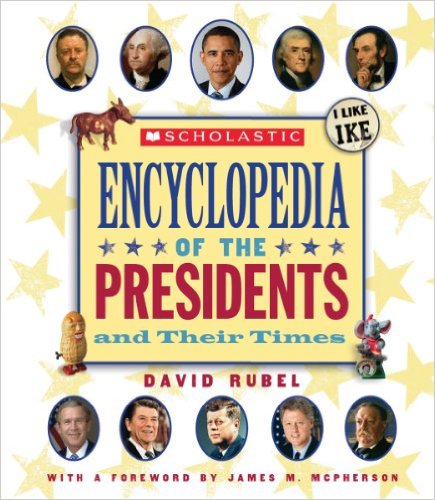
Scholastic provides the Encyclopedia of the Presidents and their Times, by David Rubel. The format offers a page for every year since 1789. This chronological history explains how the president in each year influenced or was impacted by the events that took place. A special section, “A History of the White House,” provides an extensive, well illustrated, story of the evolution of the executive mansion. Another interesting addition is the section on the “Presidential Election Results,” providing the distribution of the electoral vote (and where available the popular vote) for each of the candidates, from all of the political parties, who ran for the office. The Obamas are included.


The Big Book of Presidents by Nancy J. Hajeski provides “fascinating presidential trivia, including . . . little-known facts.” Did you know Millard Fillmore installed the first kitchen stove in the White House?  In addition to timelines and biographical facts about each president, the book contains many interesting special articles, such as: “The Houses of Congress” and “Assassinations.” Like all of the books described above, this volume is current through President Obama.


A fascinating, small book entitled Presidential Losers, by David J. Goldman, delves into controversial personages such as Aaron Burr, who assassinated Alexander Hamilton. In addition to several interesting one-time candidates, the book educates the reader on the persistent candidates who consistently lost. Henry Clay tried three times unsuccessfully, and William Jennings Bryan was another three-time failure.


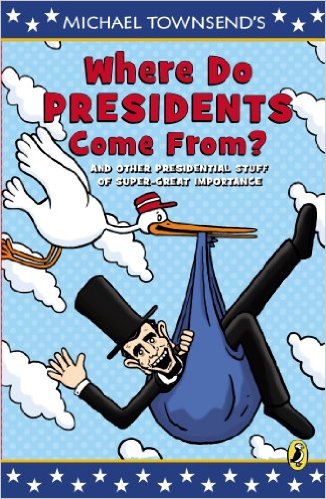
As the old cliché goes, last but not least, is Where Do Presidents Come From? And Other Presidential Stuff of Super-Great Importance, by Michael Townsend. Whereas I skimmed through many of the previously listed books, I read this one from cover to cover. Middle-grade readers will get a kick out of this comic book presentation. Heck, even I couldn’t put it down, and I haven’t been a middle-grader for almost seventy years. Townsend does not cover each president in detail, but provides an overall history of why the United States has a president and what his (that is still the correct pronoun at this writing) duties entail. One of the more fascinating chapters is “How Does a President Get Elected?” Included is a simple explanation of why we have an Electoral College. Naysayers from the losing political party consistently demand that the next election be decided by popular vote. These folks will learn why our founding fathers created this compromise protection for all of the states after reading this funny presentation. After all, we do not elect a president just for the overcrowded population centers.

Our country has just gone through what pundits today claim is an unprecedented election. Studying the history of our presidents and how they achieved this lofty position reveals many shenanigans and much gnashing of teeth by conflicting political parties over the years. When I was a middle-grade student we were required to memorize the names of the presidents. Perhaps not the most necessary of requirements, but at least we knew who they were and what they accomplished. Students today certainly should be taught the history of why we are a republic, why there are three branches of government, and why we select the important position of President the way we do.

In Bear Claws, The Iron Horse Chronicles--Book Two, I included scenes about the presidential campaign of Ulysses S. Grant in 1868 as he toured Wyoming on the first transcontinental railroad. The lives of the presidents have impacted all citizens since the nation's founding. It is right and proper that we know about them and honor them.

Thursday, September 1, 2016

History and the National Park Service

The National Park Service celebrated its 100th birthday on August 25, 2016. There are two ways to look at history and the NPS. First, there is the history of the founding of the NPS and the stories associated with the establishment of each of the parks, monuments, and sites. Second, there is the history of our country that the NPS preserves at its numerous historical sites.

The first officially designated National Park was Yellowstone, established in 1872. In the years immediately following its creation, civilian superintendents oversaw the protection of Yellowstone; but they lacked the resources to fend off poachers, souvenir hunters, and developers. In 1886, the US Army sent troops to provide muscle to the protective efforts. Today, the Army’s installation there is designated Fort Yellowstone National Historic Landmark and serves as headquarters for Yellowstone National Park. The army relinquished its responsibilities when President Woodrow Wilson signed the Organic Act on August 25, 1916, creating the National Park Service, a federal bureau in the Department of the Interior.

Theodore Roosevelt with John Muir
John Muir, a famous naturalist, was a staunch advocate of creating national parks at Yosemite, Sequoia, Grand Canyon, and Mt. Rainier. President Theodore Roosevelt toured Yosemite with Muir on a camping trip in 1903. Yosemite had been protected by the state of California since 1864 based upon a law signed by President Abraham Lincoln. It was Muir and Roosevelt, however, who worked with California Governor George Pardee to turn Yosemite into a national park in 1906. Theodore Roosevelt also signed the Antiquities Act of 1906, allowing the president to set aside "historic landmarks, historic and prehistoric structures, and other objects of historic or scientific interest" in order to stop their destruction. This act has led to the creation of more than fifty national monuments, and the act is being used even now by President Barack Obama. 

This website contains a complete listing of the facilities maintained by the National Park Service:https://en.wikipedia.org/wiki/List_of_areas_in_the_United_States_National_Park_System#National_Historical_Parks


Cavalry Barracks, Fort Laramie, Wyoming
This bring us to the second way of relating history to the NPS. As a writer of historical fiction, primarily oriented toward the middle grade reader, I have relied on personal visits to many NPS historic sites in my research travels. In The Iron Horse Chronicles, many of Will Braddock’s scenes occur at the military forts built to protect the railroad and its workers from attacks by the Indians. Fort Laramie National Historic Site in Wyoming provides the visitor with the ability to see how soldiers lived on the frontier during the time when the first transcontinental railroad was under construction. My frequent visits to Gettysburg National Military Park in Pennsylvania, though a long way from the frontier, gave me a better understanding of what it would have been like to be a soldier following the Civil War.

Union Pacific Engine #119
An important research site for The Iron Horse Chronicles is the Golden Spike National Historical Site in Utah. Here, the visitor witnesses replicas of two locomotives touch cowcatchers after the reenactment of the driving of the golden spike. To stand near one of these engines when they steam past puts the viewer right into the action—the imagination becomes real life. Walking the ground where history occurred at any such site is worthwhile for students, teachers, and writers.


Although calling it a "kid's" guide might be a turn-off for some middle grade students, the book National Parks: A Kid's Guide to America's Parks, Monuments, and Landmarks, by Erin McHugh, provides an excellent introduction for planning a family visit or school outing. The writing is listed on Amazon and Barnes & Noble as appropriate for ages 8 to 12, but the middle grade student can benefit from reading it. The book concentrates on the environmental parks, but it does include information for some historical sites. For the middle grade teacher, the National Park Service provides lesson plans and other aids at this site: https://www.nps.gov/teachers/index.htm

Pulitzer Prize winning novelist, environmentalist, historian, Wallace Stegner said: "National parks are the best idea we ever had."

Happy Birthday National Park Service!

Thursday, August 4, 2016

Authenticity versus Creativity

By Suzanne Morgan Williams

I have three projects “pending” in various stages of development. One is a fictionalized memoir. (yes, I finally said, “why not?” some of my life is pretty interesting and relevant.) One is contemporary research based fiction, and one – wait for it – is definitely historical fiction. The memoir is half done and resting. The contemporary has been out to a couple of editors and is waiting for revision. The historical is in that “hot writing” stage where, working from a very rough outline, I’m just writing to the end. I’ll see what I get.

But some interesting questions have come up as I work on the historical. It’s not only based on real people, but the plot is true too. That said, there’s precious little information about these people themselves. I’m totally creating their characters. As a writer, that’s good. It gives me flexibility and I’m quite capable of researching to make them believable, and fashioned to their times. This is historical fiction. But, they were real. There are documents about them and letters. So how much will my fiction influence any subsequent thoughts about these folks? Probably not much. But I’m thinking about it.

Maybe I should just change the names. But what I find fascinating is that the story, the plot, is real. Maybe I shouldn’t embellish the plot at all. It’s pretty good as it stands. But with a couple of other characters and some more confrontation the tension is better. With the addition of specific talents and traits that I’m assigning to them, the characters come alive. So I’m probably going to go for full out for historical fiction.

The manuscript will be true to its times. The setting, history, and some extent even the voices will be researched. But the characters – they are themselves. They will be molded from my ideas, my research, and good story. Is that wrong? Do I need to change the names? Can I manage with including an end note that explains what we know is true, what is probably true, and what I cooked up in service to the story?


For now, I’m writing the manuscript, but before I submit it for publication I have to answer these questions. Your thoughts?

Thursday, July 21, 2016

Buffalo Bill

Buffalo Bill served as an inspiration for the protagonist, Will Braddock, in The Iron Horse Chronicles. Both boys embarked on a life of their own at age fourteen. It has been said that the youth of the mid-nineteenth century grew up faster than those of today. Knowing the history of Buffalo Bill, I felt comfortable that the adventurous life into which I thrust Will Braddock at that age could actually happen. I also knew from personal experience that accepting responsibility at that age was possible, since I took my first job at age fourteen.

Born William Frederick Cody in 1846 in Iowa Territory, several months before it became a state, the future showman grew up on a frontier farm. When Bill was seven, his father, Isaac, was stabbed by a pro-slavery advocate during a rally when he spoke in support of abolition. Bill helped carry his father away, displaying early on his ability to act for himself. Bill’s father died in 1857 of pneumonia attributed to his earlier stabbing. From age ten, Bill worked to help support his mother and sisters. At fourteen, Bill became a Pony Express rider earning a reputation as one of the best. I wrote about the Pony Express on this website in a post entitled "Orphans Wanted" on May 26, 2016.

In The Iron Horse Chronicles, Will Braddock becomes a hunter for his uncle’s Union Pacific Railroad survey inspection team. At the same time Will is hunting antelope for a survey team of five working on the first transcontinental railroad in Wyoming, William Cody is hunting buffalo to feed hundreds of tracklayers for what would become the Kansas Pacific Railway. The Kansas Pacific, known until 1869 as the Union Pacific Eastern Division, had lost the race to the Union Pacific Railroad in 1866 to be the first railroad to lay track to the Hundredth Meridian and earn the right to build west to meet the Central Pacific Railroad, coming east out of California.

Cody earned the admiration of several Army officers for his marksmanship while hunting for the railroad, and it is believed they bestowed upon him the nickname of “Buffalo Bill.” Bill later served as a scout for the Army in its wars with the Native Americans. His efforts earned him a Medal of Honor in 1872. In a strange political maneuver, Congress revoked the medal in 1917 (along with 910 other recipients) when they retroactively tightened the rules. Since Bill had served as a civilian scout, and not a soldier, he was deemed ineligible. Seventy-two years after Cody died on January 10, 1917, Congress restored his medal.

Bill Cody would have known about the great hundredth meridian expedition organized by Thomas “Doc” Durant, the Union Pacific’s vice president and general manager, in October 1866. I wrote about what I consider to be “the first wild west show” on my own website’s blog on June 6, 2016. You can read that post by following this link:

Perhaps it was from the Union Pacific’s Grand Excursion to the Hundredth Meridian that Cody gained the inspiration for founding Buffalo Bill’s Wild West Show. This show became a huge success in the United States during his lifetime. Bill and his show also toured Europe repeatedly, and they played to Queen Victoria of Great Britain on three different occasions. 

Did Will Braddock and Bill Cody know one another in the late 1860s? It’s doubtful they met, but each was probably aware that the other was considered a top hunter by his respective railroad. In Bear Claws, The Iron Horse Chronicles—Book Two, Will Braddock guides a hunting expedition for a fictional German nobleman, much as Bill Cody did for a real-life Russian prince.


Eagle Talons, The Iron Horse Chronicles--Book One, received the Bronze Will Rogers Medallion Award in 2015 in the category of books for Younger Readers. Bear Claws has been selected as a finalist for the 2016 Will Rogers Medallion Award for Younger Readers.The winners will be announced at an awards ceremony in Fort Worth, Texas, on October 29, 2016. I plan to be there.

Thursday, July 7, 2016

Mythology as a Gateway to History, by Michele Hathaway

Large Blue Horses by Franz Marc (1880-1916), 1911.
(Public Domain in country of origin and areas where the
 copyright term is author's life plus 90  years or less.)
We usually begin history with the earliest known facts: geographical origins, language families, and artifacts such as tools, pottery, and structures. It's fascinating stuff, and I love it. But what if we enter history through the gateway of mythology?

If the goal is to understand a people group at their most central level, how they perceive their world and their place in it, mythology is a logical beginning.


Peter Iverson in Diné: A History of the Navajos writes
"Navajo history does not start in Alaska or northwestern Canada or along the Rocky Mountains or in the Great Basin. It does not transpire in isolation or in separation. It begins with Changing Woman, with the Hero Twins, with monsters, and with blue horses. It begins with the sacred mountains." 
Iverson is stating that Navajo mythology rather than the trickle of migratory groups is a natural starting point for Navajo history. I agree wholeheartedly. Although origins and prehistoric evidence of Navajo habitation is interesting, it is in mythology that the Navajo themselves identify their beginnings. Their mythology defines who they are and the world they inhabit. It makes sense of their world, expresses the complexities of life, and what it means to be Diné--The People.


Is Mythology Historical Fiction?


Mythology is not historical fiction, in part because it is so much more. However, I believe it may be the earliest form of the genre.

One of the essential defining characteristics of historical fiction is that it is true. It is true because it is an accurate retelling of a person or persons who lived or an event that occurred. Even if the characters are fictional, they are people who might have lived, and the story could have taken place in that time and context.

Mythology is populated with characters who previous generations believed to exist and current generations may still believe exist. It is rife with the super-natural and a universe where the impossible can and does happen.

So how can mythology be true?

Mythology reveals the world as the people understood it, and still may understand it. In this sense, mythology is true. Many cultures, for instance, express the danger and uncertainty of life in the context of their myths where humans are at the mercy of the capricious activities of their gods. For example, the Greek god Zeus could bestow favor or suddenly turn and cast a brother off Mt. Olympus, as the unfortunate Hephaestus found out. And no woman, mortal or immortal, wanted to get on the wrong side of Hera: Io, who spent the rest of her days as a cow, attests to that.


Mythology for Middle Grade


About now you may be thinking, Yes, Michele, but is this middle grade material? And I will answer Yes!  Myth is designed for the subconscious. At the middle-grade level we are not dissecting cultural constructs and looking for deep psychological structures. The beauty of mythology is that it can be digested by the young where it lies dormant for the years ahead when young adult and adult minds can rediscover it at a deeper level.

For now, parents and teachers can sow seeds while having a lot of fun. Although, there is no reason the analysis can't begin in middle grade with basic questions: Would you want Coyote as your friend? Would you have liked to be a god or mortal in Greek times? Why or why not?


Mythology is Not Going Away

The idea that myth is irrelevant to modern life has never been more false. Can any of us forget Wyle E. Coyote, after all? In numerous mythologies Coyote appears as a fool or a trickster who breaks and flaunts the rules. He gets away with things no one else can and teaches the importance of living within the established norms of the culture. On the other hand, the trickster Coyote although untrustworthy, is clever. And lets face it, we all admire that. 

In other mythologies, Coyote is powerful and dangerous. In the Marvel Universe, Loki is my favorite character: completely untrustworthy, but complex and irresistibly compelling. We want to believe him and he consistently disappoints us--which is, paradoxically, just what we want. The trickster is a reflection of our own humanity.

These are concepts that I believe upper middle-grade students can grasp. Of course, function is only a part of myth, so be sure to focus mainly on having fun, and think about entering history through this marvelous gateway.

Michele Hathaway is a writer and freelance editor. She has an M. A. in Social Anthropology and has worked in libraries in California, New Mexico, and Pennsylvania. She writes stories set in culturally diverse, historical and contemporary periods.


Subscribe to get posts automatically and never miss a post. You can use the Subscribe buttons to the right, or add http://madaboutmghistory.blogspot.com/ to Feedly or another reader.