Showing posts with label Story Settings. Show all posts

Friday, May 11, 2018

Place: The Life of Fiction


Place is the home I inhabit in a story until the last word shoves me back to a present reality. If I don't feel rooted in place, I am an itinerant soul. I don't stay long, never read that last word. 

Eurdora Welty once said, "Fiction, depends for its life on place.” If this is true for fiction, historical fiction isn't even conceived without place. Johnny Tremain needed Boston, Kit a Blackbird Pond, and the Watsons had to go to Birmingham. Anywhere else and they would have been different stories—or no story at all.


"Somehow it was hotter then: a black dog suffered on a summer's day; bony mules hitched to Hoover carts flicked flies in the sweltering shade of the live oaks on the square. Men's stiff collars wilted by nine in the morning. Ladies bathed before noon, after their three-o'clock naps, and by nightfall were like soft teacakes with frostings of sweat and sweet talcum." --Harper Lee, To Kill a Mockingbird.

Lee had me at "sweet talcum."

God is in the Details
Sometimes called the canvas of story, setting is broad and sweeping, but also filled with details--and great historical fiction balances the two. Cast Off by Eve Yohalem achieves this balance brilliantly.  Set in 1663, Cast Off is a high seas adventure about a stowaway Dutch girl and a mixed race boy. Yohalem did her research down to the nutmeg, weevil infested sea biscuits, and bloodletting medical remedies, which is only a fraction of a percent of her detail. The characters and plot are fantastic, but the details are what made me believe it.  

"...we all hate generalities, and so does place. Yet as soon as we step down from the general view to the close and particular, as writers must and readers may and teachers well know how to, and consider what good writing may be, place can be seen, in her own way, to have a great deal to do with that goodness, if not to be responsible for it." --Eudora Welty


Setting as a Character

Authors create a powerful ally when setting is a character in their story. Dickens' London is often cited as such a character--that Good Olde City with it's fog-choked alleys, counting houses, and Bob Cratchets. Place as a character sets and changes mood with daybreak or sunset, the onslaught of storm or the shell of a bombed out church. Crow's island and the ocean are characters in "Beyond the Bright Sea". Anchored to the earth on solid black rock, the island was home, prison, or trap depending on its mood.


Setting as Complication

Sometimes referred to as the Twister Effect, setting as complication fuels plots and entire stories. At the outset we suspect Eveningstar Macaw will end up in The Well of Sacrifice (written by Chris Eboch). This and other complications of setting move the story forward in exciting and nail-biting action .  Zane and the Hurricane required Hurricane Katrina for its life, but it is the predicaments of the aftermath which Zane and his new friends must overcome that make the story.

Setting as Theme is my favorite use of place. May B. by Caroline Starr Rose required an isolated dugout on the prairie for its birth. Rose used this external complication to symbolize an internal theme. Isolated by her dyslexia, May struggled with shame and a failure. By surviving and overcoming her physical isolation, she gained agency to believe in herself, to overcome her internal isolation.


The best stories are complicated layers woven of the threads of character, plot, setting, and the indefinable magic of the words themselves. No one element but all in orchestration make the best books. Yet all of the best books have a strong grounding in place.


Michele Hathaway is an author and freelance editor. She has an M. A. in Social Anthropology and has worked in libraries in California, New Mexico, and Pennsylvania. She writes middle-grade nonfiction and stories set in culturally diverse, historical periods.


Subscribe to get posts automatically and never miss a post. You can use the Subscribe or Follow by E-Mail buttons to the right, or add http://madaboutmghistory.blogspot.com/to Feedly or another reader.

Thursday, March 15, 2018

"Beyond the Bright Sea" : A review by Michele Hathaway


"My name is Crow.
When I was a baby, 
someone tucked me into an old boat
 and pushed me out to sea." --Lauren Wolk

The opening lines of Lauren Wolk's 2017 Scott O'Dell Award winner, Beyond the Bright Sea, offer promise and mystery that do not disappoint. Crow's assertion of her name pitches the entire story, forming a perfect bookend. First sentences don't get much better than this.

"I washed up on a tiny island
like a seed riding the tide."

Chapter by chapter questions wash up on the sands of our imagination:

  • What kind of name is "Crow"? Who is she?
  • Who would put a baby in a leaky, old boat and push it out to sea?
  • And Why?

Wikipedia Cuttyhunk Islands
(original Source: Bosley Wilder, Travel Editor,
The Block Island Times)
Crow's persistent quest to answer these questions lead her to the site of a former leper colony, into the path of a ruthless criminal, to buried pirate treasure, and to the brink of losing everything.


"The Island where we found each other was small but strong, anchored by a great pile of black rock that sheltered our cottage--a ramshackle place built from bits of lost ships--nestled on a bed of earth and sea muck, alongside a small garden and the skiff that took us wherever our feet could not."


Although set in 1925, Beyond the Bright Sea has a timeless quality.  Crow's quest and circumstance could be any when. The spare artifacts of life dovetail with the setting. Place, perhaps the most magical element of story, lends its power for symbol and emotional connection. Wolk's masterful use of place is lovely. She herself identifies the tiny island, part of the Elizabeth Islands of Massachusetts, as a character in her story.

This sense of place permeates the narrative to its deepest levels. Crow is doubly isolated, connected by a tenuous strip of sand at low tide to the larger island of Cuttyhunk, which in turn is separated from the mainland. More than this, she is socially isolated. Suspected of coming from the now abandoned leper colony on Penikese Island, Crow is treated as a pariah in her community. No one touches her or anything she has touched--ever--except Osh, her rescuer and guardian, and Miss Maggie, her only friend.


Breaking Nets

I think, like Crow, people can be complicit in the forces that shape them. Crow accepted the shunning of her island neighbors, but when she learned the truth about herself, she found the courage to test that shunning. She began to break the net enclosing her.

Beyond the Bright Sea offers children and adults a beautiful story where they can safely test the nets that bind them from discovering who they truly have always been and perhaps find what they never lost.


A Few More thoughts:

Diversity: We know that Crow's skin is darker than Osh's, but we never learn her ethnicity. This opens the door for a diverse audience to see themselves in Crow.

Loose threads?  We never learn Osh's given name or why he actively avoids recognition and his past. Miss Maggie is a mystery as well: How did she come to live on Cuttyhunk? Why is she alone? We don't need to know these things for the story to work. Rather, it is essential that we don't know because they steer us to the point of the story. For Osh, and eventually for Crow, what matters is not who or what they were but who they are now, in this time. And so it is for all of us. 

Thoughts for Parents, Teachers, and Librarians: 

Beyond the Bright Sea is a wonderful opportunity for cross-curriculum studies: Science--disease, marine biology, islands; Geography; Sociology--the nature of prejudice, the isolation of people with diseases; History--leprosy, immigration, orphanages; English--vocabulary, analogy, lyrical writing.


Michele Hathaway is an author and freelance editor. She has an M. A. in Social Anthropology and has worked in libraries in California, New Mexico, and Pennsylvania. She writes middle-grade nonfiction and stories set in culturally diverse, historical periods.


Subscribe to get posts automatically and never miss a post. You can use the Subscribe or Follow by E-Mail buttons to the right, or add http://madaboutmghistory.blogspot.com/to Feedly or another reader.

Thursday, June 29, 2017

BOOK A TRIP by Mary Louise Sanchez


Summertime is traditionally the time people like to travel. When I was younger, my family was inclined to travel close to home—usually someplace where we had relatives who would put us up for a few days or a week; and because we didn't have the financial means to travel far. When I got married, our travels still took us to places where we had family. In fact, I physically had never been east of Nebraska until I was in my 40s. Then, when our son and daughter-in-law moved to Philadelphia, we saw parts of the United States we had only read about. That was when the travel bug hit my husband and me hard.

But, I didn't realize I had really been bitten by the travel bug at a much younger age, as a young reader.  I was a good reader as a young child, but didn't have access to a large library. However, there were two books I read in third grade that greatly impacted my desire to explore the world beyond my small borders. One book was Heidi. In the story, I was transported to the Alp Mountains where Heidi traipsed the mountain side with the goats and the goat herder, Peter.

In the 1980s my husband and I got hooked watching Rick Steves and his European travel shows. We decided that we needed to travel beyond our borders and we even had some experience maneuvering subways by then.  What fun we had planning our month long trip to France, Switzerland, Italy, and Spain. When we got to Switzerland, we traveled to the Jungfrau region where my vision of the Heidi experience came alive. Although the mountains we saw were only 4,000 feet high (Colorado has many over 14,000 feet), they looked like mountains children draw with pointed peaks. I swear, the cows and goats stood lopsided on the sides of the mountains too—just as I had imagined the goats feeding on the mountain side in Heidi!

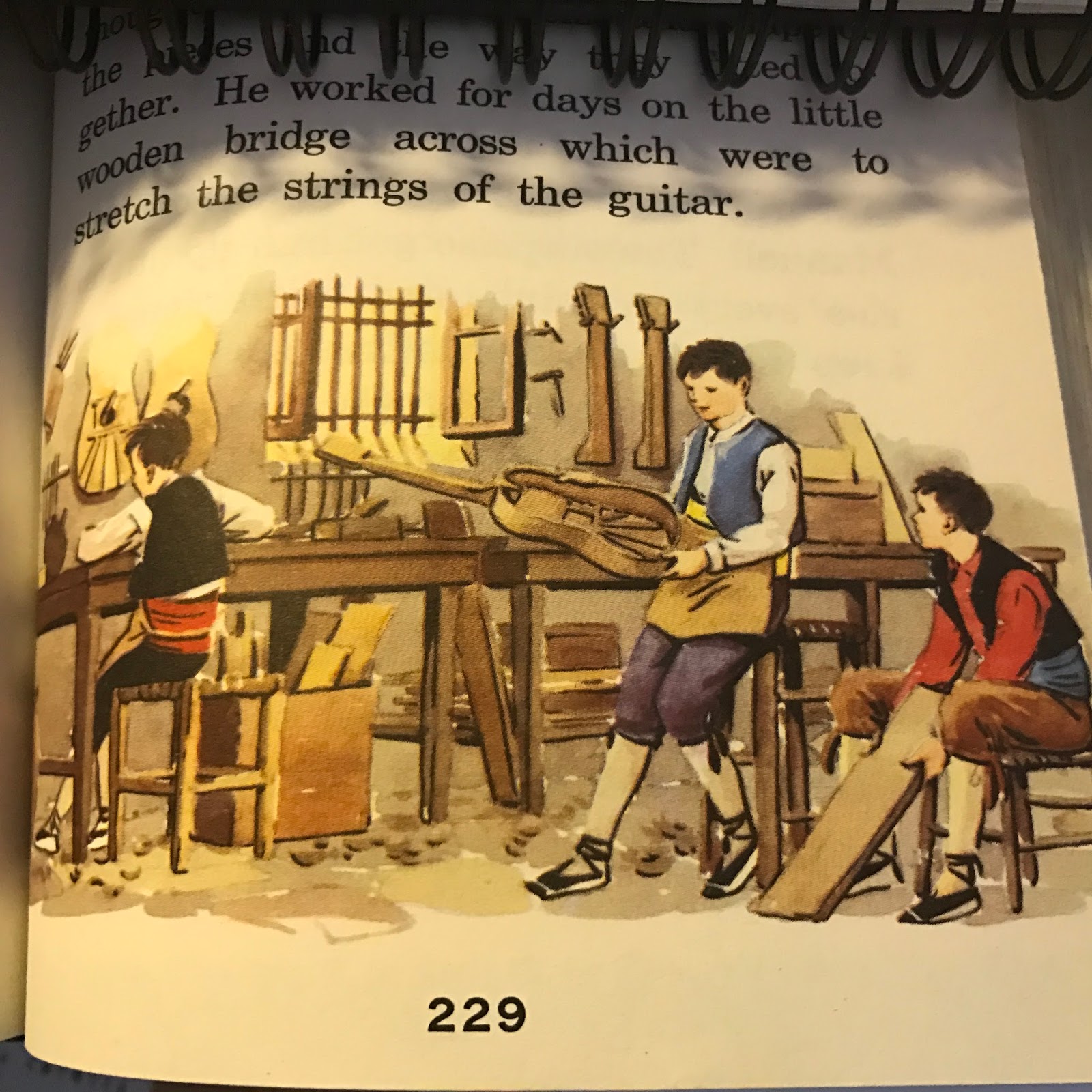
The other book that fed my travel bug in third grade was a Row, Peterson and Company  reader called If I Were Going. In the book, we readers followed Alice and Jerry's neighbors, the Sanders, as they traveled to Europe on a steam ship. One of their destinations was Spain where they roamed the narrow streets lined with white roofed houses and orange trees. Their child guide took the Sanders to a guitar shop.
When my husband and I were in Seville, we roamed the Jewish quarter where the roofs were white and we searched for and found a guitar shop, just like one Mr. and Mrs. Sanders may have visited on their trip to Spain.  Thankfully, vintage books are available for purchase on the internet and I can now venture around the world with Mr. and Mrs. Sanders just as I remember in third grade.

As a teacher/librarian in the elementary school, I developed family reading programs each year. One of those programs was called BOOK A TRIP. I introduced the program by showing the kids my own passport, my lightly packed suitcase, and books that inspired my visits to the various countries we had visited.

My clerk and I gathered fiction and non-fiction books from the library that dealt with countries around the world and made a database of them. We also put a dot with a symbol by the book barcodes so we could put the books in the appropriate continent bins when the books were checked in. Students who joined the program had laminated passports posted on the library wall, with the student's picture and a page for each continent. When the students met the requirements for each continent, they received a continent stamp on that page of the passport. Our culminating activity was a family celebration where we served desserts from around the world.

So many of our school children do not have  opportunities to venture beyond their own neighborhoods, let alone to see the world. We need to give them resources to look into lives and places different from their own.
We also need to show children where these places are in relationship to where the children live. I often introduced stories with a globe, showing the children where we lived and where we were going to in the story.  One could even flag countries with books that have that setting.

We never know the impact we have on students or the books that will touch their lives, so we need to passionate about inspiring our students to discover their world. When my husband and I travel now, we try to take a children's book with that country's setting to give to a local child. Granted, the book is in English, but I believe the child is excited is see their own country in a story.

Simple techniques, like I've presented, can open the world for children and promote peaceful co-existence. As Mark Twain said, "Travel is fatal to prejudice, bigotry, and narrow-mindedness, and many of our people need it sorely on these accounts. Broad, wholesome, charitable views of men and things cannot be acquired by vegetating in one little corner of the earth all one's lifetime."


What places in the world have you/or your students traveled to in a story? Where would you/they like to go? What story settings in the world would meet curricular needs?