Showing posts with label WWII. Show all posts

Wednesday, October 15, 2025

Back to School: #HistoricalFiction Resources for the Classroom. Download #CCSS #lessonplans for #MGLit #homeschool #teaching⁠ of #history

Now that kids (and teachers) are back in the classroom, check out these historical fiction resources for your classroom or home school use.

Share My Lesson has thousands of items under the Historical Fiction heading, including general lessons for reading/understanding/writing historical fiction, and lesson plans for specific books. You can find my lesson plans for The Well of Sacrifice (pre-Columbian Mayan times), The Eyes of Pharaoh, and The Genie's Gift here as well. As a bonus, each of these lessons is free! Or you can download my free lesson plans for my books on my website.
Student cartoons illustrating scenes from The Well of Sacrifice.
The Curriculum Corner website offers a download of Historical Fiction Resources. Some of these sound really interesting, with lessons on Comparing Fact and Fiction, Visualizing the Time Period, comparing books, comparing the past to today, and thinking about how characters in the story might present themselves in modern social media. The package also offers journal response pages, a comic strip template, book club celebration ideas, and much more.


Teachers Pay Teachers offers a variety of lesson plans when searching for historical fiction. Prices vary from free to over $20. You can get lesson plans I've provided for free, including the ones mentioned above (A CCSS-Aligned Guide for The Eyes of Pharaoh, my middle grade novel set in ancient Egypt; Projects for The Well of Sacrifice, and a Teaching Guide for The Genie's Gift, a middle grade historical fantasy set in the time of the Ottoman Empire).

Teacher Vision has over a hundred items tagged as Historical Fiction, including many book discussion guides.

If you are interested in getting classroom sets of The Well of Sacrifice, The Eyes of Pharaoh or The Genie's Gift at a discount, contact me.

Chris Eboch is the author of over 100 books for children, including nonfiction and fiction, early reader through teen. Her novels for ages nine and up include The Eyes of Pharaoh, a mystery in ancient Egypt; The Well of Sacrifice, a Mayan adventure; The Genie’s Gift, a middle eastern fantasy; and the Haunted series, about kids who travel with a ghost hunter TV show, which starts with The Ghost on the Stairs. 

Chris's writing craft books include You Can Write for Children: How to Write Great Stories, Articles, and Books for Kids and Teenagers, and Advanced Plotting.

Thursday, July 5, 2018

Ranging Through Time with Kate Messner's Time Traveling Rescue Dog


Need a stack of books to sustain your 2nd to 4th graders (and up!) on a road trip this summer? Look no further. The Ranger in Time series will eat up the miles. Why someone hasn't written about a time-travelling rescue dog before now is a mystery, but perhaps Ranger was waiting for Kate Messner to show up, and for Kelley McMorris to capture him in her winsome illustrations.


Squirrel Problems

Ranger is the best rescue dog on the planet. He just has one small problem--squirrels! Chasing one of the fluffy-tailed critters during his rescue test cost him his certification. But Ranger doesn't need paperwork to travel through time, find the lost, save lives, or hope for bacon. He returns home from each mission satisfied with a job well done and a small memento, reminders of the people he's met.


Corners of History


Ranger ends up in often overlooked corners of history.  Messner firmly sets her narrative in these corners without overwhelming young readers with facts. For example, Ranger in Time: Danger in Ancient Rome, leads us beneath the Roman Coliseum, with its wild lions, elaborate stage machinery, and tunnel to the Ludus Magnus gladiatorial school.

In Long Road to Freedom we learn about the Fugitive Slave Act of 1850 in the United States and it's devastating consequences for escaped slaves, and the abolitionists who tried to help them. Journey Through Ash and Smoke takes us to 934 A.D. and Viking Iceland where, rather than raiding, we see Viking families settling in a new land--a land of unexpected volcanic eruptions.

Inquiring minds can find many more fascinating facts in the end notes of all the books as well as personal photos from Messner's travels and her first hand observations.


Shadow and Light

History is a messy place full of shadow and light, hard edges and beautiful sunsets. Messner presents readers with fictional protagonists in true stories that include the shadows, but are still accessible to young readers.


For example, Race to the South Pole follows the fictional Jack Nin, a boy of Chinese and Maori descent from New Zealand who stows away on the fateful Scott Expedition to the South Pole. Although a few men survived the expedition, most did not, as well as all the ponies and some sled dogs. Hard truths well told.


Tid Bits:

It's the small concrete details that win me over in any story. Here's one from the Oregon Trail:

"The Fergusons had something called a roadometer attached to their wagon. It used cogs and gears to record the number of times the wagon wheels went around, and then turned that number to miles."

Who knew?!


Home
"Imagine saying good-bye to your house, almost all of your friends and extended family, and most of your possessions. Imagine leaving everything you know to begin a long, long journey to a new home in a place you've never seen." --Ranger in Time: Rescue on the Oregon Trail 

The theme of home runs through the series. Each child Ranger encounters in his time travels is on a journey toward home in some way, whether they are pioneer children, Roman or American slaves, or a viking daughter. Jack Nin journeys to the South Pole looking for adventure and glory only to discover home is the only place he wants to be.

"Ranger stood in the mud and looked up, too. It felt like something should happen. He'd rescued Pa. Would Luke come and take him home now? But when he heard the words 'Good job,' it was Sam's voice--not Luke's."

Home is a theme for Ranger, too. After a job well done of finding and rescuing, Ranger longs to return home to his boy, Luke. Eventually, he does, of course. Yet, each time the call for help comes Ranger answers without hesitation.

Eight Books and Counting!

The Ranger in Time series is eight books strong and counting. The series covers these topics:

1. Oregon Trail, 1850
2. Ancient Rome: Gladiators
3.The Underground Railroad
4. The Scot South Pole Expedition
5. Vikings in Iceland
6. San Francisco Earthquake
7. D-day
8. Hurricane Katrina
9. The Titanic (forthcoming Jan. 2019!)

Ranger in Time has appeal for both boys and girls. I highly recommend them for reluctant readers and agree with others that they are a next step for anyone who has devoured The Magic Tree House series.


Michele Hathaway is an author and freelance editor. She has an M. A. in Social Anthropology and has worked in libraries in California, New Mexico, and Pennsylvania. She writes middle-grade nonfiction and stories set in culturally diverse, historical periods.


Subscribe to get posts automatically and never miss a post. You can use the Subscribe or Follow by E-Mail buttons to the right, or add http://madaboutmghistory.blogspot.com/to Feedly or another reader.

Wednesday, March 21, 2018

Sara K Joiner: Youth Activists Leading Change

With the student walkouts for gun control reform last week and the upcoming March for Our Lives, I've been thinking about how social movements often begin with children and young people. There are a number of fiction and nonfiction books that show the world as it was, and how children and young people agitated for change.

Civil Rights Movement
Fiction
  • A Thousand Never Evers - Shana Burg
    As the civil rights movement in the South gains momentum in 1963--and violence against African Americans intensifies--the black residents, including seventh-grader Addie Ann Pickett, in the small town of Kuckachoo, Mississippi, begin their own courageous struggle for racial justice.
  • Let the Children March - Monica Clark-Robinson
    Under the leadership of Dr. Martin Luther King, children and teenagers march against segregation in Birmingham, Alabama, in 1963.
  • Just Like Martin - Ossie Davis
    Following the deaths of two classmates in a bomb explosion at his Alabama church, fourteen-year-old Stone organizes a children's march for civil rights in the autumn of 1963.
  • The Rock and the River - Kekla Magoon
    In 1968 Chicago, fourteen-year-old Sam Childs is caught in a conflict between his father's nonviolent approach to seeking civil rights for African Americans and his older brother, who has joined the Black Panther Party.
Nonfiction
  • March Forward, Girl: From Young Warrior to Little Rock Nine - Melba Pattillo Beals
    A member of the Little Rock Nine shares her memories of growing up in the South under Jim Crow.
  • Through My Eyes - Ruby Bridges
    The autobiographical story of Bridges' involvement, as a six-year-old, in the integration of her school in New Orleans in 1960. 
  • Claudette Colvin: Twice Toward Justice - Phillip Hoose
    Presents the life of the Alabama teenager who played an integral role in the Montgomery bus strike, once by refusing to give up a bus seat, and again, by becoming a plaintiff in the landmark civil rights case against the bus company.
  • We've Got a Job: The 1963 Birmingham Children's March - Cynthia Levinson
    Discusses the events when more than 4,000 African American students marched and were jailed to secure their freedom in May 1963.
  • The Youngest Marcher: The Story of Audrey Faye Hendricks, a Young Civil Rights Activist - Cynthia Levinson
    A picture book biography of the life of nine-year-old Hendricks who became the youngest known child to be arrested for picketing against Birmingham segregation practices in 1963. 
  • The March Trilogy - John Lewis
    This graphic novel series is Congressman John Lewis' first-hand account of his lifelong struggle for civil and human rights, meditating in the modern age on the distance traveled since the days of Jim Crow and segregation.
  • Today the World Is Watching You: The Little Rock Nine and the Fight for School Integration, 1957 - Kekla Magoon
    On September 4, 1957, nine African American teenagers made their way toward Central High School in Little Rock, Arkansas. Armed soldiers of the Arkansas National Guard blocked most of them at the edge of campus. The three students who did make it onto campus faced an angry mob of white citizens who spit at them and shouted ugly racial slurs.
Girl's Right to Education 
Fiction
  • The Breadwinner - Deborah Ellis
    Eleven-year-old Parvana lives with her family in one room of a bombed-out apartment building in Kabul, Afghanistan's capital city. Parvana's father, a history teacher until his school was bombed and his health destroyed, works from a blanket on the ground in the marketplace, reading letters for people who cannot read or write. One day, he is arrested for the crime of having a foreign education, and the family is left without someone who can earn money or even shop for food.
Nonfiction
  • Dear Malala, We Stand With You - Rosemary McCarney with Plan International
    Captures the impact Malala has had on girls from all walks of life. In powerfully simple language and stunning photographs, the struggles from poverty and violence faced by girls everywhere become a catalyst for change.
  • I Am Malala: How One Girl Stood Up for Education and Changed the World - Malala Yousafzai with Patricia McCormick
    Raised in a once-peaceful area of Pakistan transformed by terrorism, Malala was taught to stand up for what she believes. So she fought for her right to be educated. And on October 9, 2012, she nearly lost her life for the cause: She was shot point-blank while riding the bus on her way home from school.
  • Malala's Magic Pencil - Malala Yousafzai
    As a child in Pakistan, Malala made a wish for a magic pencil. She would use it to make everyone happy, to erase the smell of garbage from her city, to sleep an extra hour in the morning. But as she grew older, Malala saw that there were more important things to wish for.
Workers' Rights 
Fiction
  • Iqbal - Francesco D'Adamo
    A fictionalized account of the Pakistani child who escaped from bondage in a carpet factory and went on to help liberate other children like him before being gunned down at the age of thirteen.
  • On Our Way to Oyster Bay: Mother Jones and Her March for Children's Rights - Monica Kulling
    Though eight-year-old Aidan and his friend Gussie want to go to school, like many other children in 1903, they work twelve hours, six days a week, at a cotton mill in Pennsylvania instead. So when the millworkers decide to go on strike, the two friends join the picket line. Maybe now life will change for them.
Nonfiction
  • Kids on Strike! - Susan Campbell Bartoletti
    Describes the conditions and treatment that drove workers, including many children, to various strikes, from the mill workers strikes in 1828 and 1836 and the coal strikes at the turn of the century to the work of Mother Jones on behalf of child workers.
  • Kid Blink Beats The World - Don Brown
    A story of the newsboys (and girls) who took on the world's most powerful press barons--and won.
  • Iqbal Masih and the Crusaders Against Child Slavery - Susan Kuklin
    An account of the former Pakistani child labor activist whose life and unexplained murder has brought the evil of child bondage to the attention of the world.
Social movements, alone, aren't the only place where children try to make lasting change. Some turn into activists and fighters when they see truly horrible situations arise and cannot remain silent.

Fiction 
  • Aluta - Adwoa Badoe
    For eighteen-year-old Charlotte, university life is better than she'd ever dreamed, a sophisticated and generous roommate, the camaraderie of dorm living, parties, clubs and boyfriends. Most of all, Charlotte is exposed to new ideas, and in 1981 Ghana, this may be the most exciting and most dangerous adventure of all. 
  • Finding Zasha - Randi Barrow
    Twelve-year-old Ivan has escaped from the siege of Leningrad, but when the town he has taken refuge in is occupied by Hitler's troops, he sees his chance to help the partisans he has met--and to rescue two German shepherd puppies, Zasha and Thor, from the cruel Commander Recht. 
  • Ahimsa - Supriya Kelkar
    Gandhi asks for one member of each family to join the fight for independence from the British, and when ten-year-old Anjali's mother is jailed for doing so, Anjali must step out of her comfort zone to take over her mother's work. 
  • Kiss the Dust - Elizabeth Laird
    Her father's involvement with the Kurdish resistance movement in Iraq forces thirteen-year-old Tara to flee with her family over the border into Iran, where they face an unknown future.
  • Number the Stars - Lois Lowry
    In 1943, during the German occupation of Denmark, ten-year-old Annemarie learns how to be brave and courageous when she helps shelter her Jewish friend from the Nazis.
  • The Bicycle Spy - Yona Zeldis McDonough
    Twelve-year-old Marcel loves riding his bicycle, and dreams of competing in the Tour de France, but it is 1942 and German soldiers are everywhere, stopping him as he delivers bread from his parents' bakery around Aucoin--then one day he discovers that it is not just bread he is delivering, and suddenly he finds himself in position of dangerous secrets about his parents and his new friend from Paris, Delphine.
  • When My Name Was Keoko - Linda Sue Park
    With national pride and occasional fear, a brother and sister face the increasingly oppressive occupation of Korea by Japan during World War II, which threatens to suppress Korean culture entirely.
  • Shadow On the Mountain - Margi Preus
    In Nazi-occupied Norway, fourteen-year-old Espen joins the resistance movement, graduating from deliverer of illegal newspapers to courier and spy.
  • When Morning Comes - Arushi Raina
    Zanele is skipping school and secretly plotting against the apartheid government. The police can't know. Her mother and sister can't know. Her best friend Thabo, schoolboy turned gang member, can tell she's up to something. Across the bridge, in the wealthy white suburbs, Jack plans to spend his last days in Johannesburg burning miles on his beat-up Mustang--until he meets a girl with an unforgettable face from the simmering black township--Soweto. Working in her father's shop, Meena finds a packet of banned pamphlets. A series of chance meetings changes everything. A chain of events is set in motion. And the students will rise. 
  • The War Within These Walls - Aline Sax 
    Misha and his family do their best to survive in the appalling conditions of the Warsaw ghetto during World War II, and ultimately make a final, desperate stand against the Nazis. 
  • The Fall of the Red Star - Helen M. Szablya
    Fourteen-year-old Stephen takes up arms and joins the resistance in this novel of the Hungarian Revolution.
Nonfiction
  • Hans and Sophie Scholl: German Resisters of the White Rose - Toby Axelrod
    Profiles the brother and sister who founded White Rose, a student group at Munich's Ludwig-Maximilians University which attempted to build resistance against Hitler through anti-Nazi leaflets and graffiti.
  • The Boys Who Challenged Hitler: Knud Pederson and the Churchill Club - Phillip Hoose
    At the outset of World War II, Denmark did not resist German occupation. Deeply ashamed of his nation's leaders, fifteen-year-old Knud Pedersen resolved with his brother and a handful of schoolmates to take action against the Nazis if the adults would not.
  • We Will Not Be Silent: The White Rose Student Resistance Movement That Defied Hitler - Russell Freedman
    The true story of the White Rose, a group of students in Nazi Germany who were active undercover agents of the resistance movement against Hitler and his regime.
  • Who Will Shout If Not Us? Student Activists and the Tiananmen Square Protest, China, 1989 - Ann Kerns
    In the spring of 1989, university students in Beijing grabbed world headlines with a courageous stand against decades of Communist authoritarian rule in China. Thousands and then millions of students and workers from all over China gathered on the city's Tiananmen Square to support demands for democracy, clean government, and increased personal freedoms.
But activism also doesn't have to mean great upheaval. It can be as simple as trying to encourage yourself and others to think about the life you want to have in the community in which you live.

Fiction
  • Edwina Victorious - Susan Bonners
    Edwina follows in the footsteps of her namesake great-aunt when she begins to write letters to the mayor about community problems and poses as Edwina the elder.
  • Steinbeck's Ghost - Lewis Buzbee
    Unhappy after his parents move to a weird subdivision and become workaholics, thirteen-year-old Travis returns to his old Salinas neighborhood and becomes actively involved in saving the John Steinbeck Library.
  • Imogene's Last Stand - Candace Fleming
    Enamored of history, young Imogene Tripp tries to save her town's historical society from being demolished in order to build a shoelace factory.
  • Going Going - Naomi Shihab Nye
    In San Antonio, Texas, sixteen-year-old Florrie leads her friends and a new boyfriend in a campaign which supports small businesses and protests the effects of chain stores.
Nonfiction
  • Teenage Rebels: Successful High School Activists, from the Little Rock 9 to the Class of Tomorrow - Dawson Barrett
    Provides a glimpse into the laws, policies, and political struggles that have shaped the lives of American high school students over the last one hundred years.
  • Marley Dias Gets It Done and So Can You! - Marley Dias with Siobhan McGowan
    Drawing from her experience, Marley shows kids how they can galvanize their strengths to make positive changes in their communities, while getting support from parents, teachers, and friends to turn dreams into reality.
  • Activism: The Ultimate Teen Guide - Kathlyn Gay
    Gay
    explains why people become activists, the types of causes they advocate or oppose, and how teenagers can get involved.
  • Luna and Me: The True Story of a Girl Who Lived in a Tree to Save a Forest - Jenny Sue Kostecki-Shaw
    Social activism combines with environmentalism in this picture book bio of Julia Butterfly Hill and Luna, the thousand-year-old redwood tree whose life she saved.
  • Political Activism: How You Can Make a Difference - Heather E. Schwartz
    Describes what political activism is and serves as a guide explaining how youth can make a change in their world.
The changes these children and young people sought to make are still being felt around the world. In some places, these changes are slower to arrive. In other places, these changes have paved the way for even more changes to move society toward a more just and stable place.

As we can see throughout history, there will be setbacks and obstacles, but change will come.

Sara K Joiner is the author of After the Ashes. She is also a public librarian.

Thursday, January 25, 2018

Sara K Joiner: A Review of "Victor Dowd and the World War II Ghost Army"

Last year I reviewed the first book in the Spy on History series. The second book is now available, and it features more opportunities for readers to find clues hidden throughout the text and illustrations.

Victor Dowd and the World War II Ghost Army tells the fascinating story of the Twenty-Third Headquarters Special Troops, also known as the Ghost Army. The troops were a special unit of about a thousand men specially selected for their skills. They were artists, sonic engineers, meteorologists, and radio operators. Most of them were not trained in combat.

What on earth were a group of non-combat-prepared men doing in the Army in the middle of Europe during World War II?

They were a deception unit. Their job was to make the Germans believe specific Army divisions were in one location when that division was actually somewhere else entirely.

Armed with rubber tanks and artillery, lots of sound recordings, fake radio transmissions, cans of paint, and very few real weapons, they helped the Allies battle their way across France and Luxembourg and into Germany. Along the way, they took part in the Battle of the Bulge by "filling in" gaps in the military lines by pretending to be entire other units.

Their greatest success came in March of 1945. The Ghost Army--a group of about a thousand men--had to pretend they were two divisions of the Ninth Army--about 30,000 men. Dwight Eisenhower was hoping to convince the Germans that the Allies were planning to invade Germany ten miles south of the true invasion point.

Once the Allies crossed the Rhine and invaded Germany, they discovered documents indicating the Germans believed Allied troops were massing exactly where the Ghost Army was.

Using the included spy tools--red acetate, vellum, cipher wheel, and Morse code--readers decode clues throughout the story to find Victor's sketchbook.

Although the information about the Ghost Army is fascinating and suspenseful, the story is short on characterization. Reluctant readers might not mind as the Ghost Army moves from one mission to the next, but I wanted a bit more detail about Victor.

The book gives teachers opportunity to discuss camouflage and how that's a benefit or a detriment. There's also brief discussion of minor details about daily life that people don't often think about. The Ghost Army had to convince the Germans they were someone they weren't. An Army isn't just vehicles and artillery and people. It's also the daily lives of those people--hanging laundry, getting water, leaving trash. It's a chance to discuss those tiny details with students.

Like the previous title in the series, this won't necessarily hold up to heavy library or classroom use because of the spy tools. If any of those are lost, you will have a hard time solving the puzzle without skipping to the end.

Having read the previous book in the series, I was more familiar with how the clues worked in this one, so I was able to spot more of them without using the answers at the back. I still missed some though!

This series is a fun way to introduce readers to codes and codebreaking without making it too difficult. Even readers who have cracked a few codes in their time will enjoy one more opportunity to spin a cipher wheel and work out a message. Maybe they'll even be inspired to create their own!

Victor Dowd and the World War II Ghost Army is written by Enigma Alberti and illustrated by Scott Wegener. It is the second of Workman's Spy On History series. The next book in the series, Anna Strong and the Revolutionary War Culpepper Ring, is scheduled for publication in January 2019.
Workman Publishing supplied a free copy of the book for review purposes.

Sara K Joiner is the author of After the Ashes. She is also a public librarian.

Thursday, December 7, 2017

December 7—A Day That Will Live in Infamy

Today, December 7th, is Pearl Harbor Day. On this date in 1941 Japan attacked the United States Navy fleet lying at anchor in Pearl Harbor, Hawaii. President Franklin D. Roosevelt went to the Congress the day after the attack to ask for a declaration of war. In his remarks to the members of Congress he called December 7 “a day that will live in infamy.” Congress passed the resolution of war, and three days later Germany and Italy (Japan’s axis partners) declared war against the United States. After years of isolationism, America fully committed itself to participate in World War II.

This largest of world wars deserves the study and understanding by all citizens of a free world. The war had a significant personal influence on my life as a young boy, and its aftermath impacted my military service and civilian employment as I matured.

The Bombing of Pearl Harbor by John F. Wukovits is a book in the World History Series published by Lucent Books. The author, a retired junior high school teacher, knows how to write for younger readers. Wukovits explains the menace facing peace-loving people before the United States entered World War II. Throughout the 1930s, the majority of Americans strongly believed in isolation. They wanted nothing to do with the warfare that Japan, Germany, and Italy were inflicting on their enemies. The book tells how President Franklin D. Roosevelt worked to prepare America for war while appeasing those who opposed him. The book explains why Japan decided to start the war with America and the impact of that choice upon the Japanese people. Photographs provide vivid illustrations of the destruction of the fleet at Pearl Harbor and of airplanes on nearby airfields. Wukovits builds his agonizing story from both primary and secondary sources. He concludes by discussing the effort required following the attack to rebuild the Navy and how the sneak attack changed the attitude of Americans overnight.

World War II in the Pacific by Don Nardo is another book in the World History Series by Lucent Books. The author, having written over 200 books, is recognized as a leader in producing history lessons for younger readers. He contrasts the cultures of the United States and Japan, and delves into the transformation of Japan into a world power. Nardo writes vividly about the attack on Pearl Harbor. Excellent maps enhance the reader’s understanding of how the Japanese pulled off the surprise. He explains the defeat of the Americans in the Philippines, and discusses the horrors of the Bataan Death March. Twenty-two thousand Americans died on the march. My first grade teacher’s husband was one of the few survivors of the Japanese atrocities committed against their prisoners in the Philippines. Nardo appropriately documents the turning point in the Pacific War as the Battle of Midway, when the United States reestablished its supremacy of the seas. The American aircraft carrier USS Yorktown was sunk during that battle. An uncle of mine was one of the survivors of that sinking. Nardo discusses the development of the nuclear bomb and explains why President Harry S. Truman dropped two bombs on Japan. The author concludes by explaining how this horrible event caused the Japanese to surrender.

Kamikazes by Earle Rice, Jr., is a title in Lucent Books’ The American War Library Series. The Japanese high command created the Kamikaze Special Attack Corps late in the war. Rice explains how Emperor Hirohito approved the use of this suicide weapon after determining the war was not going well for his country. Kamikaze means “divine wind” and carries strong religious overtones. The sacrifice of one pilot and one airplane in exchange for sinking one American warship became an acceptable way to die for one’s country. The Japanese Army already had a reputation for seldom surrendering. Japanese soldiers died in banzai charges against the Allied troops confronting them in the Pacific. The author explains how the Japanese warrior had traditionally committed honorable death through seppuku. Disemboweling oneself with a sword, known in the vernacular as hara-kiri, had been the preferred way for warriors to die since the days of the samurai. The book is well illustrated with the destructive actions the Kamikazes inflicted on the American fleet. Today’s younger reader is aware of the suicide bombings committed by radical Islamic terrorists. This book confirms that such a way of attacking an enemy is not new.

Yet another book in the World History Series by Lucent Books is The Making of the Atom Bomb by Victoria Sherrow. The author begins by explaining what led to World War II and how it generated an arms race that resulted in the United States developing the atomic bomb. She provides a section on the science of nuclear physics and the roles played by such famous men as Albert Einstein and Enrico Fermi. She writes about the secretive Manhattan Project under the supervision of Robert Oppenheimer, known as the “Father of the Atomic Bomb.” To test this unproven weapon, the Army detonated the first atomic bomb near Alamogordo, a town in central New Mexico. I had recently completed the second grade in Hobbs, New Mexico, when on that July 16, 1945, morning, the first bomb was exploded at 5:30 AM. Those in my town who were awake at that time described an unusually bright light appearing in the sky 200 miles to the west. Ms. Sherrow covers the planning and execution of dropping the first bomb by the aircrew of the B-29, Enola Gay. She delves at some length into the horrific death and destruction to Japan caused by the event. After a second bomb fell on Japan, the country surrendered, and the war in the Pacific concluded. Ms. Sherrow ends her book with a discussion of what might happen to the world if atomic weapons’ development continues. The concerns she identifies impacted me when I served as an Army officer during the Cold War. In the decades following World War II, the threat of nuclear war between the United States and the Soviet Union resulted in me being stationed in Europe when the Berlin Wall was erected. Later, I was stationed on Johnston Atoll in the Pacific Ocean as part of the U.S. National Nuclear Test Readiness Program. Since then, several nations have acquired the atomic bomb. The question of further nuclear proliferation is pertinent today because of the ongoing disagreement between the United States and North Korea over their desires to possess nuclear weapons.

World War II—Pacific by Barbara Williams is part of Lerner Publications’ America’s Wars Series. This book summarizes the entirety of World War II in the Pacific. Excellent maps allow the reader to follow the war from the attack on Pearl Harbor in 1941 through the Battle of Okinawa in 1945. The author covers each of the major battles through the intervening years. She provides information on the soldiers and sailors as well as the ships, aircraft, and armaments they used to wage war. A brother-in-law of mine served as a bomber pilot in the battles fought in the South Pacific. Ms. Williams also describes the effort required on the home front to support the war. She includes a short section on the unfortunate Japanese-American internment camps where thousands of men, women, and children were incarcerated in the United States during the conflict. The author writes about the special effort American women provided during the war. Williams’ book includes a timeline of the significant battles and events comprising the Pacific war. Although shorter than the other titles reviewed here, Williams’ book provides the younger reader an easily understood account of the entire war in the Pacific.

Today, December 7, is a good day for middle-grade students to commence or continue their study of World War II. They live in a world created by the results of that mammoth conflict.

Thursday, April 13, 2017

Immigration: Always in the News

To say that Immigration is in the news these days is an understatement. The truth is, people have been moving around the planet since the first humans ventured out of Africa. What causes people to leave the comforts of home? Adventure lures some, economic gain attracts others. but the inciting incidents that move masses of people are usually due to famine, persecution, and war. It's no surprise then that much historical fiction centers on immigration stories. Here are a few I've discovered recently.


Last year, I reviewed several Irish historical fiction stories including the Nory Ryan series by award winning Patricia Reilly Giff. Maggie's Door, the second in the series, follows Nory as she journeys to America in the wake of The Hunger--the terrible potato famine of 1845-1847.Wrenching, yet inspiring, Nory overcomes tremendous odds to bring herself and her little brother across an ocean to find her remaining family.


Streets of Gold, by the beloved children's book author Rosemary Wells and beautifully illustrated by Dan Andreason, is a retelling for children of Mary Antin's memoir The Promised Land. Due to increasing persecution, a Jewish family emigrates from Russia at the turn of the century.

As with Maggie's Door, the father leaves first to establish a job and home before sending for the family. This struck me as a key dynamic I had not understood before. Immigration stories are very much about the courage of those left behind and the complication of making the journey without a father.

When the family arrives in America, they discover the streets are not paved with gold, of course. But they are safe. They are together, again.


Journey to America by Sonia Levitin is another Jewish immigration story, which takes place on the
eve of WWII. Again, the father precedes the family to America leaving his wife and three daughters to escape Germany when the time is right.

This story opened portrays the flight of many people into Switzerland before WWII, the difficulties children faced there, and the overwhelming situation for the Swiss in dealing with the flood of refugees. Some children were exploited while other Swiss generously took children into their own homes, although this further separated children from their families. It was often months before refugees could obtain an exit visa, if they could obtain one at all. Levitin also shows how each child may cope differently with upheaval in their lives.


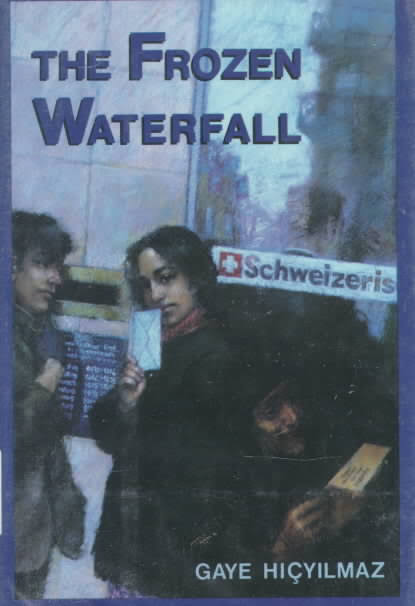
The Frozen Waterfall by Gaye Hiçyılmaz is a more contemporary immigration story, but I add it here because it is a rare find--a Turkish family that immigrates to Switzerland for economic reasons.

Twelve-year old Selda has trouble adjusting to life in Switzerland, but her friendship with a Turkish boy who is an illegal immigrant leads to the realization that life can not only be difficult, it can be dangerous. This book is for upper middle-grade and high school. It is also quite long, and the writing is fair, but for me, it was worth the effort to gain a valuable perspective, and to understand more intimately the hardships of immigration on not only children but also parents.


I hope these books will inspire you to find more immigration literature and share it with the children in your lives. Please share any of your favorites with me!


Michele Hathaway is a writer and freelance editor. She has an M. A. in Social Anthropology and has worked in libraries in California, New Mexico, and Pennsylvania. She writes stories set in culturally diverse, historical and contemporary periods.

Subscribe to get posts automatically and never miss a post. You can use the Subscribe or Follow by E-Mail buttons to the right, or add http://madaboutmghistory.blogspot.com/to Feedly or another reader. 


Thursday, January 26, 2017

Dogs At War


Throughout history when men have gone to war, so have their dogs.  The first story here, War Dog, by Henry Treece (1911-66), is a stirring tale set in south-eastern Britain, A.D. 43. 
Bran was a black, rough-haired pup who was entrusted to Gwyn, son of the Catavellauni king’s hound keeper, to rear and train as a war-dog.  When old enough, he was taken to the blacksmith and fitted with the broad bronze collar that would protect his vulnerable throat in confrontations with wild animals. Once Bran had sufficiently honed his attack skills against wolves, he was tested against a different foe – a Silurian prisoner.  Though unused to fighting a man and at first bewildered, Bran won this fight. Now he was ready for war, and his bronze collar was overlaid with a massive spiked collar.
In AD43, Claudius launched an invasion of Britain. Bran accompanied Gwyn and his master, Caratacus, King of the Catavellauni, to war against the Roman invaders.  Though the Catavellauni fought bravely, their chariots and stallions were no match for the great number of heavily armoured Romans and their elephants.  At the battle’s end, Caratacus was led off prisoner, Gwyn lay dead on the field, and Bran was beaten unconscious and left for dead as he lay over Gwyn’s body.
He did not die, however; there were more adventures for Bran before his journey’s end, in Rome, far away from south eastern Britain. 
While Henry Treece does not gloss over the hardships, cruelties and uncertainties of the time, he reminds us that the Ancient Britons were not savages but much like ourselves, albeit minus radio, telephones, cell phones, satellites, and television. This neat little book artfully combines an action tale with history, and includes two pages of  historical fact at the end.

Although Judy’s story is fact, not fiction, she was such a heroine of the war in the Pacific, she deserves recognition.  Robert Weintraub’s book is a children’s version of his earlier adult book. It is a gripping tale of one amazing dog, a true heroine if ever there was one. 
    Judy was born in a kennel for British citizens in Shanghai.  Ever adventurous, she escaped from the outdoor pen at just a few weeks old.  Her first encounter was then, when a Japanese sailor kicked the tiny pup across the street. This, Judy’s first encounter with them, led to a lifelong dislike of Japanese.  Luckily, shortly afterwards a girl who worked at the kennel found the pup and took Judy back.
The story goes from Judy’s days as a Royal Navy ship’s mascot on a gunboat in the Yangtze River to her ship being bombed, her long and dangerous trek through the jungle, her narrow escape when she attacked a crocodile while saving ‘her men’, to her days as an official Prisoner of War, and her many narrow squeaks from being shot by the Japanese guards.  Throughout, Judy went about her work of alerting people to imminent danger, saving many lives, and comforting those in distress.  The last man she attached herself to was Frank Williams, who she sensed was desperately in need of a friend.
While it is a harrowing tale, it does have some funny incidents and young readers will be happy to learn  in 1946 Judy was awarded the Dickins medal, the canine equivalent of the Victoria Cross.

My last choice is the stories of three dogs, from the foul trenches of the first World War, to Greenland in the early days of WWll, and finally to Vietnam.
Sheila Keenan provides the text and Nathan Fox the illustrations.  I must confess I couldn’t follow the graphics – too much – but I am prepared to believe they will appeal to a reluctant reader. 
The first story is of Marcellinus, dubbed Donnie, and his Border Collie Boots.  In December, 1914, they followed Dr. Fulham to Ypres with the Nova Scotia Highlanders.  A white band round his middle, with a broad Red Cross either side, denoted Boots was a mercy dog.  Her task was to crawl into no-man’s-land after dark to sniff out wounded men; she could even detect life in those left for dead.  Then she would guide the stretcher bearers to the rescue.  After one tremendous, blinding explosion Donnie and Boots were separated from the doctor and ended up with an Irish regiment. Boots managed to catch a goose, which made a welcome change from army rations.  The story ends with Boots rescuing a wounded Donnie, and both being reunited with Dr. Fulham.
The second story is a totally different setting, a brand new American Air Force base in icy Greenland, spring 1942.  New recruit Cooper is assigned to work the dog team. Loki, the only white dog on the team is labelled “tricky – he’ll do anything for food and is hard to handle,” by the sergeant.  Cooper forms an immediate bond with Loki, much to the sergeant’s annoyance.  When the sergeant learns Nazis have come on an espionage mission, he sets out on reconnaissance. Cooper, with Loki leading the team, goes with him.  From then on it’s all action – they hear, but cannot see, another sled – Nazis?  An American plane goes down close to them, when they reach it there’s only the pilot alive.  He’s badly injured. The ice starts to move, there’s a top secret weapon aboard the plane, it cannot fall into enemy hands.  One hazard follows another, and Cooper has to depend on Loki’s smarts, strength, and courage to succeed in his mission.
The third story hinges between August 1968 in North Carolina and 1967-68 in Dau Tieng, Vietnam.  Henryis lonely.  His mother assured  him North Carolina, where she came from, would be special.  But the trailer park was anything but special that summer – no other kids, and old Mrs.Johnson who ‘thought she was special because she was the only one with a working television, and kept it blaring all the time to let folk know’.  The trailer next to Henry’s was empty. One day his mother brought home a Beagle pup that Henry named Bouncer.  Alas, Bouncer fell foul of Mrs Johnson. Tibbets, the park manager arrived just in time to see Bouncer knock over a trash can. He told Henry he had to get rid of Bouncer, or he would.  The ‘empty’ trailer door opens, and Lanford orders Henry to pick up the trash.  Tibbets yelps that he won’t stand for it…Lanford grabs Tibbets by the shirt front and stares him down.  Tibbets goes off, muttering, “Crazy Vet, crazy Vet”, which leads to Lanford having nightmares about Vietnam.
Bouncer leaps on him as he lies in his lounger outside his trailer, waking Lanford who commanded, “Down!” and much to Henry’s surprise, Bouncer obeyed.  Lanford had a dog once.
He helped Henry train Bouncer, and little by little man and boy became friends.  Lanford is a super artist. His trailer is full of drawings, of Vietnam, his buddy Hado, and his beloved German Shepherd bitch, Sheba.  She was one wonderful dog. The graphics portray the hell that was Vietnam, Lanford’s pain when Hado was blown apart and still tried to joke, and, even worse when he had to leave Sheba behind.
This story leaves the young reader with a lot of questions, because there are a lot of Lanfords out there, now coming from Iran and Afghanistan.
            The colours chosen for the graphics are evocative of the particular times; the khakis, oranges, scarlet and shadows of the trenches, the starkness of the Arctic, the camouflage greens and duns of Vietnam.  As I’ve said, the written word is more powerful for me, but the bilingual eleven year old grandchild to whom I gave this book loves it.